






Most question libraries start in spreadsheets and an LMS quiz tool, and the trouble shows when a score appeal arrives: the program has to produce the exact version of every question the candidate saw. With exams running twice a year, those requests keep coming. AI tools add to the pressure by drafting new questions faster than reviewers can tag and check them.
Working out how to build a question bank comes down to a few decisions that are cheaper to make before any software is chosen:
- what the exam covers
- how each question is labeled
- which edits create a new version
- when weak results retire a question.
Each decision feeds the next. With all of them in place, the library can answer an appeal in minutes and point to the questions that need rewriting after every exam.
What Is a Question Bank?
A question bank (also called an item bank) is a managed library of exam questions. Each one is stored with its correct answer, tags such as topic and difficulty, a version history and its past results. Software draws on these records to build quizzes, practice sets and certification tests.
A folder of Word files can hold 800 questions too. Finding ten in it where candidates apply infection control to a patient case can take days, and so can building a retake that leaves out everything a candidate saw last spring.
Software working from tagged records does both in minutes. It can also give each candidate a different set of 60 while keeping each set’s topic mix and difficulty close to the plan.
Once enough candidates have answered a question, its results decide whether it stays in rotation or goes back for revision.
Key Terms: Item, Stem, Key, Distractor, Form, Blueprint
Six words come up in nearly every conversation about a bank. Psychometricians, the specialists who check that test scores mean what they claim, use each one in a fixed sense. One item from a food handler certification exam shows all six.
What minimum internal temperature must a cooked chicken breast reach before it’s safe to serve?
A. 145°F
B. 155°F
C. 165°F
D. 175°F
Each part of the question has its own name, and the bank stores the parts as separate fields:
- a question and its answer choices make one item; in the bank, its labels and statistics travel with it
- the line asking about the chicken breast is the stem
- the correct choice, here 165°F, is the key
- each wrong choice is a distractor; 145°F catches anyone recalling the rule for fish
- one assembled exam is a form, and this item may appear on several
- the plan that sets how many cooking-temperature items each form needs is the exam blueprint
Once the whole team uses these six words consistently, a note saying “replace the 175°F distractor” is clear both to the item writer and to the developer building the bank software.
Who Needs One: Universities, Certification Bodies, Test Prep, and L&D Teams
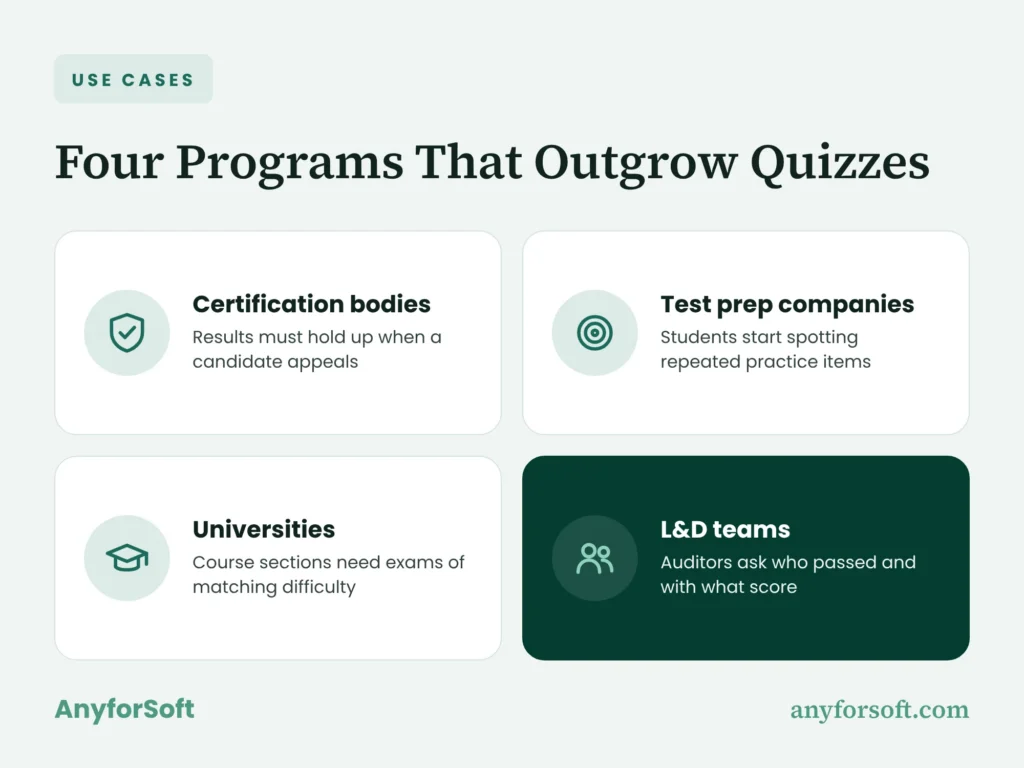
A bank pays off once questions are reused across more than one exam. Each kind of program reaches that point for its own reason:
- certification bodies and professional associations, whose exams have to hold up when a candidate or an accreditor challenges a result, and whose records must show exactly what that candidate saw
- test prep companies, whose students start recognizing repeated items after a dozen SAT or NCLEX practice tests, so drills and mock exams on a custom test prep LMS need one large library to draw from
- universities that split a large course into sections, where a shared library lets all of them take exams of matching difficulty
- L&D teams running compliance training, where auditors ask who passed which test and with what score
What they’ve got in common is reuse at scale. An instructor who gives one quiz per term in a single course can wait, since the quiz tool built into the LMS keeps a small library of its own.
What Should You Define Before Writing a Single Item?
Before you build a question bank, three decisions need settling:
- what the exam covers
- what an acceptable item looks like
- how many items the library has to hold
Without these decisions, reviewers lack a shared standard, and there’s no basis for judging when the library is large enough.
Build the Exam Blueprint
The planning table behind every exam sets each content area’s share and the level of thinking it calls for. Some programs call it the test specifications.
The Standards for Educational and Psychological Testing (AERA, APA and NCME) call for evidence that a test’s questions match the field it covers, evidence based on test content that many practitioners still call content validity.
Here’s a simple version for a 60-item food safety exam:
| Domain | Weight | Items per form | Cognitive level |
| Cooking temperatures | 15% | 9 | Recall and application |
| Storage and holding | 20% | 12 | Application |
| Cross-contamination | 25% | 15 | Application |
| Cleaning and sanitizing | 25% | 15 | Recall and application |
| Personal hygiene | 15% | 9 | Recall |
Each row becomes a rule for assembly: nine cooking-temperature items in every form.
If the library can’t supply them, the exam comes out lopsided, and its score no longer means what the blueprint promises.
Set Item Specifications and Style Rules
Writers working from one blueprint still turn out different items until someone writes down what an acceptable one looks like. A one-page spec usually covers:
- allowed item types, such as single-answer questions or short scenarios
- the number of answer choices
- the reading level, so a food safety exam doesn’t become a reading test
- the documents that count as the authority for the key, such as the FDA Food Code
- house style for units, abbreviations and negatives
With these choices written down, a reviewer can cite the rule an item breaks. The chicken item’s spec entry would require the key to cite the Food Code section that sets 165°F. One person, typically the assessment lead, owns the spec and approves every change to it.
Without a written spec, reading level and the number of choices drift from writer to writer, and forms built from one blueprint stop matching each other.
Estimate How Many Items You Need
No single number fits. A program running fixed forms, one exam shared by every candidate, keeps spare items to swap in once too many people have seen an item. Randomized forms give every test taker a fresh draw.
With linear-on-the-fly testing (LOFT), each test is assembled on the day from blueprint rules, and in computerized adaptive testing (CAT), each next question depends on the previous answers. In every mode, the pool has to be several times larger than a single exam’s worth of items.
A 2026 study by Jarrah and Itani puts numbers on how pool size affects repeat exposure. In their setup, each practice quiz drew 5 questions from the exam’s own library. After three quizzes, a given exam item was still new to a student with about 73% probability when the library held 50 questions, and about 42% when it held 20.
For fixed forms, the arithmetic is simple.
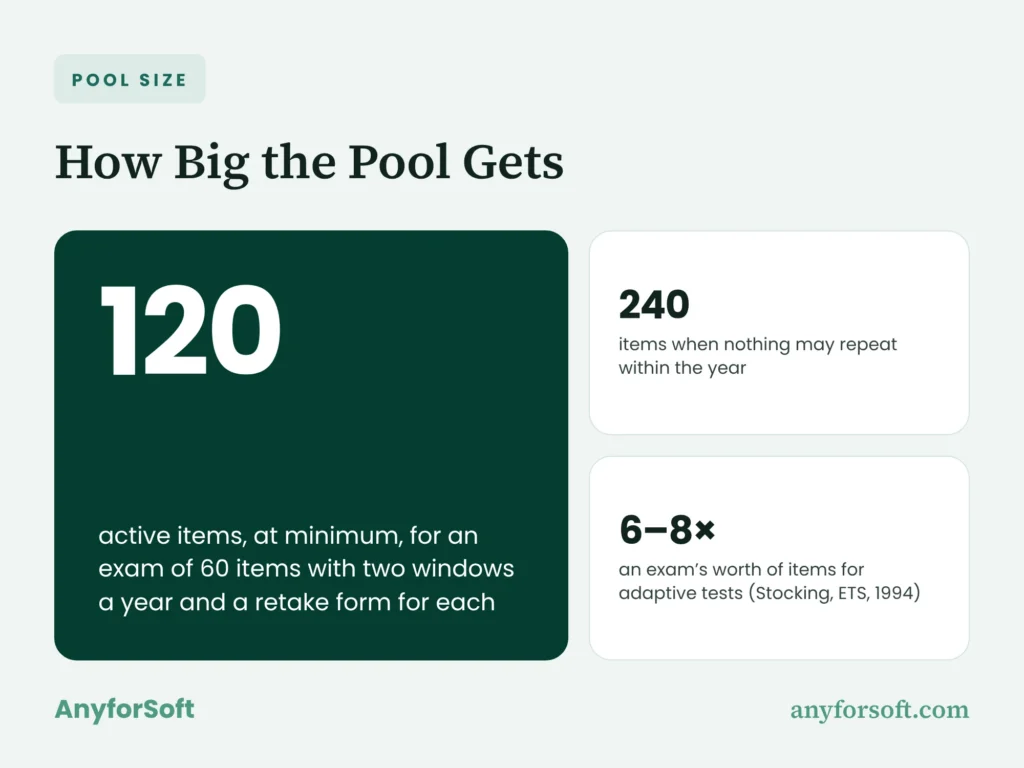
Take a 60-item exam with two testing windows a year and a separate retake form for each window: that’s four forms a year.
If no item may appear on both a form and its retake, the pool needs at least 120 active items, and if nothing repeats within the year, it needs 240.
Adaptive testing asks for far more.
An ETS analysis by Martha Stocking found that a pool holding as many good items as six to eight fixed exams was enough to run adaptive tests about half their length. Pilot items come on top of all these counts, since they don’t score yet.
High-stakes programs need the largest pools, since item security depends on how often any one entry is seen.
How Should You Tag Items? A Metadata Schema That Scales
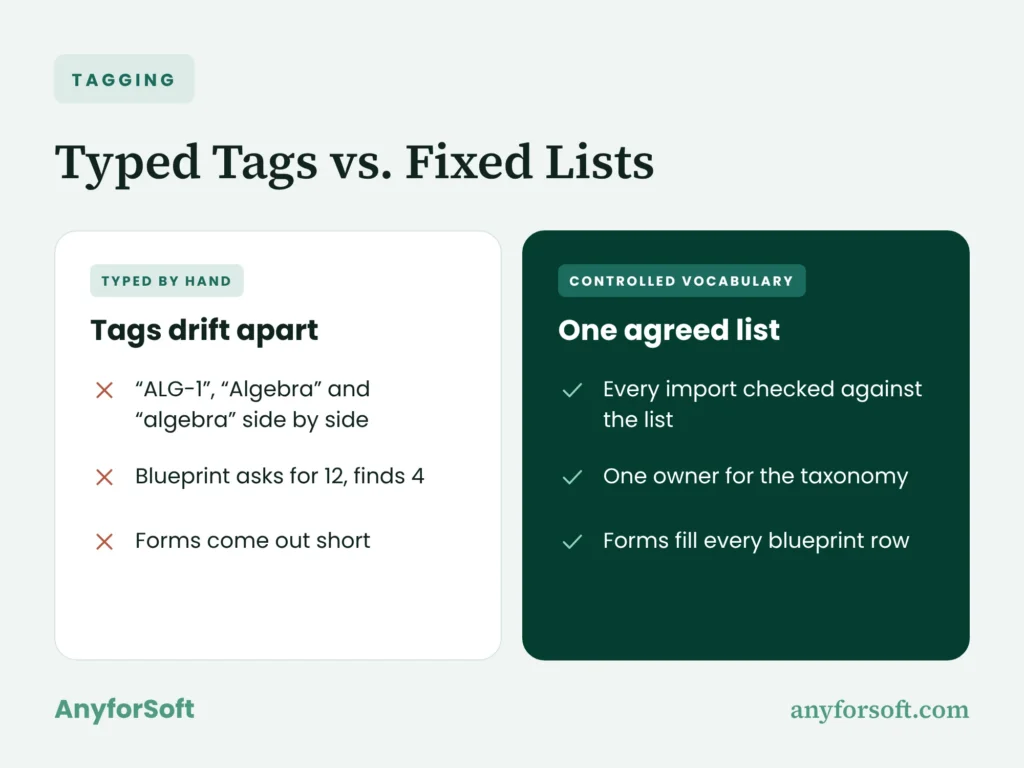
Tags are what let the library answer a search, filter a pool and assemble a form straight from the exam blueprint. They work only when each one draws from a fixed list of values, a controlled vocabulary agreed before the first import.
Content Tags: Domain, Topic, Learning Objective
Every item carries three labels that place it in the subject, from the broadest area down to the skill it tests, usually arranged as a topic hierarchy such as:
Food safety > Cooking temperatures > Poultry.
Many programs map their learning objectives to a competency framework, the skills list a licensing body or employer publishes.
Tags typed by hand drift apart. One writer saves “Algebra”, another “algebra”, and an old import says “ALG-1”. A blueprint rule asking for 12 algebra items then finds 4 and quietly builds a short form.
The fix is to check every import against the agreed lists and give one person ownership of the taxonomy, the full set of tag lists. A library that already lives in spreadsheets meets these lists for the first time when it moves to new software.
Cognitive Level and Difficulty
Naming the highest safe fridge temperature and deciding what to do with a warm milk delivery belong to one topic, yet they call for different kinds of thinking.
Programs record the kind of thinking with a level from Bloom’s taxonomy, a ladder of thinking skills, usually grouped into bands such as recall and application.
The first task is recall. The second is application, because the candidate has to use the rule.
Difficulty is a separate tag: writers set a target difficulty level when they draft, and the actual share of correct answers replaces it once enough candidates have answered.
A recall item can turn out hard and an application item easy, so the two labels stay apart.
Operational Tags: Status, Author, Source, Exposure, Enemy Items
Housekeeping tags track each question’s life in the library. Each entry gets an item ID that stays fixed through minor edits, and its item status runs from draft to retired. Two fields, author and reviewer, record who wrote it and who signed it off.
Each entry’s source reference points to the passage that backs the key, and an exposure count tracks how many people have seen the question.
Two items are enemy items when one gives away the other’s answer or both test one fact, and form assembly keeps them apart.
A second question whose stem says poultry is safe at 165°F would be an enemy of the chicken question.
| Field | Allowed values | Example (chicken temperature) |
| Item ID | System-generated, never reused | FS-0417 |
| Domain > topic > subtopic | Fixed hierarchy | Food safety > Cooking temperatures > Poultry |
| Learning objective | Code from the objective list | FS-CT-02: state minimum cooking temperatures |
| Cognitive level | Recall / Application / Analysis | Recall |
| Target difficulty | Easy / Medium / Hard | Easy |
| Status | Draft / Review / Pilot / Active / Retired | Active |
| Source reference | Approved document and section | FDA Food Code, cooking temperatures |
| Enemy items | IDs | FS-0452 |
| Exposure count | Updated after each testing window | 1,240 |
| Version | Major.minor | 2.0 |
With these values filled in, the form builder can find the chicken item and place it in the right blueprint row.
How to Write Multiple Choice Questions That Measure Real Understanding
Once the blueprint and tags tell writers what to produce, most of what they write is multiple choice questions. They’re quick to score and easy to analyze, but only when each one is written well, and published item-writing guides largely agree on what that takes.
Write a Focused Stem
A quick test shows whether the question part of an item works: cover the answer choices and read it alone. Someone who knows the subject should be able to answer right away. If they need the choices to work out what’s being asked, the stem is incomplete, so the fix is to move the main idea into the stem. Covered this way, the chicken stem still asks a complete question about a minimum internal temperature.
Guides such as the NBME Item-Writing Guide, written for U.S. medical licensing exams, favor the single best answer format, where one choice is clearly best and each of the others is wrong for a reason an expert could explain.
Stems built on negative phrasing, such as “Which of these is NOT…”, trip up candidates who read past the NOT, so an unavoidable negative goes in bold capitals.
Build Plausible Distractors
A wrong answer earns its place when someone who half-knows the material would pick it. Good ones come from real mistakes, such as errors on earlier exams or a rule that’s close to the right one. All the distractors should match the key in length and grammar, so none stands out for its form.
How many choices each question needs is an old debate. A meta-analysis by Michael Rodriguez, which pooled earlier studies, found that three options (one key, two wrong answers) work best for most items. Candidates then answer more questions in a fixed testing time, so coverage widens and score quality holds up. Many certification programs keep four choices, which works if some candidates pick each wrong answer.
Avoid the Most Common Item-Writing Flaws
Some mistakes let candidates find the key without knowing the subject, a problem known as cueing. Five turn up again and again:
- answers like “all of the above” and “none of the above”, which reward partial knowledge
- choices where the key is longer or more detailed than the rest
- absolute words such as “always” and “never”, which test-wise candidates rule out
- grammar clues, where only one choice fits the wording of the question
- overlapping choices, such as “above 150°F” and “above 160°F”
With any of these flaws, a careful reader can reach the key by elimination alone. All five appear among the 31 rules in a review by Haladyna, Downing and Rodriguez, drawn from testing textbooks and research. The first draft of the chicken item stacks several of them in four lines.
Before: Chicken should always be cooked to: A. 145°F B. 155°F C. 165°F, the minimum safe temperature for all poultry according to USDA D. All of the above
After: What minimum internal temperature must a cooked chicken breast reach before it’s safe to serve? A. 145°F B. 155°F C. 165°F D. 175°F
The draft’s question is an unfinished sentence with an absolute word in it, and its key is the only long choice. “All of the above” is also impossible, since each choice names a different minimum temperature.
Run a Two-Step Review: Content Accuracy and Fairness
Two separate checks, by different people, come before an item goes live, because accuracy and fairness need different eyes. In the subject matter expert (SME) review, a practitioner confirms the key, checks that each wrong choice is wrong for a real reason, and compares stated facts with the source reference, since official guidance can change.
For the chicken item, that means checking 165°F against the current FDA Food Code.
Next comes the bias and sensitivity review, which asks whether anything besides the subject could make an item harder for some candidates. Test takers trained in Celsius might lose time converting °F, for example, and printing both scales, as in 165°F (74°C), usually solves the problem.
Regional slang and idioms are flagged too, since they’re harder for candidates taking the exam in a second language.
How Do You Version Exam Items Without Breaking Live Tests?
Each change to an item is saved as a new version, and every form keeps pointing to the exact one it was built with. Without that record, one entry’s statistics mix answers to different wordings, and the program can’t explain a past score.
The record matters most for the cut score, the exam’s pass mark.
An expert panel sets it in a standard setting study, partly from candidate results on each question. If a question is edited without a new version, the pass mark rests on results for wording that no longer exists.
Define the Item Lifecycle: Draft, Review, Pilot, Active, Retired
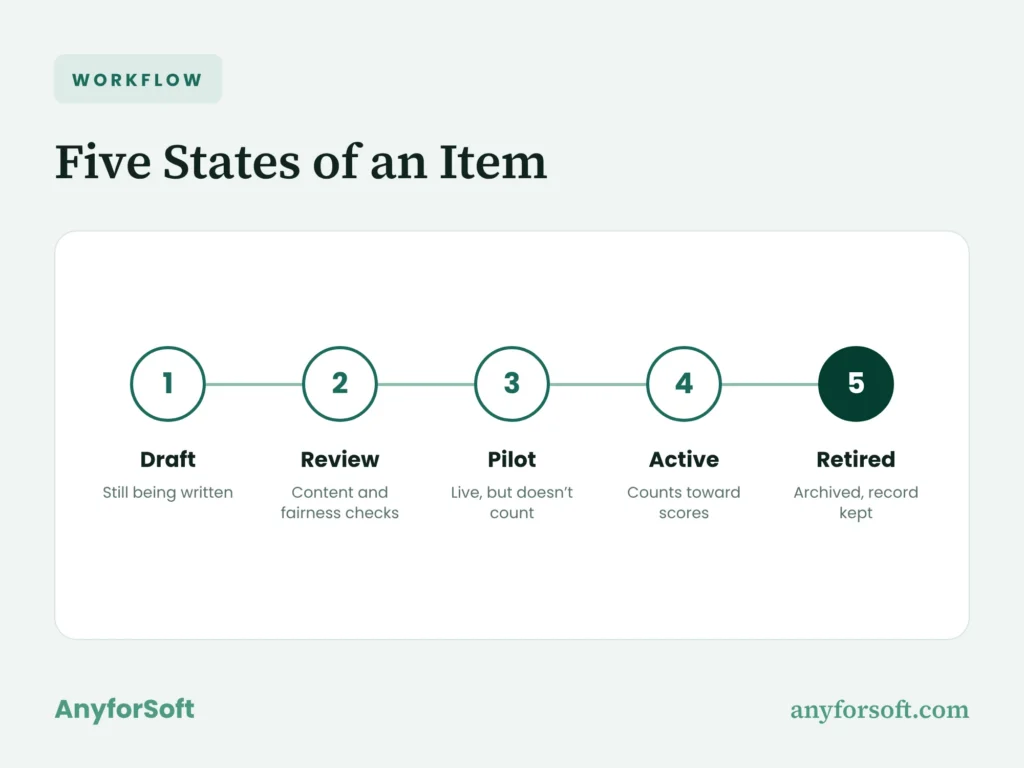
Items move forward through five states. A draft is still being written. In review, the content and fairness checks run, and the item can go back to the writer. A pilot question appears on live forms without counting toward anyone’s score, so its statistics build up safely. Active items count toward scores. When a question is outdated or no longer needed, programs retire and archive it and keep the record, because old scores were calculated with it.
An active item whose statistics show a problem drops back to review and, after a fix, starts again from pilot.
Minor Edit or New Item? Set Clear Version Rules
The dividing line is whether a change could alter how candidates answer. Fixing “chiken” to “chicken” in the stem creates a minor version: the item still measures the same thing, so its statistics carry over.
Dropping the 175°F choice once statistics show almost nobody picks it is different. Candidates now face a new set of choices, so the change creates a major version (a new ID in some systems), and item analysis starts over.
Neither edit is made on a form that’s in use. The new version goes live with the next testing window.
Keep an Audit Trail and Control Exposure
On the engineering side, each version is a record that can’t be edited after release, and each response is stored with the exact item version the candidate saw. Edits land in a change log that records who changed what and why, and permissions follow role-based access.
These records are what answer an appeal. The program can pull the form the candidate sat, the version of every item on it, their responses, and each item’s sign-offs and statistics at the time.
Who may edit or approve a question is a matter of LMS security as much as of exam policy, since one shared admin login erases the record of who did what. Programs also use exposure control: once an item’s exposure count passes a set limit, the item is taken out of rotation for a while or retired.
What Is Item Analysis, and How Do You Use It to Fix Weak Items?
Item analysis is a statistical review of how each question performed on a real test. It flags items that are too easy, too hard or confusing, along with any that don’t separate strong candidates from weak ones.
Most programs run test item analysis with classical test theory (CTT), which works from simple counts of who chose what. For a library with a few hundred candidates per form, those counts are enough. Large and adaptive programs add item response theory (IRT), which models how each question behaves across ability levels and needs far more responses.
Difficulty Index (p-value)
The simplest number is the share of candidates who chose the key. If 720 of the 1,000 candidates who answered a question got it right, the share is 0.72. This share is the item difficulty index, written as p. Its name misleads: a higher value means an easier item.
Values near 1.0 can’t tell candidates apart, because almost everyone answers correctly. What counts as good depends on the test’s purpose. A mastery check on basic safety rules can live with high values, while an exam that ranks people needs most items in the middle range.
Discrimination Index and Point-Biserial Correlation
Comparing strong and weak test takers on one item is the next check. One common version ranks everyone by total score, then takes the share of the top 27% who answered the item correctly and subtracts the share of the bottom 27% who did. Using every response instead, the point-biserial correlation shows how closely a right answer on this item goes with a high total score.
Both values run from −1 to +1, and a positive value means stronger test takers got the item right more often. A negative value means the item works against the test: stronger candidates lose marks on it more often than weaker ones. Many programs send any item below 0.20 for review. An illustrative point-biserial of 0.38 on the chicken item would mean candidates who know the material reliably get it right.
Distractor Analysis
This check looks at the wrong answers. It counts how many candidates picked each choice, ideally split into stronger and weaker scorers. Working distractors draw some people, mostly from the weaker group, while a choice almost nobody picks only adds reading time.
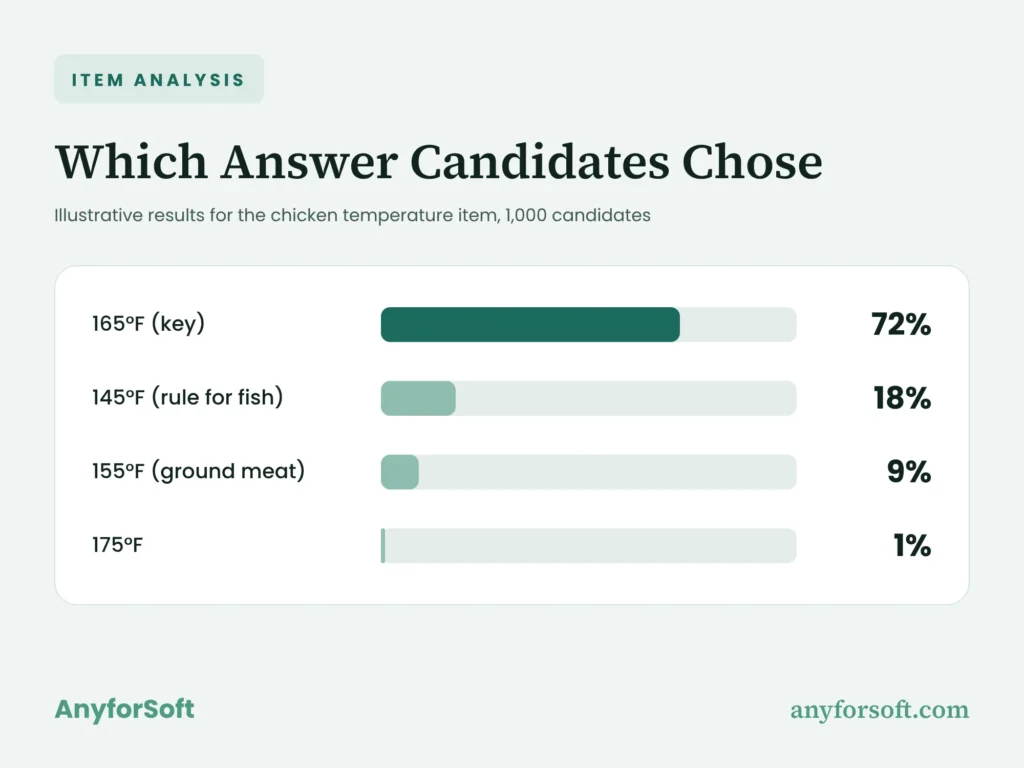
Here are illustrative numbers for the chicken-temperature item, answered by 1,000 candidates: 720 chose 165°F, 180 chose 145°F, 90 chose 155°F, and only 10 picked 175°F. The 145°F answer is the rule for fish and 155°F is the Food Code’s figure for ground meat, so both catch candidates who mix up nearby rules.
At 1%, 175°F falls below the common 5% line for a working distractor.
It makes 175°F the one choice worth replacing or dropping, and under the version rules, dropping it creates a major version.
Revise, Retire, or Keep: A Simple Decision Rule
Most programs read the three checks against flag values like these:
| Metric | What it shows | Common review flag |
| Difficulty index (p) | Share of correct answers | Above 0.90: very easy. Below 0.30: very hard |
| Discrimination (index or point-biserial) | Whether stronger candidates do better on the item | Below 0.20: review. Negative: check the key first |
| Distractor choice rate | How often each wrong answer is picked | Under about 5%: the distractor isn’t working |
Cut-offs vary between guides. The difficulty and discrimination flags follow the University of Twente, and UT Austin Testing Services also advises removing items that discriminate near or below zero.
The 5% line comes from a study by Ali and Ruit, and the University of Washington uses its own bands, calling a question easy from 85% correct.
Difficulty and discrimination together point to one of three actions:
- keep an item with a middle-range p-value and positive discrimination, or a very easy or very hard one that stronger candidates still answer better, as long as the blueprint needs that level
- revise an item whose discrimination sits near zero or below: it goes back to review and, after a fix, restarts from pilot, as the item lifecycle requires
- retire an item when the rewrite doesn’t help
Take an item with p = 0.35 and a discrimination of −0.15: only about a third of candidates got it right, and the stronger ones did worse than the weaker ones. That pattern usually means a wrong key or two answers that can both be defended.
These numbers can be trusted only once a few hundred candidates have answered the item, since a few lucky guesses can flip a result in a small group. Removing weak questions also tends to raise the test’s reliability, how consistently it ranks test takers. Programs measure it with KR-20 or Cronbach’s alpha.
Item statistics get used most when they appear in the LMS analytics dashboards where course teams already read completion and scores.
Can AI Help You Build a Question Bank Faster in 2026?
Yes for drafting and organizing items, and no for approving them. Whether a question goes live is still a call for a subject expert, and recent research on AI-assisted writing shows why.
AI Drafts, Experts Approve
Drafting with large language models (LLMs) works best from approved material. In retrieval-augmented generation (RAG), the system pulls the relevant passages, such as the Food Code’s cooking temperatures, and the model drafts only from them. Asked for more items like the chicken one, it can write turkey and ground beef versions, each linked to its source line.
Because each draft carries its source line, a reviewer checks it against that passage instead of hunting for the rule, and AI solutions for education built on retrieval keep the source line attached to every item they draft.
Each AI draft also enters the lifecycle as a draft, so it goes through review and pilot like any other item. Every item from AI item generation also carries a provenance tag: the model, the source passage and the reviewer who signed it off.
Auto-Tagging, Duplicate Detection, and Enemy Items
AI can suggest each new item’s topic, objective and likely level of thinking. A reviewer confirms or corrects every suggestion, so the fixed lists stay clean. A check based on semantic similarity compares each draft with the whole library by meaning, so a reworded copy still gets caught.
The turkey draft is a good test. Its wording shares little with the chicken item, but it tests that 165°F rule too, and a meaning-based check catches that where a word match wouldn’t. Once caught, the turkey draft gets the chicken item’s ID (FS-0417) in its enemy-items field, so form assembly never puts the two on one form. Until a reviewer confirms them, the suggested tags stay out of the controlled lists.
Where Human Review Is Non-Negotiable
The risks of unreviewed drafts are specific:
- factual errors stated with full confidence
- weak distractors that nobody would choose
- bias, or examples that only make sense in one culture
- text copied word for word from the source
- secure items leaking when staff paste them into public AI tools
None of these risks shows up on a quick read. The risk of leaks is also why the drafting tool and the library belong in a private deployment, out of reach of public AI tools.
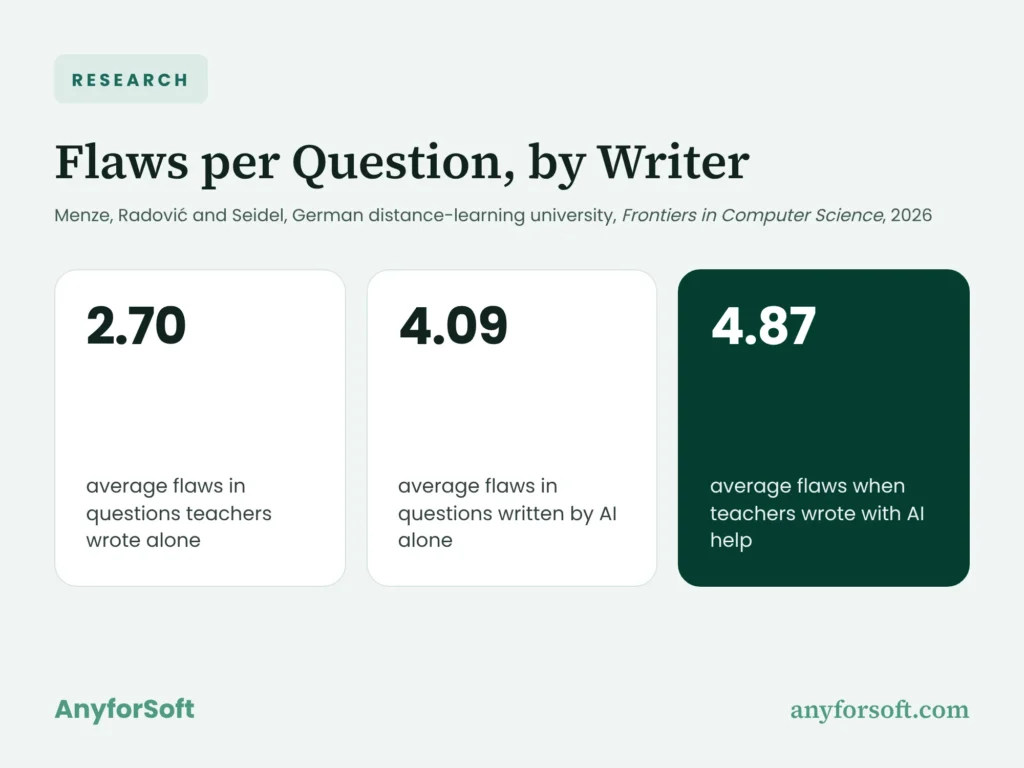
A 2026 experiment by Menze, Radović and Seidel found a risk in the reviewers themselves. Teachers at a German distance-learning university wrote test questions alone, with AI help, or left the writing to AI. Teacher-only drafts averaged 2.70 flaws each, AI-only ones 4.09 and joint ones 4.87, which the authors put down to automation bias: people trusted the AI’s output. The model was an older one, but the lesson about reviewers holds.
Human-in-the-loop review works only when each draft is checked against the full item-writing rules, with a checklist.
Question Bank Software: LMS, Off-the-Shelf, or Custom Build?
Three routes cover most programs: the quiz bank inside the LMS, an off-the-shelf assessment tool, or a custom build. Each handles the core features differently, and the right one depends on how many exams, candidates and products the library has to serve.
Must-Have Features Checklist
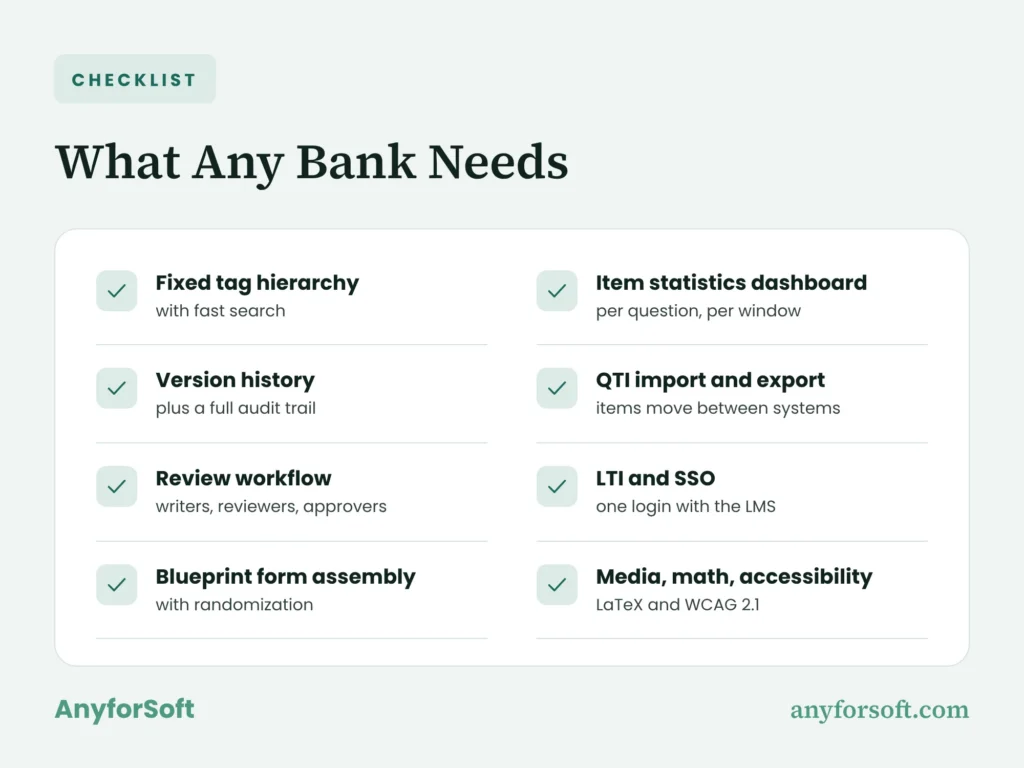
Whatever the route, a library that’s expected to grow needs:
- a tag hierarchy with fixed values and fast search
- records of every change, with a version history and an audit trail
- roles and a review workflow for writers, reviewers and approvers
- form assembly from the exam blueprint, with randomization
- an item statistics dashboard
- import and export in Question & Test Interoperability (QTI) format, the 1EdTech standard now at version 3.0
- connections to the LMS through LTI (launching outside tools inside it) and SSO (one login for both), usually set up by LMS integration services
- media and math support, including LaTeX
- accessibility to WCAG 2.1
LMS quiz banks usually handle tags, media and accessibility, and fall short on blueprint assembly across forms and on item statistics. QTI moves the items themselves between systems. The SCORM vs xAPI vs LTI choice is a separate one: it decides how courses launch inside the LMS and report results.
When Your LMS Quiz Bank Is Enough
For course-level quizzes, the LMS is often enough. A university instructor running a weekly check for a single class, or an L&D team with a short compliance check, doesn’t need more.
Moodle’s built-in option, the Moodle question bank, sorts questions into categories and can draw random ones for each attempt, while Canvas item banks in New Quizzes can be shared across courses. Which bank a program ends up with usually follows from the Moodle vs Canvas decision the institution made for its teaching as a whole.
The built-in bank starts to fall short once a program needs blueprint rules across forms, strict version control or statistics beyond a basic report. Staff then keep blueprint counts and item statistics in spreadsheets next to the LMS, and finding the right question gets slow again.
When Off-the-Shelf Assessment Tools Fit
Dedicated assessment tools add a full item library and blueprint-based forms, with psychometric reports on top. They’re fast to start. Most test bank software is priced per candidate or per seat, which suits steady volumes but costs more as the number of candidates grows.
The trade-off is a fixed data model: custom fields, unusual scoring rules or links to a membership system have to fit what the vendor supports.
For a mid-sized program with standard needs, a fixed data model is a fair price. Export is the other thing to check: a tool without full QTI support can keep the items, tags and history behind when the program leaves.
When a Custom Platform Pays Off
A custom build fits when the exam has rules no ready-made tool supports, such as certification scoring of its own or one rule set across several exam brands. It also suits programs that want to own every item and response outright. Most custom builds connect to a CRM or membership system through an API, the interface two systems use to swap data, for example to renew a membership once a member passes. Integrations like this usually belong to custom LMS development, where assessment logic is designed with the rest of the learning product. A dedicated question bank platform costs more up front and takes months to build, so it pays off for programs that expect years of growth.
Which Route Fits Your Program?
Three tests settle most cases:
- the LMS bank, for a program that needs no blueprint-based forms, no version records that hold up in an appeal and no item statistics beyond a basic report
- an off-the-shelf tool, which typically costs less than a build when those needs exist but the scoring, retake and blueprint rules fit a standard model and candidate numbers stay steady
- a custom platform, when at least one of these holds: the exam has its own scoring logic, several exam brands share one rule set, or the bank has to exchange data with a membership system or CRM
Per-candidate pricing tips the decision too. Once yearly fees approach what a build and its support would cost spread over three to five years, owning the platform becomes the cheaper route.
A certification body with a few hundred items, two windows a year and a growing candidate base often falls between the second and third routes, and the deciding factor is how far its rules differ from what ready-made tools support.
Side by side, the three routes compare like this:
| LMS built-in bank | Off-the-shelf tool | Custom build | |
| Setup time | Days; it’s already installed | Weeks | Months |
| Cost model | Included in the LMS license | Per candidate or per seat | Build cost, then hosting and support |
| Data ownership | Inside the LMS | In the vendor’s system; export depends on QTI support | Fully owned |
| Item analytics | Basic reports | Standard psychometric reports | Whatever the program needs |
| Integrations | The LMS itself | The vendor’s connectors | Any system with an API |
Which column fits depends less on today’s feature list than on how many exams, candidates and connected systems the library will serve in three years.
From Spreadsheets to a Bank: The Migration Steps
Whichever route a program picks, its questions won’t all start in one place. Most libraries arrive as spreadsheets, Word files and an LMS export, each with its own columns and naming habits. The move goes faster in a fixed order:
- an inventory of every source, with an item count and the columns each file uses
- a duplicate pass, where near-identical items are merged and one is kept as the master
- tag lists and fields signed off before any data moves
- a column map from each old file to the new fields, tested on a sample of about 50 items
- tags for untagged items, split among writers by domain and checked by a reviewer
- the import, where an item enters as active only if its statistics can be traced to its current wording, and as pilot otherwise
Tagging is the slowest of these steps, because a writer has to read every untagged item and choose its objective and level. The assessment lead who owns the taxonomy owns the migration as well, while a developer builds the column map and the import scripts. The inventory doesn’t cost anything and pays off at once: counting items by domain against the exam blueprint shows where the library is thin before any software is chosen.
Assessment Platforms in Practice: AnyforSoft Case Studies
Two AnyforSoft projects show parts of this work in live programs, though neither was a pure question bank build. The SAT platform covers form delivery and adaptive scoring, and the High Pass tools cover item-level reporting.
Digital Testing Platform for a U.S. Tutoring Company
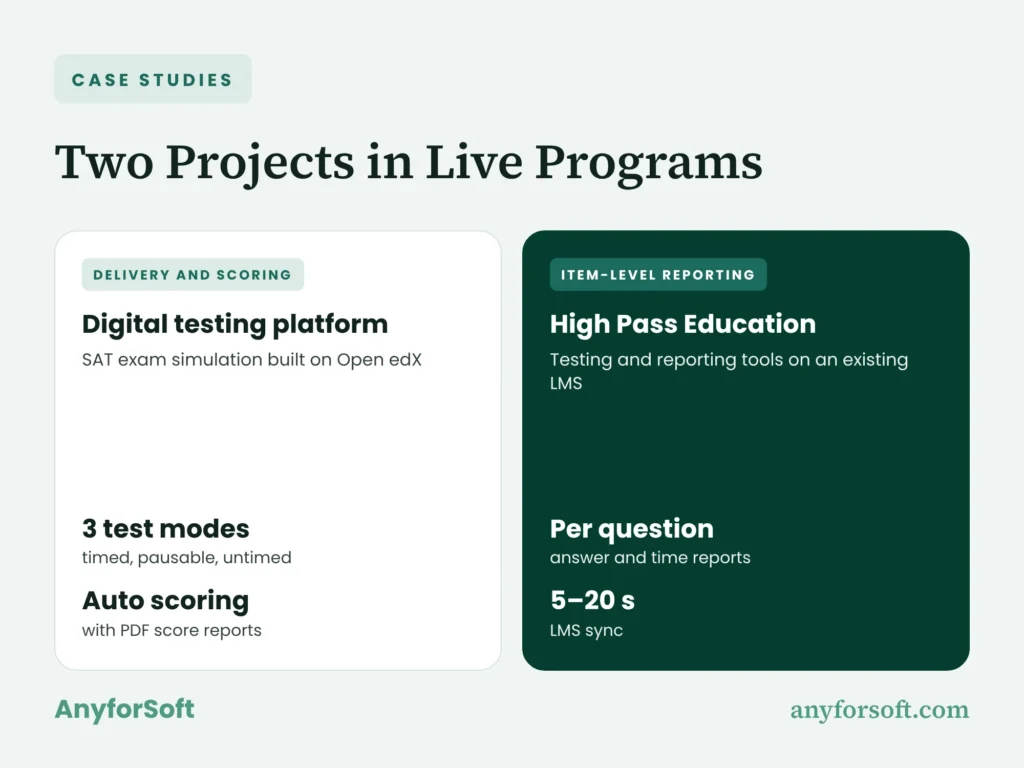
The client prepares U.S. students for the SAT. It wanted a digital simulation of the exam in place of printed practice tests, hand grading and hand-written reports. We kept Open edX as the core and built a Python and React layer on top of it:
- three test modes: timed test conditions, timed practice that can be paused, and untimed practice
- Bluebook-style tools, including a calculator, a reference sheet, notes and answer cross-out
- adaptive modules that serve simpler or harder questions depending on the previous module
- automatic scoring, PDF score reports and a Salesforce connection
Grading and report writing no longer take staff time, along with most other manual steps.
For a test prep team, the digital testing platform shows the delivery and scoring layer an exam-style question set needs once it moves off paper.
High Pass Education
High Pass Education prepares candidates for mental-health licensure exams. We built testing and reporting tools that extend the LMS it already used.
These tools added:
- individual test rules for each learner, from time limits and retakes to pass marks
- speedrun tests that train accuracy under time pressure
- reports that show learners whether a weak result comes from gaps in knowledge or from time management
- admin reports showing which answer each question draws most often and how long learners spend on it
With the admin reports, instructors see how each question performs and use those numbers to improve both tests and course materials.
Routine questions now take fewer one-to-one sessions, and, by the client’s account, the High Pass Education program can take on more learners without hiring more instructors. The admin reports also show which wrong answer each question draws most often, which is distractor analysis on real tests.
Licensure and certification programs need this question-by-question evidence to find and fix weak items.
Why Assessment Teams Choose AnyforSoft
AnyforSoft is an EdTech partner that builds learning and assessment software for certification bodies, test prep companies, universities and corporate training teams. On assessment projects, the team works on both sides of the job: the exam logic that assessment leads care about, and the data, integrations and access rules that keep an item library defensible as it grows.
15+ Years Building Education Software
AnyforSoft has worked in EdTech for more than 15 years. Its team of 80+ engineers works on a portfolio of 150+ education-focused projects, from course portals and learning apps to exam software development for test prep and licensure. Clients rate AnyforSoft 4.9 out of 5 on Clutch, across 88 reviews.
Assessment Logic Built Around Your Exam Rules
Scoring, timing and attempt rules follow the client’s own exam. For the SAT tutoring project, results come out as a band of likely scores, the way the real exam reports them. For a certification exam platform, the pass marks and retake rules come from the credentialing body.
Your Code, Your Item Data, No Per-Seat Fees
Clients own the code we write and every item, response and statistic stored in the system. Pricing covers the build and support, not the number of candidates who take the exam. If the program ever moves to another system, its item data goes with it.
Works with Moodle, Canvas, Open edX, or From Scratch
Some programs need a testing layer added to the LMS they already run, and others need a platform built from the ground up. A dedicated development team handles either path. For High Pass Education, user updates sync between the LMS and the LTI tools within 5 to 20 seconds, and the interface follows WCAG 2.1.
FAQ
What is a question bank, and how is it different from a test bank?
Both terms name a stored set of test content, but they’re used differently. In the testing industry, a managed library with tags, versions and statistics is usually called an item bank. “Test bank” more often means the set of questions a publisher supplies with a textbook.
How many questions should a question bank have?
The library has to be much larger than what any one exam or practice set draws from it. How much larger depends on the stakes, how often candidates retake, and whether each person gets a different set of items. For a 60-item exam with two windows a year and a retake form for each, that means at least 120 active items, while adaptive tests need pools the size of six to eight full exams.
What metadata should every exam question have?
At a minimum, every item needs:
- a permanent ID and a current status
- domain, topic and objective tags
- the item’s cognitive level and target difficulty
- author, reviewer and source reference
- version number, exposure count and any items it must never share a form with
More fields can wait until the program actually needs them.
What makes a good multiple choice question?
Good multiple choice questions put one clear problem in the stem, have a single defensible answer, and offer distractors drawn from real mistakes. They also avoid clues that point to the key, such as a long key or “all of the above”.
What is a good difficulty index and discrimination index?
One common set of cut-offs, used by the University of Twente, treats a p-value between about 0.30 and 0.90 as workable and a discrimination index above 0.20 as healthy. A mastery test can accept easier items than an exam that ranks candidates. Whichever cut-offs a program picks, it applies them the same way in every testing window.
Can you build a question bank in Moodle or Canvas?
Yes, and for course-level quizzes it’s the quickest route. Both systems already include a built-in bank. Programs running certification exams move to a dedicated tool or a custom platform once they need forms assembled from a blueprint and full version records.
What is QTI, and why does it matter when you move questions between systems?
It’s 1EdTech’s standard for packaging items, tests and their metadata so that different systems can read them. Without it, moving a library to new software often means re-entering every question by hand or losing their tags and history on the way.
How much does custom question bank software cost?
Scope, integrations, user roles and the exam’s own scoring and blueprint rules drive the price, just as they drive custom LMS development cost. A discovery phase turns them into an estimate for a specific program.
Can AI write exam questions that are accurate and fair?
Drafts, yes; final versions, not without a person. A model working from approved source material can produce accurate first drafts, but only a subject expert can confirm the key, and only a fairness reviewer can spot wording that puts some candidates at a disadvantage.
How can AI auto-tag questions and find duplicate or enemy items?
A model reads each new item and proposes its topic, objective and thinking level, and a reviewer accepts or corrects each label. For duplicates, the system compares meaning. A reworded copy of an existing item, or a pair that tests one fact, gets flagged before both land on one form.