



Corporate L&D, Associations and CE
Strategy & Discovery
Innovative education platforms
Build & Launch
Online training solutions
Grow & Support
Creative content & apps
Platform & Technology Expertise

Custom LMS Software Development Company

Off-the-shelf platforms impose feature limits and per-user pricing your team constantly works around. We build learning solutions from scratch, shaped around your content, workflows, and existing tools.

Scope my LMS
Partners, not just projects

Behind each logo is a long-standing relationship, built on trust as much as delivery.

What people say about us

Reviewed on Clutch
stars 4.9/5 rating
Ron Huber
Company logo
Internet & Technology
US flag USA

I was pleasantly surprised by the quality of their developers, yet what I found the most impressive was their project management. AnyforSoft team took time to learn our expectations and technical needs. They’re a perfect size, big enough to provide quality resources, yet small enough for management to jump in when needed.

Ron Huber

When a Custom LMS Makes Sense

Choosing between custom LMS vs an off-the-shelf one comes down to one question: how much of your budget and team time goes toward working around what software can’t do.

Full Control Over Features

Off-the-shelf tools ship with fixed feature sets — what’s on the roadmap is what you get. A purpose-built learning tool is built to your specification. Course structures, workflows, reporting views, and learner interactions reflect how your organization runs training.

No Per-User Licence Fees

SaaS software pricing ties your costs to headcount. It makes scaling expensive before it becomes valuable. A solution you own carries no per-seat fees. Growth in your learner base doesn’t trigger a pricing conversation with a vendor.

Seamless System Integration

Off-the-shelf software supports the integrations their vendor prioritized. A tailored application connects to the HR, CRM, or content tools your team uses today. Data flows in the direction your workflows require.

Branded Learning Experience

SaaS applications allow logo placement and color changes within their interface constraints. A tailor-made app gives your L&D team full control over the learner interface, so the tool reflects your brand rather than your vendor’s product design.

Is a custom LMS right for you?

A custom LMS is the right call when…An existing platform may be enough when…
Your learning model doesn’t fit standard course structuresStandard courses, quizzes, and certificates cover your needs, and platform-based LMS development can deliver them
Per-seat licensing grows faster than your training budgetLearner numbers are stable and licensing costs are predictable
The LMS is part of your product: you sell training or run an EdTech platformThe LMS is an internal tool that supports training
You need deep two-way integrations with HR, CRM, or proprietary systemsThe vendor’s standard connectors cover your integrations
You need full control over data residency and complianceVendor certifications meet your compliance requirements
You can invest 3+ months before launchYou need to launch within weeks

Custom LMS vs Off-the-Shelf LMS

Weighing custom LMS software development against a SaaS or open-source platform comes down to control as you grow.
With custom learning management system development, you decide the architecture, the feature roadmap, and what growth costs.

Custom LMSOff-the-shelf SaaS LMSOpen-source LMS, customized
Upfront investment$25,000–$300,000 buildLow: setup and onboardingAbout $5,000 to $50,000+ customization
Cost as learners growNo per-seat feesRises with every new useNo per-seat fees
Ongoing costsHosting, maintenance, supportSubscription plus add-onsHosting, maintenance, plugin updates
Feature roadmapYou decideVendor decidesYou decide, within the platform’s architecture
Code and IP ownershipYoursVendor’sOpen-source core plus your custom code
IntegrationsBuilt around your HR, CRM, and content toolsLimited to the vendor’s connectorsPlugins plus custom APIs and LT
Branding and UXFully yoursLogo and colors within vendor limitsCustom themes within platform UX patterns
Upgrade riskFollows your release planVendor pushes changes on its scheduleCore upgrades can break custom plugins
Time to launch3–14 monthsDays to weeksWeeks to 6 months
Best fitUnique learning models, LMS as a product, complex complianceStandard training and a fast startControl on a budget, academic setups

If an open-source or existing platform already covers most of your needs, our LMS development services build on it.

Custom LMS Development Services

LMS Consulting

Organizations planning a new learning environment often know what isn’t working before they know what to build. A structured requirements audit maps the gaps in your current training infrastructure and produces a development scope your team can act on, through our LMS consulting.

LMS Development from Scratch

When your training requirements don’t fit a product built for the average organization, adapting to its constraints costs more over time than building to spec. With custom LMS development, your content structure and user roles shape the learning environment from the first line of code.

LMS Platform Customization

When the platform you run today still handles enrollment and course delivery, extending it usually costs less than a rebuild. Our LMS development services add the missing layers, like custom reporting or assessment logic, on top of it.

LMS Integration

When completion records and enrollment triggers don’t move automatically between your learning software and your HR tools, your team handles the transfer manually. We build connections between your training environment and the tools your organization runs on, including Salesforce, so learner data moves without manual intervention.

LMS Migration

Moving from an aging or poorly-fitted training infrastructure means transferring learner records and course content without losing data or disrupting active programs. We handle the full transfer to your new environment, including content restructuring, record mapping, and migration from Canvas.

LMS Maintenance and Support

A bespoke learning environment requires ongoing attention as your content grows and the tools it connects to receive updates. Maintenance and support keeps your training platform performing reliably, with issues resolved and compatibility maintained without your team managing the technical upkeep.

Turn your requirements list into a build scope
Send the spreadsheet, the RFP draft, or the workarounds your team runs today. We’ll map them to a from-scratch build on a scoping call.

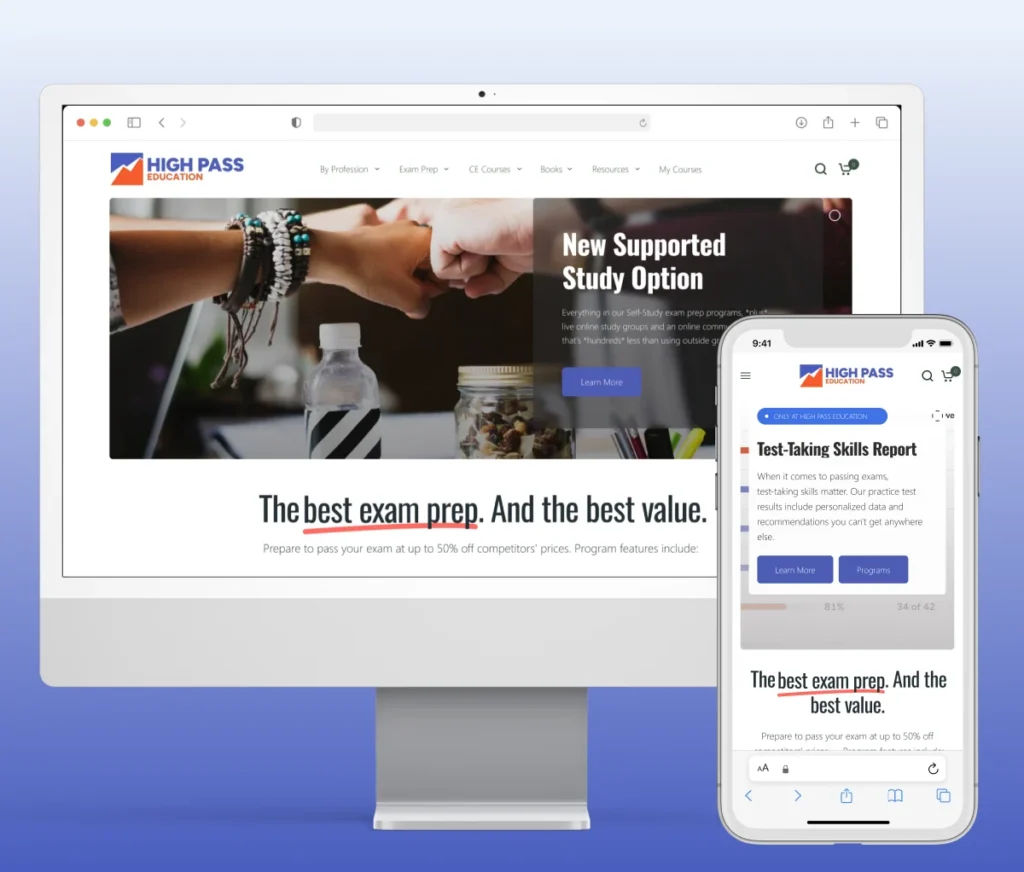
High Pass Education: Strongest Q1 on Record

High Pass Education needed exam preparation capabilities their existing capabilities for learning couldn’t deliver. AnyforSoft built a specific assessment and reporting layer on top of it, without replacing the tools the team already ran.

  • Learners gained visibility into performance trends across multiple attempts, not just final scores
  • Instructor time on manual analysis reduced through consolidated reporting
  • Program growth supported without expanding instructional staff
  • New test formats and reporting logic added without reworking existing functionality
Your training environment may be one custom layer away from what your learners actually need.
Tell us where your current platform falls short and we’ll outline what a tailored solution or extension would change.

Our technology stack

Back-end CMS Databases Front-end Mobile UI/UX tools
Next.JS Next.JS Node.JS Node.JS Symfony Symfony PHP PHP Django Django Python Python
Firebase Firebase Supabase Supabase
Angular Angular CSS CSS GATSBY GATSBY Graph QL Graph QL JQUERY JQUERY Jest Jest PWA PWA React React TypeScript TypeScript
Flutter Flutter PHP PHP
Acrobat Acrobat Adobe After Effects Adobe After Effects Adobe Illustrator Adobe Illustrator Adobe Photoshop Adobe Photoshop Avocode Avocode Figma Figma InVision InVision Sketch Sketch

Core Features of a Custom LMS

Course and Content Management

Structured content reaches learners faster:

  • Course owners update materials without support requests
  • Learners always access the current version
  • Content organized by role reduces navigation time

User Roles and Permissions

Role-based access protects compliance records:

  • Managers view only their team’s completion data
  • Authors publish within their assigned scope
  • Access updates automatically when HR records change

Assessment and Certification Engine

Automated certification closes record gaps:

  • Credentials issue when assessment conditions are met
  • Compliance records update without manual entry
  • Recertification schedules trigger before deadlines pass

Learning Analytics and Reporting

Analytics surface program performance early:

  • Completion and drop-off rates visible by cohort
  • Managers pull progress reports without L&D involvement
  • Content gaps appear before compliance targets are missed

Mobile Learning

Mobile access raises completion rates:

  • Learners progress from any device without losing position
  • Field teams continue coursework with inconsistent connectivity
  • Training completion no longer depends on office access

Gamification

Visible progress keeps learners on track:

  • Points and indicators give learners a measure of advancement
  • Completion rates improve when milestones carry recognition
  • Leaderboards create peer accountability across teams

LMS Integrations

CRM Integration

Training outcomes reach sales teams automatically:

  • Completion data flows into customer records
  • Managers track progress without leaving their CRM
  • Training ties directly to pipeline activity

HRM and HRIS Integration

HR data drives enrollment without manual input:

  • New hires enroll in required programs automatically
  • Role changes trigger updated course assignments
  • Completion records sync to HR profiles without L&D involvement

Video Conferencing Tools

Live sessions stay inside the learning environment:

  • Attendance logs automatically from virtual sessions
  • Learners join scheduled sessions without leaving the application
  • Completion credit for live training applies without manual entry

Content Authoring Tools

Authored content publishes without manual transfer:

  • Courses move from authoring tools in one step
  • Updates to source content reflect in published courses automatically
  • L&D teams maintain one version across both tools

Payment Systems

Course monetization runs within the system:

  • Learners purchase and access courses in a single flow
  • Payment records and enrollment confirmations generate automatically
  • Revenue from training tracks without a separate reporting tool

Single Sign-On (SSO)

Learners access training with existing credentials:

  • First-session drop-off decreases as the login barrier disappears
  • IT workload on credential resets reduces
  • Access rights update when HR records change
Map every system your LMS should talk to
Your HR, sales, and finance teams each run tools that need training data. On one call, we chart which records go where, and how often.

AI Features in a Custom LMS

When AI in an LMS is built from scratch, preparing and structuring your organization’s data is where the work begins. How that data is handled determines what the AI can do. It’s the foundation of our AI solutions for education.

Personalized Learning Paths

Generic course sequences assign the same content to every learner regardless of prior knowledge or role. A custom AI-powered LMS builds each learner’s path from their role and completion history, so training time concentrates where each person has actual gaps.

AI-Powered Assessments

Fixed question banks test the same knowledge in the same order regardless of what each learner has demonstrated. Adaptive assessments built into your training environment adjust question focus based on each response, so time in assessment concentrates on areas where gaps remain.

Intelligent Content Recommendations

Learners navigating a course library without guidance tend to return to familiar content and miss what’s most relevant to their current role. Recommendation logic built on completion history and performance data surfaces the next relevant resource before the learner has to search.

Conversational AI Tutors

Learners who hit a knowledge gap mid-course typically leave the training environment to find answers, breaking their focus. A conversational tutor built into the learning environment answers questions in context, keeping learners on course without interrupting the training flow.

Your learner data is only as useful as the tools built to read it.
Tell us about your current setup and we’ll map where an AI layer would make the most immediate difference.

Development Process

1

Discovery and Requirements Analysis

Your training requirements and existing technical constraints are mapped in detail before any architectural decisions are made.
2

Architecture Design

Integration points and feature logic are defined before development begins, so structural issues surface on paper rather than in code.
3

Development and Customization

Development follows the approved architecture, with progress reviewed at regular intervals so your team can refine before the next stage begins.
4

QA and Testing

Each feature is tested against the original requirements, covering integration behavior and learner-facing flows before release.
5

Deployment and Onboarding

The tested environment is deployed to your infrastructure with documentation and guidance so your team can manage the tool from day one.

Custom LMS Development Timeline and Budget

Most teams start by asking how much does it cost to build an LMS, and the answer depends on scope.
Each added integration, user role, or AI feature adds weeks and can push the build into the next tier.
Our guide on how to build a learning management system walks through each stage, from discovery to launch.

ScopeTypically includedTimelineBudget
DiscoveryRequirements, architecture, integration map, estimate4–6 weeksBilled separately
Core LMSCourses, roles, assessments, certificates, basic reporting3–5 months$25,000–$60,000
Mid-range buildCore plus HRIS, CRM, and SSO integrations, custom workflows, advanced analytics5–9 months$60,000–$150,00
Enterprise and AIMid-range plus AI features, multi-tenancy, enterprise integrations, compliance tooling9–14 months$150,000–$300,000
Get a project estimate built on your scope
With your user roles, integrations, and target launch date in hand, we prepare a project estimate for your build.

Why AnyforSoft

AnyforSoft is a custom LMS development company with 15+ years in EdTech. Clients include Wittenborg University of Applied Sciences and Imperial College Business School. For institutions, we build learning environments that keep pace with compliance demands and growing student audiences. For corporate L&D teams, we build training infrastructure that connects to existing HR and CRM tools.

EdTech-Focused Expertise

Compliance requirements and content structures in learning organizations follow patterns that take years of project work to internalize. This experience covers universities managing complex institutional systems and online schools scaling beyond off-the-shelf training tools.

Full-Cycle Development

A single team covers custom LMS software development from requirements through maintenance, so nothing is lost between stages. When the professionals maintaining software are the ones who built it, issues get resolved faster and improvements are grounded in the platform’s actual history.

Scalable Architecture

A learning environment that can’t grow with your organization requires structural rebuilds at the worst possible moments. AnyforSoft designs architecture to accommodate that growth from the start: when WUAS needed to add an AI assistant in 2024, the platform built in 2023 supported it without reconstruction.

Every workaround your team runs today is a requirement for your tailor-made solution.
Share what your current platform can’t do and we’ll scope what replacing it would take.

FAQs

What is custom learning software development?

Building a learning platform from the ground up means designing every feature and integration around your organization’s requirements. The work covers architecture design and development specific to your workflows. The integrations connect to tools your organization already runs. Since the platform is fully owned, there are no per-user fees and no vendor roadmap constraints.

How much does it cost to build a custom learning management system?

Scope drives cost most.

The cost of custom LMS development typically falls within these ranges:

  • Basic app with standard features: $25,000–$60,000
  • Mid-range build with adjusted workflows and integrations: $60,000–$150,000
  • Complex application with AI features and enterprise integrations: $150,000–$300,000
  • Discovery and scoping: billed separately, 4–6 weeks

To confirm a specific figure, requirements must be mapped in a discovery phase first. Book a call to discuss your requirements.

How long does custom learning management platform development take?

Timelines depend on scope, with discovery producing the first reliable estimate.

Most projects follow these ranges:

  • Core version: 3–5 months
  • Mid-range build with integrations: 5–9 months
  • Complex environment with AI features: 9–14 months
  • Discovery phase: 4–6 weeks before development begins

Every custom LMS development project begins with a scoped requirements document. It gives the most accurate delivery window.

What is the difference between a custom learning management system and an off-the-shelf one?

Off-the-shelf tools are configured within a vendor’s existing capabilities, built for the broadest possible audience. The core distinction between a custom LMS and an off-the-shelf one is who owns the architecture. With a purpose-built tool, the design follows your organization’s specific workflows and content structure. No vendor constraints apply to what can be built or changed. The Custom LMS vs Off-the-Shelf LMS table compares both by upfront cost, upgrade risk, and time to launch.

Can a custom system for learning be integrated with existing HR or CRM systems?

Yes. Since every system stores data differently, each connection is built around your specific tools. LMS INTEGRATION with HR and CRM tools is a standard part of a bespoke solution, with no connector template limitations to work around.

What features should a custom learning management system include for corporate training?

For corporate training, enrollment automation tied to HR data is the first priority. Compliance certification with automatic record-keeping removes the manual tracking that creates audit gaps. When scoping a corporate build, the LMS FEATURES that consistently appear are role-based access controls and direct manager visibility into team completion data.

Is a custom learning management system scalable for large enterprises?

Yes. Architecture decisions made during discovery determine how the environment handles growth from the start. Increasing learner numbers and expanding content libraries are planned for before development begins. As the organization grows, integrations and feature layers can be added without rebuilding the core architecture. Unlike licensed software with tier-based pricing, a tailored solution carries no vendor ceiling on users or features.

How does AI improve learning outcomes in a custom learning management system?

Personalizing training to each learner’s actual knowledge gaps is where the measurable improvement begins. In an app adjusted to a specific organization, the AI layer works from your organization’s own data, including completion history and performance records. That grounding is what makes AI IN LMS more effective than a generic layer applied to a third-party platform. Because the model draws on real learner data, adaptive assessments shift question focus to where gaps actually remain.

What AI-powered features can be built into a custom LMS?

Personalized learning paths and adaptive assessments are the most commonly requested AI features. While learning paths draw on each learner’s completion history, assessments shift question focus based on individual responses. Content recommendation engines surface the next relevant resource from performance data. Conversational AI tutors answer questions within the training environment, keeping learners on course without a context switch.

How do I choose a custom learning management system development company?

Start by verifying that the agency’s experience is specific to learning systems rather than general software development. Among custom LMS development companies, the ones worth shortlisting are those whose custom LMS development services span discovery, architecture, development itself, and post-launch support. Ask whether the team that scopes the project also builds and maintains it. Requesting examples of delivered learning environments gives the most reliable basis for comparison.


Looking for a reliable custom LMS software development partner?

Our team is glad to create an LMS from scratch for you. Contact us today and let us transform your idea into a competitive product.

Let’s talk
Vlad
Vlad

Business Development Manager

Anatolii
Anatolii

CEO

AnyforSoft
Privacy Overview

This website uses cookies so that we can provide you with the best user experience possible. Cookie information is stored in your browser and performs functions such as recognising you when you return to our website and helping our team to understand which sections of the website you find most interesting and useful.