









Three vendors quote the same requirement, and no two quotes can be compared.
The one charges per person on the roster, another per credential issued. A third prices by tier, while a fourth returns one annual figure with no breakdown.
Buyers of continuing education software meet that spread on almost every shortlist. What a solution costs depends on your credential volume and your renewal frequency.
Integration depth changes the number again, long before anyone signs a contract.
Every quote is a rate multiplied by something. The rate is easy to find, and what it multiplies usually is not. This guide covers:
- what each pricing model actually counts, with published figures from vendors who disclose them
- the charges that appear after the subscription line, and what makes each one grow
- how to find your break-even point between licensing and building
- where AI cuts administrative work, and where it adds a second charge to the same invoice
- the questions to put in an RFP so every line arrives priced separately
Reading a quote starts with finding what the number is counting.
What Is Certification Management Software?
A certification body issues credentials, then has to prove they are still valid. The software built for that job handles four things: issuing, tracking, renewing, and reporting. Each one runs against the rules of whichever board or association sets them.
Those four jobs matter beyond the feature list. Every one of them becomes something a vendor can count and charge for. Issue a credential and something increments. Track a person and something else does. The differences between quotes begin with those four jobs.
Much of the tracking covers continuing education (CE) credits, the study units a professional logs to keep a credential current. Credit totals update as each person finishes a module. Each board sets its own cycle, and the expiry date follows from it.
Boundaries matter too. Course delivery and exam hosting belong to the LMS, a learning management system. Membership records at a professional association stay with the AMS, the association management software (AMS) system. A credentialing platform reads from both and writes back to both.
Confusing the three is how organizations end up paying twice for one workflow. Vendors and engineering teams group this work under certification and continuing education software development.
Why Certification Software Pricing Is So Hard to Compare
What gets counted is set before any conversation about rates begins. Two organizations with identical requirements can receive quotes that differ several times over.
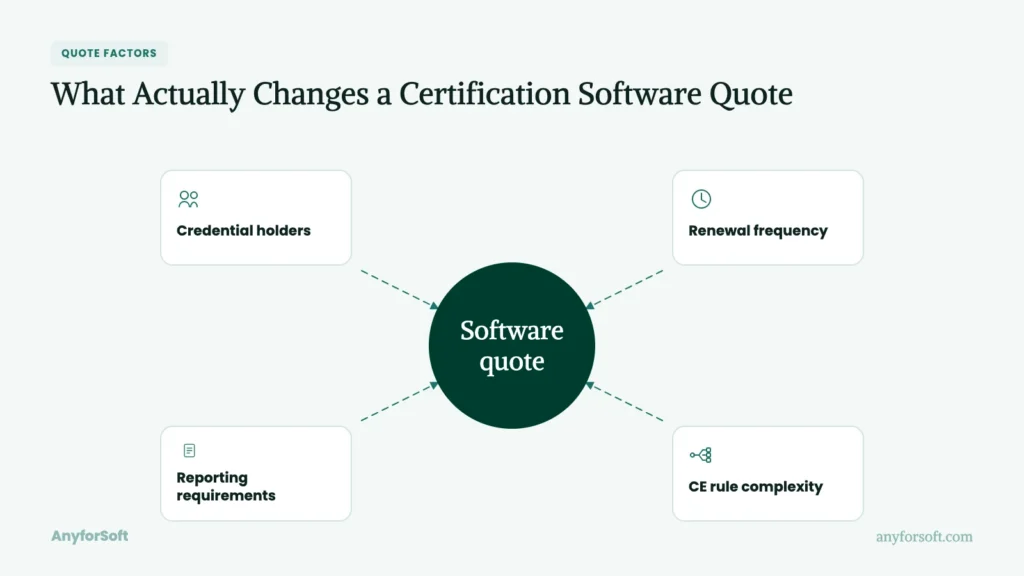
The gap rarely reflects product quality. Four variables decide it, and each carries a question a vendor can answer in writing:
- Credential holder count. A roster of 400 professionals does not mean 400 billable seats. Inactive holders, lapsed members, read-only administrators and temporary reviewers may each register differently on the count. Ask what counts as a billable seat, and whether dormant records register.
- Renewal frequency. A body running two-year recertification cycles generates half the chargeable events of an annual one. Reinstatement is the edge case worth raising early, since a returning credential may bill as a fresh issuance. Ask how a reinstatement is charged, and whether an off-cycle credential renewal counts separately.
- Reporting requirements. Report formats drive this line more than volume does. A standard export adds nothing to the subscription, while a custom layout needs engineering hours. Ask which report layouts ship as standard, and what a new one costs.
- CE rule complexity. Accreditation rules diverge between boards, and inside a single board too. Washington asks registered nurses for 8 hours per cycle, two of them on health equity. Advanced practice nurses in the same state need 30 hours, plus 15 more in pharmacology with prescriptive authority. Ask which rule types are configurable, and which need custom work.
Answers to all eight questions turn a quote into something comparable. A vendor who will not put them in writing has answered anyway. Published credentialing software cost figures assume standard rules and a clean roster.
Your own numbers change the figure once they replace those assumptions.
Certification Management Software Pricing Models and Typical Cost Ranges
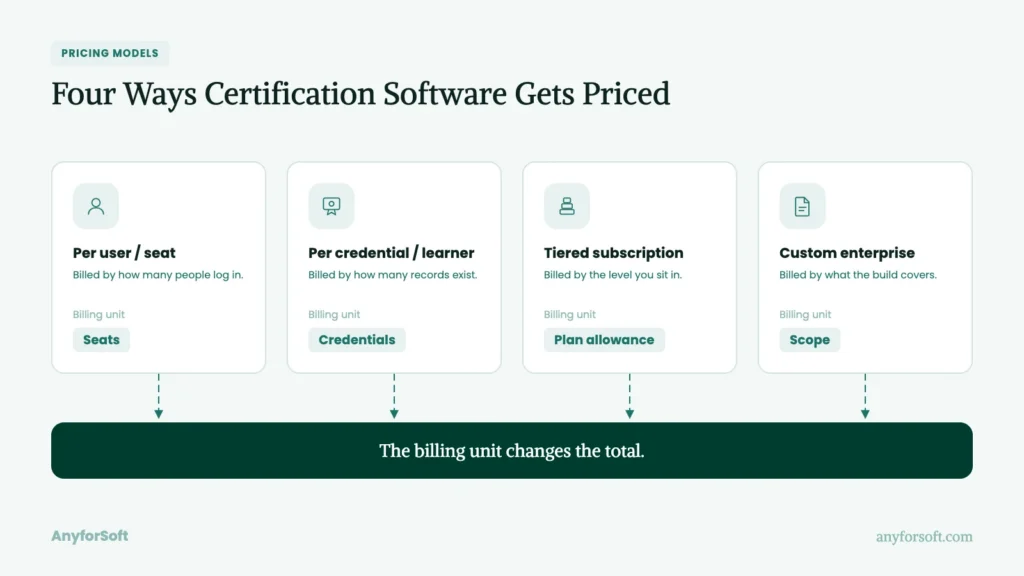
Four ways of counting dominate this category. Each picks a unit, then charges a rate against it. The same logic drives LMS pricing models, where seats and active users divide the same way. The unit a model bills on decides which organization it suits.
Per-User / Per-Seat Pricing
Seats are the unit, and the definition of a seat carries the whole figure. Certemy publishes $3.00 per user monthly for its tracking tier, with a higher rate where workflow management is included.
A separate charge applies each time the platform verifies a licence at its issuing board. Two counters run inside one product: one on payroll size, one on verification volume. Workforce teams buying employee certification tracking software usually find seats and headcount close together. Per-user pricing works best where nearly everyone tracked is also employed.
Per-Credential or Per-Learner Pricing
Issuance replaces headcount here, and the two numbers diverge more than buyers expect. Accredible counts unique recipients per year, so one person can receive unlimited credentials without adding to the total. Other providers count each credential issued, which makes a member holding four designations count four times. A body awarding many credentials to few people pays very differently under those two rules. Programs with predictable issuance volume fit certification tracking software priced this way, on a per-credential pricing basis.
Tiered Subscription Plans
A tiered subscription bundles an allowance into a flat annual license, which keeps budgeting simple until the allowance runs out. Entry plans commonly cap at a few dozen users, and the next tier arrives as a step. Certification features are often packaged above the base licence as a paid module, so the advertised price covers less than it appears to. An organization just under a threshold pays little. Crossing that threshold can double the annual figure overnight.
Custom Enterprise Quotes
No public rate exists at this end of the market, so the custom quote is assembled from scope. Accrediting bodies supported, integrations required, reporting formats, and chapter structure each add hours to the estimate. Published ranges start around $50,000 for a single organization with standard workflows. Multi-chapter or multi-board platforms with custom reporting and integrations run roughly $150,000 to $350,000 and above. Those figures are a starting reference. Discovery replaces them with a number built on your own rules.
The Hidden Costs Behind the Subscription Price
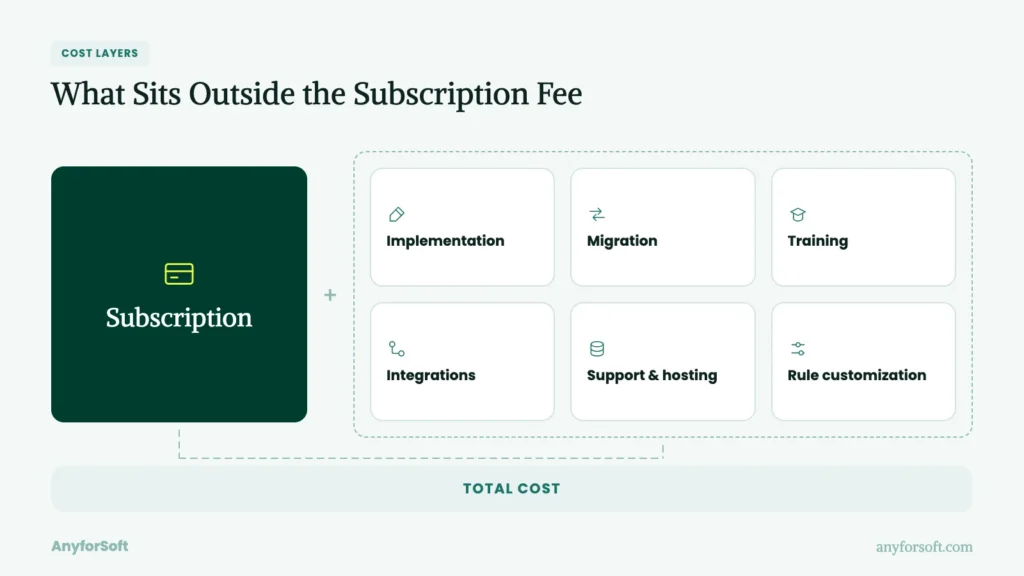
Subscription rates are the part of a quote that arrives early and stays stable. The charges around them do neither. Six of them appear in most implementations, and each grows on something other than the rate you negotiated.
1. Implementation and Configuration
Configuration work is where an accrediting body’s rules become a tool’s behaviour. Someone builds the cycles, the credit categories, the approval steps and the role permissions before anyone logs in.
Vendors quote it as a one-time implementation fee, separate from the subscription line. Rule count moves this figure more than user count does. A single-board program configures in days, and a body serving several professions can take weeks.
2. Data Migration From Spreadsheets or Legacy Systems
The condition of your records sets the data migration price. Volume matters far less. A ten-year membership spreadsheet arrives with inconsistent date formats and duplicate entries under slightly different names. Every merge takes a few minutes by hand, and across thousands of rows those minutes become billable hours. Cleaning the source before migration begins usually cuts the quoted fee. Ask what the provider will import, and whether historical credit records come across.
3. Staff Training and Change Management
Budgets rarely reflect what adoption actually requires. Nonprofit technology spending puts roughly 1% toward staff training against 14% for software licences, according to NTEN and Heller Consulting. Under-trained staff keep the old spreadsheet running alongside the new system, which means paying for both. The follow-on cost is a second onboarding round, six months later, once the workarounds have hardened into habit.
4. Integrations Between Certification Tracking Software, AMS, and CRM
System integration fees follow two questions: whether a prebuilt connector exists, and whether your other platforms expose an API. An API-first architecture on both sides makes the work predictable. A legacy AMS integration without one turns a routine sync into engineering. Single sign-on (SSO), SCORM/xAPI compliance, and role-based dashboards each carry their own scope. Anything the system cannot reach stays a manual export, which is a staffing charge and not a licence one.
5. Ongoing Support, Hosting, and Upgrades
What looks like one annual figure contains three separate recurring charges.
Hosting covers the infrastructure, ongoing support and maintenance covers response times, and upgrades cover the version you end up running. Cloud software often bundles all three, while on-premise deployments itemize them. Renewal automation is frequently a tier above the base plan, so check which side of that line your quote falls on. Ask what the annual increase cap is, since a contract without one has no ceiling you can budget against.
6. Customization for State-Specific or Board-Specific CE Rules
Every divergent rule is customization work somebody bills for. Mandated topics are the clearest example: CE tracking that counts total hours cannot tell whether two of them covered health equity. Reciprocity across jurisdictions adds another layer, since a professional licensed in two states may satisfy one board and fall short with another. Rule changes arrive on the board’s schedule. Each one is a change request unless your contract says otherwise.
Off-the-Shelf vs. Custom-Built Certification Software: Which Costs Less Long-Term?
Subscription and build are two different shapes of spending. One recurs and scales with your program, the other lands up front and stays flat. Which costs less depends entirely on where your credential population sits in three years.
When Off-the-Shelf Pricing Works
Configured platforms make sense when your rules already resemble what the product assumes. A single accrediting body, predictable cycles, reports the board accepts as exported, and no requirement to sync with anything else: this profile fits what vendors have built.
Volume matters as much as rules. A program holding steady at a few hundred credential holders never reaches the tiers where per-seat arithmetic turns painful. Organizations already paying an association management software cost each year are weighing two subscriptions. A second platform with overlapping member records is a real argument against building a third thing.
When a Custom Build Lowers Total Cost of Ownership
Licensing grows with the program, while a build absorbs growth without changing price. Every new credential holder adds to a per-seat invoice forever, and none of that spending produces anything the organization owns. Purpose-built systems invert the arrangement. Higher spend arrives up front, then maintenance, with the data model and workflows under your control. Owning that data model is also what removes vendor lock-in when the contract ends.
The case strengthens where rules diverge from what products assume. Multi-board reporting, reciprocity logic and non-standard renewal rules arrive as change requests against a configured platform. Each one is billable. Chapter federations are a multi-tenant architecture problem, and products that treat chapters as tags rather than tenants never solve it cleanly. Continuing education software built around your own accrediting requirements also removes the manual exports that fill the gap between what a product does and what a board demands.
Published ranges start around $50,000 for a single organization with standard workflows. Multi-chapter or multi-board platforms run from roughly $150,000 to $350,000 and above.
A third option sits between the two, and it is the one buyers overlook. Keeping an existing platform and building only the layer it cannot provide costs a fraction of a full replacement. High Pass Education took that route, and the case below shows what it preserved.
How to Calculate Your Break-Even Point
Four numbers produce the comparison, and all four are available before anyone signs anything.
- Project your credential population at year three. Use your actual growth rate, not the current roster. Under-projecting here is the most common reason a per-seat contract stops making sense a year after signing.
- Multiply by the quoted unit rate. Apply the tier structure honestly, including the step where your projected number crosses a threshold.
- Add the recurring charges around the licence. Support, hosting, renewal uplift and the integrations you cannot avoid all belong in the annual figure.
- Compare the three-year total against build plus maintenance. The arithmetic matches what a custom LMS development cost estimate involves at similar scale.
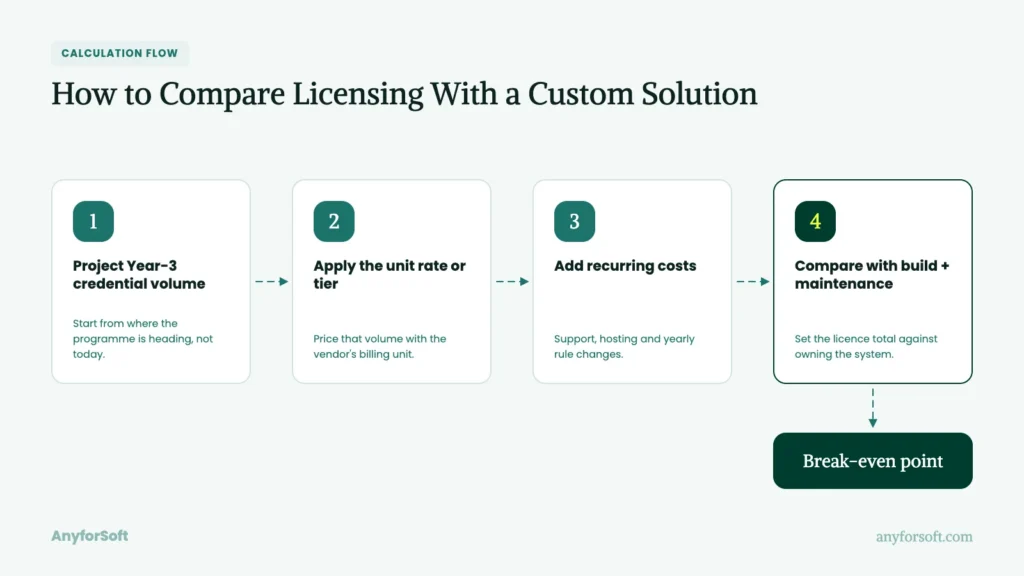
Break-even often lands between years three and five for organizations with rule complexity, and later for those without it. The exercise is worth doing even when the answer is to stay where you are, because it tells you which year the conversation reopens.
How AI Is Changing the Cost of Certification Management Software
AI moves the figure in both directions at once. Labour comes down where chasing submissions and compliance checks stop needing a person, and the licence line goes up where those features arrive as paid additions.
Compliance risk reduction is the outcome buyers are paying for in either case.
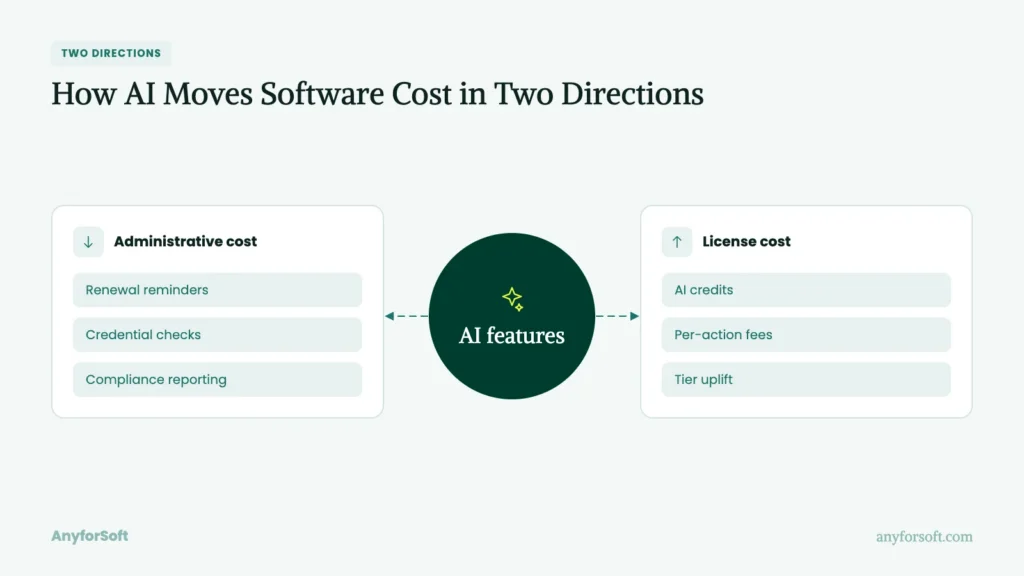
Where AI Cuts Administrative Cost
Compliance monitoring is repetitive work performed against a deadline, which is what makes it automatable. The pattern that works runs as a loop: a scheduled check, a submission, intelligent credential verification, then a decision. Confident results clear on their own. Ambiguous ones route to a person, along with whatever context the system used to flag them. AI-assisted renewal reminders escalate missed deadlines without anyone remembering to chase.
AnyforSoft built that verify-and-escalate structure for FilterSync, a property compliance platform where edge cases reach a reviewer before any final decision. The same shape applies to credential renewal: the categories differ, the loop does not.
Judgment stays with people. The follow-up disappears, and administrative overhead falls with it. Staff review the few submissions that genuinely need a human read, while automated compliance reporting produces the board return from the same records. AI-driven audit readiness works the same way, since a system that logs every decision generates its own evidence trail. Faster renewal cycles follow, and member satisfaction tends to track the reminders that actually arrive on time.
Where AI Adds to the License Price
Automation arrives with its own billing unit, and it rarely matches the one you already negotiated. Credit allowances are now common: a plan includes a set number of AI actions monthly, with overages billed per action beyond it. Atlassian, outside this category but illustrative, allocates 25 credits per user each month and charges $0.30 per conversation on consumption features. Per-verification charges work the same way. Certemy bills separately each time the platform confirms a licence at its issuing board, so the AI that saves administrative hours also meters them.
Unexpected charges follow. Zylo’s 2026 SaaS Management Index reports that 78% of IT leaders encountered charges tied to consumption or AI features they had not anticipated in the past year.
Two questions cover it. Ask which AI features are included at your tier and which sit above it. Then ask what the unit is for each one: a credit, a per-action charge, or a flat uplift on the seat rate.
Budgeting and Procurement Best Practices
Procurement decides how comparable your quotes are before a single one arrives. Three habits separate a process that produces usable numbers from one that produces a stack of incompatible proposals.
Align Stakeholders on Requirements Before Requesting Quotes
Requirements drift between demos, and the quotes drift with them. Finance asks about price caps, the program team asks about board reporting, and IT raises single sign-on in week three.
Each addition changes what the last vendor was quoting against, so the proposals arrive describing different products.
Fixing it costs one meeting. Write down what the platform must do, what it should do, and what nobody needs, then circulate that list before the first call. Disagreements surface in the room and not in a proposal three weeks later. The list also gives you a defensible reason to reject scope a vendor adds on their own initiative.
Build an RFP That Isolates Every Cost Line Item
A single annual figure hides everything the previous sections covered. Ask vendors to price each element separately, and the comparison becomes arithmetic. Six lines carry most of the risk:
- The unit and its rate. What gets counted, what it costs, and what happens to dormant or inactive records.
- Implementation and configuration. Quoted as a one-time fee, with the rule count it assumes stated explicitly.
- Data migration. Priced per record or per hour, with a clear statement of what comes across and what stays behind.
- Training. Hours included at signing, and the hourly rate once those run out.
- Integrations. Named system by system, separating prebuilt connectors from work someone has to build.
- Renewal terms. The uplift cap, the tier thresholds, and what triggers a move to the next band.
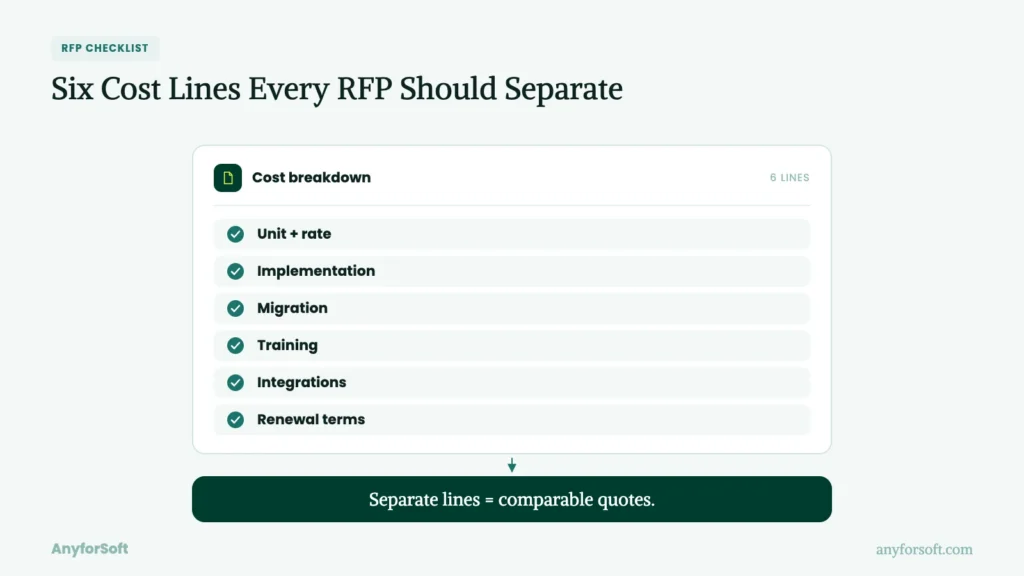
Vendors who answer all six in writing are telling you something about how the relationship will run. So are the ones who will not.
Budget Across the Full Renewal Cycle
Year one is the cheapest year of the contract, and budgeting against it guarantees a shortfall later. Growth in the credential population raises the recurring figure on its own. The uplift compounds on top of that. Tier thresholds sit somewhere in between, and crossing one produces a jump with no growth curve predicted.
Board rule changes arrive on their own schedule and land as change requests. Two or three across a three-year term is ordinary. Budget a contingency line for them, because program integrity depends on absorbing a rule change in the cycle it lands.
Model three years, at the population you expect in year three. That figure, and not the signing figure, is what the organization actually commits to.
Certification and CE Software in Practice: AnyforSoft Case Studies
Two projects show the arithmetic from the previous section playing out differently.
High Pass Education
Mental health professionals preparing for licensure exams needed testing that matched real exam conditions. The off-the-shelf learning platform running their program could not configure test rules per scenario or per learner, and it reported single-attempt scores where trends were what instructors needed.
AnyforSoft added a custom assessment and reporting layer over that existing platform. Time limits, attempt counts, grading rules and passing thresholds became configurable per learner. Comparative analytics across attempts separated knowledge gaps from pacing problems, and administrators gained aggregated statistics across their whole learner base.
The base licence stayed. Only the layer the product could not provide was built, which is the middle path between renting and replacing. High Pass Education reported its strongest Q1 performance to date in 2025, and the program grew without adding instructional staff.
Digital Testing Platform
A private tutoring company had run SAT preparation on printed materials, manual grading and hand-written reports since the 1980s. Generic testing products would have priced the program per seat, across a student population that turns over completely every year.
AnyforSoft built a custom exam-prep and assessment platform on a heavily customized open-source core. Three test modes cover timed, self-paced and untimed practice. Module difficulty adapts to each student’s answers, a custom grading scheme mirrors the official scoring range, and PDF score reports show time spent per question. Proctors supervise sessions from their own cabinet, while two-way CRM synchronization keeps enrollment records aligned.
Per-seat licensing disappeared from the cost base entirely.
Why Associations and Certification Bodies Choose AnyforSoft
Associations, licensing boards and certification bodies arrive with rules no product was built around. Five things decide whether a partner can price that work honestly.
Full-Cycle Certification Software Audit and Cost Estimate
Discovery comes before any code. A technical assessment maps your accrediting requirements, renewal logic and reporting formats against what your current systems already handle. The output is a technical approach and a figure built on your rules, replacing the published ranges earlier in this article. Organizations running a platform that mostly works get told so, along with what a targeted layer would cost.
AI-First Engineering Approach
AI goes where it removes real friction: renewal verification, compliance monitoring, adaptive pacing. Each feature ties to a task someone handles daily, and a person stays accountable for the output. Ten-plus AI products for education sit behind that approach. The same thinking runs internally, where specification-driven development has engineers define system behaviour and direct AI against it under review.
Track Record With Education and Association Software
Fifteen years of engineering since 2011, 150+ projects focused on education, 140+ clients, 80+ engineers. Clutch rates the team 4.9 out of 5 across 88 reviews, and its 2026 lists name AnyforSoft a Top AI Company in Education and a Top Drupal Company Globally. Depth shows in the standards work: SCORM/xAPI interoperability, single sign-on, WCAG 2.1 accessibility, and GDPR and SOC 2 alignment decided at architecture stage.
Transparent, Milestone-Based Pricing
Scope breaks into milestones with figures attached, and each one gets approved before work starts. Timelines follow the same logic: roughly three to six months for a single-system platform with standard renewal rules, and nine to eighteen months where AMS, CRM or several accrediting bodies are involved. Support continues after launch as standard practice, not as a separately negotiated add-on.
Flexible Engagement Models
Some organizations want an education software development partner running the full cycle from discovery through support. Others want a dedicated development team embedded in a workflow they already run, working to their sprints and their tooling. AnyforSoft delivers both as standard. Teams are distributed across Europe and Ukraine, with a US office in Sarasota handling client-facing work.
Frequently Asked Questions
What does certification management software cost?
Entry-level tools start near $3 per user monthly, while platforms for a single organization with standard workflows are quoted from around $50,000 to build. The gap reflects what each product counts, not what each one is worth. Published rates assume standard rules and a clean roster, and both assumptions change once your own numbers replace them.
What pricing models do vendors use?
Four dominate. Per-user pricing charges by seat, per-credential pricing by issuance, tiered subscription plans bundle an allowance into a flat fee, and enterprise deals are quoted from scope. Vendors of certification management software often run two of these inside one product, which is why a headline rate rarely describes the whole bill.
What hidden costs should I budget for beyond the subscription fee?
Six recur: configuration, data migration, staff training, integrations, ongoing support and maintenance, and rule customization. None of them tracks your subscription rate. Migration price follows how clean your records are, integration price follows whether an API exists, and customization price follows how far your board’s rules sit from the product’s defaults.
Is it cheaper to buy off-the-shelf or build custom certification software?
Buying costs less until credential volume or rule complexity makes it stop. Published build ranges run from roughly $50,000 for a single organization to $150,000 and above for multi-chapter or multi-board platforms. A third route often costs least: keeping an existing platform and building only the layer it cannot provide.
How does credentialing software cost compare to certification management software?
The terms overlap, and the pricing follows the use case rather than the label. Credentialing tools lean toward regulated verification work, where primary source checks against issuing boards carry their own per-check charge. Certification management leans toward association programs built on renewal cycles and CE credits. Leading platforms serve both, so compare what each one counts.
How long does it take to implement?
Configured platforms in adjacent categories typically take three to nine months, depending on data complexity. Custom builds run roughly three to six months for a single-system platform with standard renewal rules. Timelines reach nine to eighteen months where AMS, CRM or several accrediting bodies are involved.
Which features drive the price up the most?
Primary source verification, multi-board reporting, and integrations with systems that lack an API. Each adds its own charge on top of the seat rate. Certification tracking software priced per verification bills every time it confirms a licence, so verification frequency matters as much as headcount.
How do continuing education (CE) tracking requirements affect software cost?
Rule divergence is the cost driver. Washington asks registered nurses for 8 hours per renewal period while Nevada requires 30, four of them in cultural competency. North Carolina sets no single hour total, offering eight ways to demonstrate continuing competence. Every rule shape your platform has to support is configuration work.
How is AI changing the cost of certification management software?
It moves the figure both ways. Administrative work drops where AI-assisted renewal reminders and automated compliance reporting replace manual follow-up, and AI-driven audit readiness removes the scramble before a board submission. The licence line rises where those features sit above your tier or bill per action.
What AI features should I look for when evaluating pricing?
Ask what each one is billed against. Credit allowances, per-action charges and flat uplifts on the seat rate all appear, sometimes together in one contract. Intelligent credential verification and renewal automation are the two features most often placed above the base plan, so confirm which tier includes them.