



A membership director can paste a renewal email into ChatGPT for a cleaner draft. The chat window has no idea which 400 members will probably lapse in March. Or which nurse still needs six continuing education (CE) credits before her license comes up.
Once the AI runs inside the systems that hold your member records, it’ll see both. That’s what AI for associations looks like in practice: features built into your own software. You’ll notice the change first in member experience, and later in member retention.
AI can:
- spot members drifting toward a lapse months before the dues invoice
- answer a policy question from your own standards
- suggest the next CE course from a learner’s transcript
- check an uploaded certificate against your credit rules
Two choices shape how far any of those features can go: which records the AI can reach, and whose software it runs on.
What Does AI for Associations Mean in 2026?
In 2026, artificial intelligence for associations means AI that lives inside the tools you already pay for. These tools are the association management software (AMS) with your member records, the learning management system (LMS) running CE courses, the member portal, plus site search and event tools. Staff writing emails in ChatGPT counts too, though it’s a side benefit.
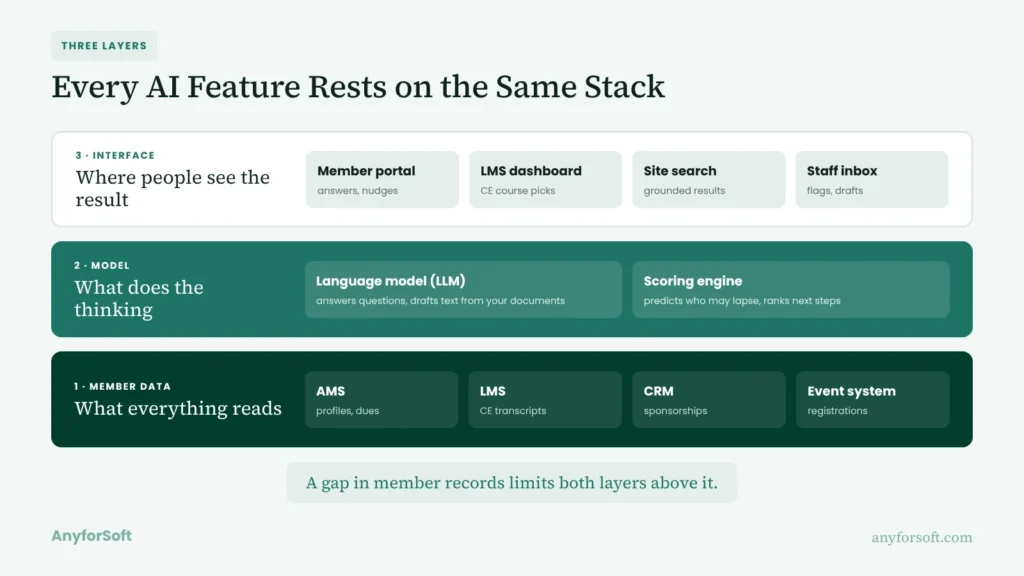
Every feature needs three layers, stacked in the following order:
- member records: profiles, dues, CE transcripts, event history
- a model: a large language model (LLM) for answers and text, or a scoring engine for predictions
- an interface: the screen where a member or staff member sees the result
No model, however good, fixes records that are missing or scattered across four systems. So the data decides how far the other two layers can go.
Why Are Associations Moving AI From Staff Tools Into Their Software?
Members expect the instant, tailored service their bank’s app gives them. Where dues revenue stays flat, that pressure lands on non-dues revenue from certification programs, conferences, sponsorships and CE revenue, with only a handful of staff to run them.
A public chatbot can’t help here: it doesn’t see member records, engagement history, CE transcripts or dues status, so it can’t predict who’ll lapse. It still ends up in daily work, drafting replies and summarizing meeting notes, often without anyone vetting it first.
That’s shadow AI: useful tools running outside any policy on what they may touch.
Bringing the AI inside your own systems solves both problems, though it raises a harder one first.
Only about 43% of associations can easily reach their own member data, according to ASI, maker of iMIS.
So building AI for membership organizations into the AMS starts with making those records reachable, well before anyone picks a model.
One member ID has to run across the AMS, the LMS and whatever spreadsheets the team still keeps.
Which AI Software Features Deliver the Most Value in 2026?
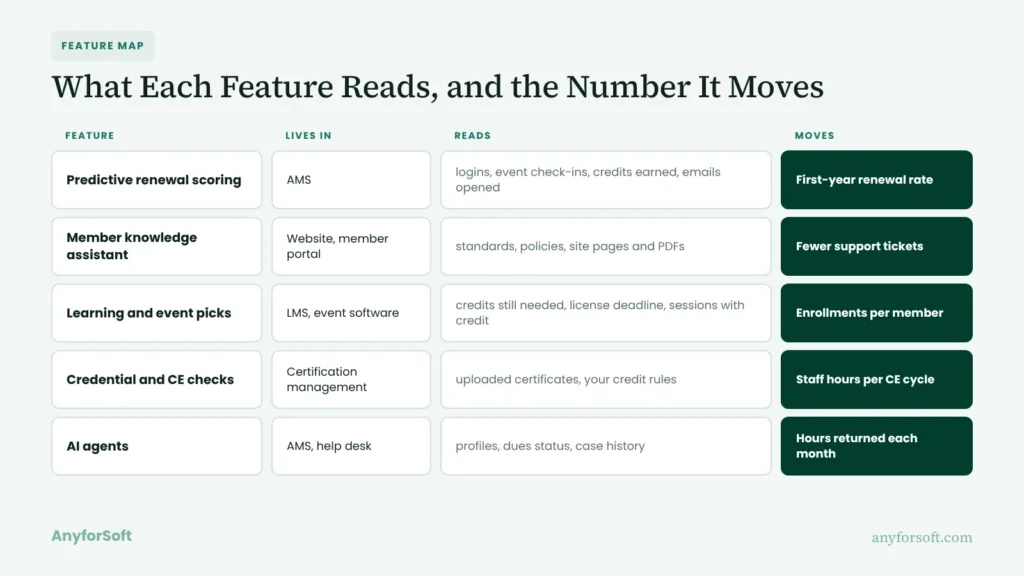
The most useful AMS AI features share one trait: each one reads member records you already keep and moves a number you already track, from first-year renewals to staff hours per CE cycle.
Predictive Renewal and Churn Scoring Inside the AMS
Lapses tend to show up in login and event data well before renewal season. You’ve probably got the signals in the AMS already.
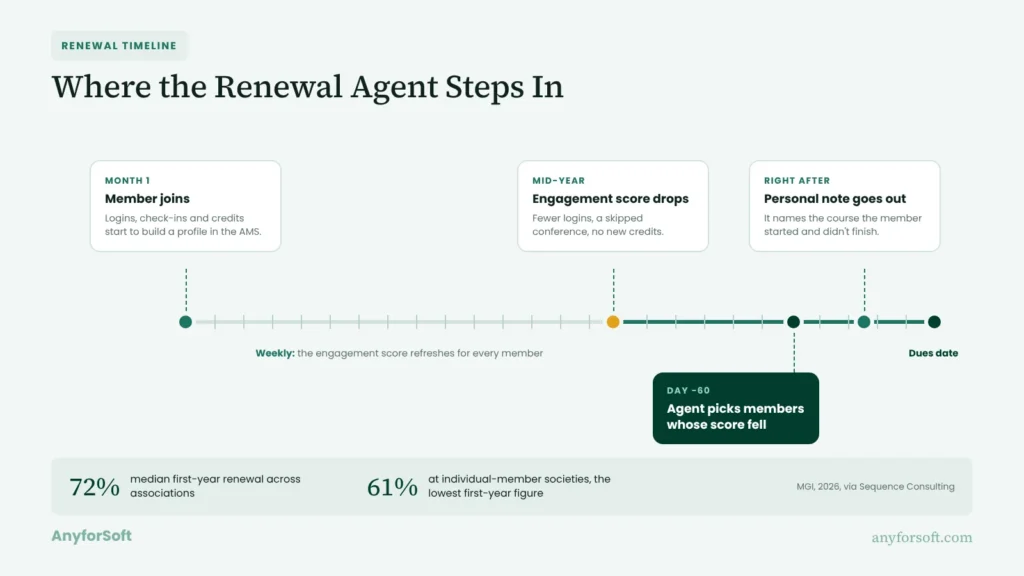
Logins. Event check-ins. Credits earned, emails opened. Feed them to predictive renewal scoring and you get a member engagement score per person, updated every week.
New members are the ones most likely to leave. A typical association keeps 72% of them after the first year. If your members join as individuals, like nurses or therapists paying their own dues, the figure drops to 61%, so nearly four in ten don’t come back. Every first-year member you keep raises the overall renewal rate, so that’s where a lapse score pays off soonest.
About sixty days out from dues, a membership renewal AI agent (software that acts on its own, within limits you set) goes down the list of members whose score fell.
For each one it drafts a personal note, say, mentioning the course they started in spring and didn’t finish. Since it’s built as predictive analytics and behavioral AI inside the AMS, it reads member records straight from the source.
Member Knowledge Assistants Grounded in Association Content
Membership inboxes fill up with the same handful of questions.
Which credits count. Whether the ethics code covers telehealth. When the next exam window opens. (And, every time, where last year’s slides went.)
Your AI member assistant can field them from your own standards.
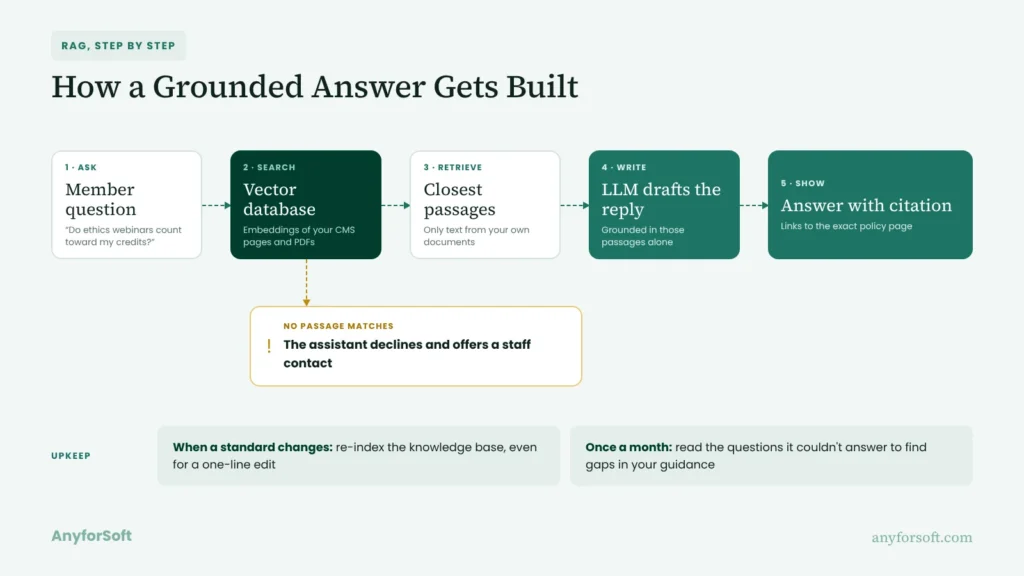
The method is retrieval-augmented generation (RAG). In plain terms, it looks up the matching passages in your documents, then writes the reply from those and nothing else. Its index can also run AI-powered site search on your website.
The tool AnyforSoft built for Wittenborg University of Applied Sciences draws on a controlled knowledge base of the university’s pages and documents, so its answers update when the pages change.
At a private academy, a similar AI chatbot development project answered 60% of student questions directly and cut repeat email and phone queries by 30%.
A membership inbox would see both effects: answers that keep up with your standards as they change, as at Wittenborg, and fewer routine questions about credits and exam dates reaching staff, as at the academy.
This adds up to fewer support tickets, with staff time left for the questions that need a person.
Personalized Learning, CE, and Event Recommendations
Connected to the AMS profile, a continuing education platform knows which credits a member hasn’t earned yet and when their license deadline falls. It can then build personalized learning paths and put CE course recommendations on the dashboard, like an ethics module for someone three credits short with eight weeks left.
At conferences, event management software can flag the sessions that carry credit for a member’s track.
One private university runs professional certification programs. AnyforSoft built its LMS with adaptive learning paths. After launch, the client says churn dropped as materials became easier to reach.
To see whether the recommendations work, compare how many courses each member signs up for before and after launch.
Automated Credential and CE Credit Verification
Every spring, someone on staff opens hundreds of uploaded certificates and checks providers and hours by hand. The checks stall because every provider formats its certificate differently.
With credential verification inside certification management, the system reads each document against your rules and approves the clear cases.
Fewer certificates arrive late when the system reminds members first. A medical technology company had AnyforSoft set up automated deadline reminders and role-based dashboards in its Moodle LMS, and by the client’s account, completion reached 85% in the first training cycle.
FilterSync, a property compliance platform, needed proof that tenants had actually changed their air filters. AnyforSoft built its verification engine: a Python microservice (a small, separate program) checks each tenant’s photo, returns Pass or Fail and flags suspicious ones. The AI now handles most checks on its own, and only borderline photos go to a reviewer.
Swap the air-filter photo for an uploaded CE certificate and the job is the same: your rules applied to the proof a member sends in, with unclear cases left to staff.
Members face the same kind of deadline at recertification, so a reminder sent weeks ahead means fewer late certificates and fewer follow-up emails from your team.
Automated checks need a record behind them. Purpose-built certification and continuing education software keeps an audit trail, so if an accrediting body asks why a credit was accepted, staff can show the rule and the document behind it. The clearest measure of the payoff is staff time: the hours spent on each CE cycle before and after launch.
AI Agents for Member Service and Back-Office Workflows
An assistant replies to a member’s question. An agent doesn’t stop there: it changes records, such as updating a profile or opening a support case in the AMS.
Typical agent jobs include:
- welcome emails and profile prompts for automated member onboarding
- a suggested next-best-action for staff, such as calling a lapsed member who just joined a webinar
Each agent should log every record it changes. Staff productivity shows up as hours returned to the team each month.
How Does AI Connect to Your AMS, LMS, and Member Data?
If you’re still choosing an AMS, start with how to build custom association management software. The rest assumes one is running. Four engineering decisions wire your records to the AI and decide whether AI for associations can read them.
Start With a Unified Member Data Layer
Take one member. Her dues live in the AMS, her credits in the LMS, her sponsorship history in a customer relationship management (CRM) tool, and her conference badge in the event system.
Kept apart, those systems produce odd results, like an LMS still pushing courses at someone who stopped paying last quarter.
Linked under one member ID in a data warehouse (one central database for reporting), every score draws on a single source.
Integrate Through APIs, Not Spreadsheet Exports
A CSV file exported at midnight is out of date by the morning shift. The fix is API-first integration: systems pull data from each other directly, through APIs, the connection points between programs. Webhooks push each change the second it happens.
Then single sign-on (SSO): one login for the portal and the courses.
Speed matters as much as the connection itself, as AnyforSoft saw on its High Pass Education project. There, course delivery and assessment run on separate platforms, so the team set up synchronization between the LMS and the LTI systems (LTI is the standard for plugging outside apps into an LMS). User updates now reach the other side within 5 to 20 seconds, and learners move between content, tests and results as one workflow.
Ground Generative AI in Your Own Content With RAG
A grounded assistant runs on a short pipeline that starts in your content management system (CMS), Drupal, WordPress or similar.
Each page and PDF is split into passages, and each passage becomes embeddings: numbers that capture its meaning. A search over a vector database finds the passages closest to a member’s question. The LLM writes from those. At Wittenborg, it’s a Drupal module. It calls the OpenAI API and searches for a Milvus index.
Keep Humans in the Loop for High-Stakes Decisions
Some calls shouldn’t be left to software. Denying a CE credit is one. So is suspending a credential.
An automated mistake on either costs trust fast, so route them to human-in-the-loop review.
FilterSync works this way: low-confidence results go to a person, and every override gets its own decision record. Once a month, run model evaluation against those overrides. Where staff keep correcting the AI, its accuracy is slipping.
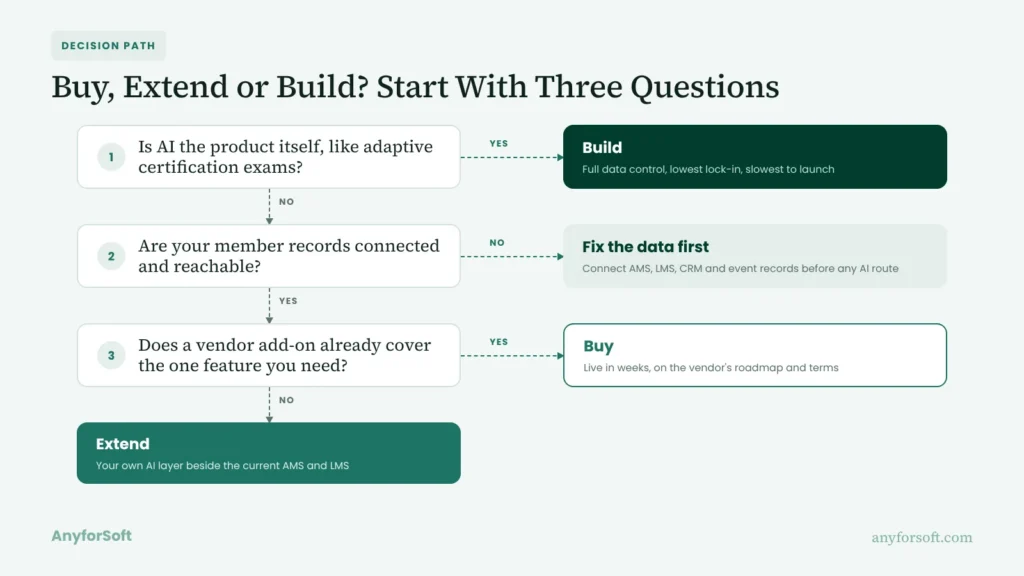
Should You Buy AI Add-Ons, Extend Your AMS, or Build Custom AI?
With the data connected, the open question is ownership of the AI and the screens members see. If the AMS itself needs replacing, that’s a job for custom association management software development.
Buy: Vendor AI Add-Ons and Off-the-Shelf Tools
The vendor’s add-on is the quick option. Once it’s switched on, lapse prediction, or a help-desk bot, is live in a few weeks.
Third-party AI tools for associations plug in similarly from outside the AMS. What you give up is control. Their roadmap, their terms.
An add-on also sees only the system it belongs to, so a lapse score built inside the AMS can’t count the courses a member dropped in a separate LMS.
If you leave later, you rebuild the feature and move its settings by hand. It’s a fit for a small team that needs one standard feature now and keeps most member records in one system.
Extend: A Custom AI Layer on Top of Your Current Platform
Extending keeps the AMS and LMS and adds your own AI components beside them through their APIs. You own the logic and the data flows. The core system stays untouched.
High Pass Education took this route, adding assessment and analytics on top of its existing off-the-shelf LMS.
This route works best with a partner for AI integration services who already knows what your vendor’s API allows and where its limits are.
Build: A Platform Designed Around AI From Day One
Starting from scratch makes sense when AI is the product, such as a certification body launching adaptive exams.
Here, custom AI development produces an AI platform for membership organizations shaped around your data from the start, with full data control and the lowest lock-in of the three, as long as you own the code.
It costs more time and a larger upfront budget, and the association management software cost breakdown puts figures on that.
| Option | Best for | Data control | Time to value | Lock-in risk |
| Buy | one standard feature, small team | vendor’s terms | fastest | high |
| Extend | adding AI to a system that works | yours, for the AI part | medium | low, if you own the code |
| Build | AI as the core product | full | slowest | lowest, if you own the code |
If your AMS works and your data is connected, extending gives you the most control for the time it takes.
What Risks Come With Adding AI to Member-Facing Software?
Each risk below belongs to one layer and comes with a control your developer can build in.
Member Data Privacy and Consent
An assistant that can read every member file can also expose one. Three controls cover most of the risk:
- permissions through role-based access, so a chapter volunteer can’t see national dues data
- flags from consent management that keep opted-out members out of AI processing
- data handling that meets CCPA, California’s privacy law, for members in that state
AnyforSoft applies GDPR to its own work as well as its clients’. On association projects, the team plans for GDPR and AI compliance from the first design session: what the AI may read, how long query logs are kept and who can see the results. Before the AI gets access to member data, the systems holding that data need to be secure.
For Delaware County Community College, which runs continuing education programs in Pennsylvania, AnyforSoft started with a full security audit of three websites, two of them restricted to students.
The team then added stronger authentication, encryption and regular security audits to protect students’ personal data, and kept a dedicated support team on the sites.
An association’s member portal holds the same kind of records, and an AI assistant connected to it is only as safe as the logins and encryption around it.
Accuracy and Hallucinations in AI Answers
Generative AI guesses when it doesn’t know. The guesses sound right. Give a member the wrong eligibility rule and they might miss a testing window they can’t get back.
Two controls cut that risk:
- Every answer with source citations linked to the exact policy page, so a member can check it
- Built-in guardrails that make the assistant decline questions outside your documents
Between the two, a member gets either an answer they can verify or a clear sign that the question needs a person.
Protecting Your Content and Intellectual Property
Members pay for standards, exam banks, course recordings, journal archives. Paste those into a public AI service and you may not get them back. Private deployment helps: the provider signs a contract that keeps your data out of training.
Vendor contracts add a second layer: content copyright terms in each one confirm that your standards and course materials stay yours. Inside the organization, an AI acceptable use policy lists which documents can’t go into outside tools, so staff don’t have to guess.
AI Software in Practice: AnyforSoft Case Studies
Three AnyforSoft projects show all three layers working together: the records an AI reads, the model that makes the call and the screen where people see the result.
Wittenborg University of Applied Sciences (Higher Education)
Wittenborg, a Dutch university and AnyforSoft client since 2023, needed an assistant that would answer applicant and student questions at scale and still fit its team’s content workflow.
We built it as a module inside the university’s own Drupal 10 site, replying from official pages and documents. The university keeps the controls:
- admins set the tone of voice and the content it may use
- replies stay on university topics
- when a direct answer doesn’t fit, it points to the right page, form or contact
An association could adapt the Wittenborg solution into a member knowledge assistant, with your standards and member resources as its knowledge base.
High Pass Education (Certification Exam Prep for Mental Health Professionals)
High Pass Education prepares mental health professionals for certification exams and sells on-demand CE courses.
Its off-the-shelf LMS couldn’t show learners where they stood between attempts, so we added an assessment and reporting layer on top:
- tests with per-learner rules for time limits, attempts and passing scores
- comparisons across attempts that show each learner’s trend
- pacing signals from how learners move through a test
- accessibility aligned with WCAG 2.1, the web accessibility standard
In 2025, the client had its strongest first quarter to date. For an association, the High Pass Education reporting model could show certification candidates where they stand before each exam attempt.
FilterSync (PropTech / Compliance)
FilterSync helps property managers prove tenants changed the air filters in their heating and cooling (HVAC) systems. We built its AI verification engine and the process around it:
- a scheduled check opens for each property
- the tenant gets an SMS link to a live camera page
- the photo goes to the AI for a decision
- each completed check leaves an audit record and updates the manager’s dashboard
It’s now backed by a provisional patent. Swap air filters for CE certificates, and the FilterSync loop could verify an association’s credits.
Why Choose AnyforSoft for Your AI Software Project?
AnyforSoft is an EdTech partner. Its education work carries over to professional societies on four counts.
15 Years of Engineering Behind Education Platforms
Founded in 2011, AnyforSoft has spent 15+ years on education software, with 150+ projects focused on education for 140+ clients. Association and CE work is now a core focus, from member management to credentialing tools.
AI Shipped to Production, Not Just Prototyped
AnyforSoft has shipped 10+ AI products for education so far (assistants, agents, adaptive assessment, automated grading, content tagging). Engineers check what the AI produces on every build. They answer for the result.
Integration-First Engineering for Existing Platforms
The team is 80+ engineers. They work in Moodle and Canvas and wire them to student information systems (SIS), HR systems (HRIS), CRM tools and AMS data. That’s the skill you need when AI has to fit around the system you already have.
EU-Based, GDPR-Aware Delivery With Flexible Engagement
Headquarters: Mārupe, Latvia. Sales office: Sarasota, Florida. Engineers work across Europe and Ukraine. Hire a project team, or a dedicated development team that’ll work inside your roadmap. On Clutch, clients give the work 4.9 out of 5 (88 reviews so far).
Frequently Asked Questions
What Is AI for Associations?
Software features that use your member records to predict, answer or check things on their own. Lapse scores inside the AMS are one example. A course suggestion that pops up when a member logs into the LMS is another. A first project is usually one feature and one number the team already watches, like first-year lapses.
Where Should an Association Start When Adding AI to Its Software?
With one problem you can count. Good candidates are first-year lapses or a CE inbox running three weeks behind. A short discovery phase then settles whether the data is good enough and what connecting it would take. The AI implementation strategy guide picks up from there.
What AI Features Should an Association Management System Have in 2026?
Lapse scores first, plus a way for staff to act on them. The rest depends on your members. Before you add a second feature, get straight answers from the vendor or developer on:
- which records the feature reads
- how staff override a wrong call
- what it reports back, in member engagement and dues income
If they can’t answer the last one, you won’t know in a year whether it worked.
How Much Does It Cost to Add AI Features to an AMS or LMS?
There’s no single price, because two things drive it: how clean your data is and which route you pick. A vendor add-on is a monthly or annual subscription. Extending or building opens with integration work and a proof of concept on one feature, so you get a real number before rollout. (Messy data is the line item teams tend to underestimate.)
Is It Better to Buy an AI Add-On or Build a Custom AI Solution?
Depends what you’d hate to give up: speed or control. Buying is quick. Before you sign, though, find out what it’d cost to pull your data and settings back out if you change vendors. If control matters most, build and accept the longer timeline. Plenty of associations end up in between and extend what they already run.
How Does Predictive AI Help Improve Member Renewals?
It catches the drift early, while a phone call can still change someone’s mind. The engine behind it, churn prediction, lines up each member’s last few months (fewer logins, a skipped conference) against members who already left. Get to those people early and you protect member lifetime value (all the dues and fees one member pays over the years).
Can AI Integrate With an Existing AMS, LMS, and CRM?
Usually yes, as long as there’s an API on each system. The AI component reads through it and writes results back to the original record, so staff keep working where they already work. Older systems without an API need middleware first, a small program that translates between them.
How Do You Keep Member Data Private in AI-Powered Software?
Start small: the AI sees only what its job needs, and every action it takes gets logged. Two less obvious steps:
- a retention period for query logs, since a member’s question can include license or health details
- the provider’s answer, in writing, on where your data gets processed and stored
Auditors ask about both. It’s easier to have the answers before launch than after.
What Is an AI Agent, and How Can It Automate Membership Workflows?
Think of it as software with a to-do list and permission to work through it. Say a new member’s profile is still half blank three weeks in. The agent spots it, sends a nudge, and fills in the record once they write back. Day to day, an association membership AI agent handles a lot of small jobs like that (onboarding steps, dues follow-ups) and logs each change it makes.
How Do RAG-Based Assistants Keep AI Answers Accurate for Members?
By answering only from your own documents. That’s also the weak spot: answers are only as current as the files behind them. So re-index after every standard update, even a one-line one. And every few weeks, read through what it couldn’t answer. That list tends to show exactly where your published guidance has holes.