








Technology modernization in education centers on one task: upgrading the institutional and learning environments that have fallen behind. When inherited setups age without intervention, technical debt accumulates and security exposure grows.
Regulatory risk accumulates at the data layer. The learner experience deteriorates at the delivery layer. Broken integrations between the two make both problems worse.
Built on infrastructure from a decade ago, most learning environments were not designed for current AI readiness or cybersecurity requirements. Defining a clear technology roadmap early has moved from good practice to the first requirement of any serious upgrade program.
From district SIS upgrades to enterprise LMS replacements, this work has moved off the long-term planning list. With each academic cycle, technical debt grows. Regulatory deadlines do not pause for budget approvals. Across K-12, higher ed institutions, corporate L&D, and EdTech, the pressure to act has moved from strategic to immediate.
Each segment faces different inherited architectures and the same compounding cost of delay. The case for education and modernization is now a question of operational continuity.
This guide covers:
- What’s driving the urgency across K-12, academic institutions, corporate L&D, and EdTech
- Best practices for auditing, planning, and executing an upgrade program
- How AI is changing the analysis, migration, and risk management process
- Anyforsoft case studies from real institutional and EdTech projects
- How to select the right partner for your segment and scope
The institutions that move first will set the architectural standard their competitors spend years trying to match.
Why Technology Modernization Can’t Wait
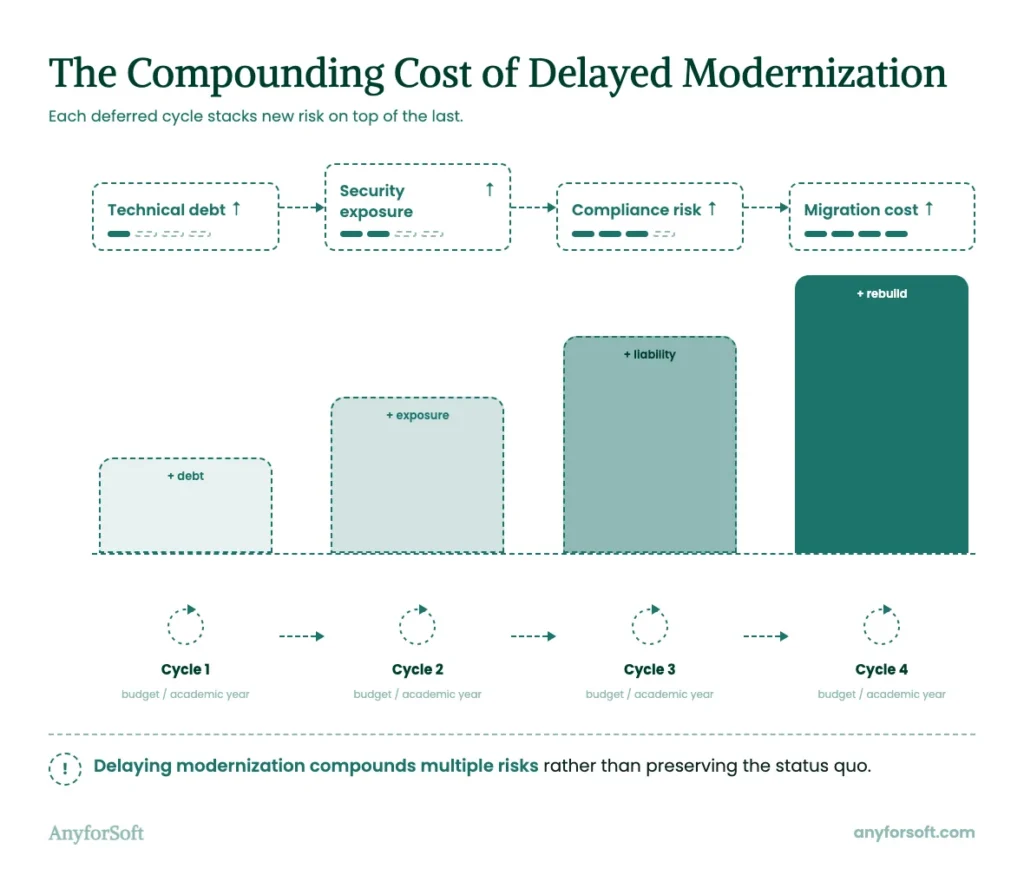
Delayed upgrades do not hold infrastructure in place. With each passing cycle, inherited infrastructure falls further behind the operational demands placed on it. Every year an outdated SIS runs without replacement, the integration debt it carries grows.
An audit cycle without current compliance controls adds regulatory exposure that a future migration will have to absorb. Delayed controls leave institutions exposed to:
- Data breaches
- FERPA violations
- COPPA penalties
- Failed audits
The exposure compounds. The cost of technical debt accumulates differently than in commercial software. Budget cycles are longer, and procurement windows are narrower.
Regulatory findings from missed FERPA disclosures carry consequences no reprioritization resolves. For COPPA violations, institutional consequences arrive long after any sprint cycle can respond. Retroactive compliance fixes are significantly more expensive. Controls built into a replacement from the start cost significantly less.
Cybersecurity hardening added onto aging architecture takes longer and costs more. Embedding it during a planned migration is faster and cheaper.
Security debt and integration debt compound together. IT teams maintaining inherited infrastructure spend capacity on upkeep that should be directed at institutional priorities.
For K-12 districts, universities, and corporate L&D teams alike, the case for modernization in education rests on a straightforward calculation. Staff hours and budget recovered from deferred assets fund the priorities that inherited infrastructure has been blocking.
Technology Modernization Across Education Segments
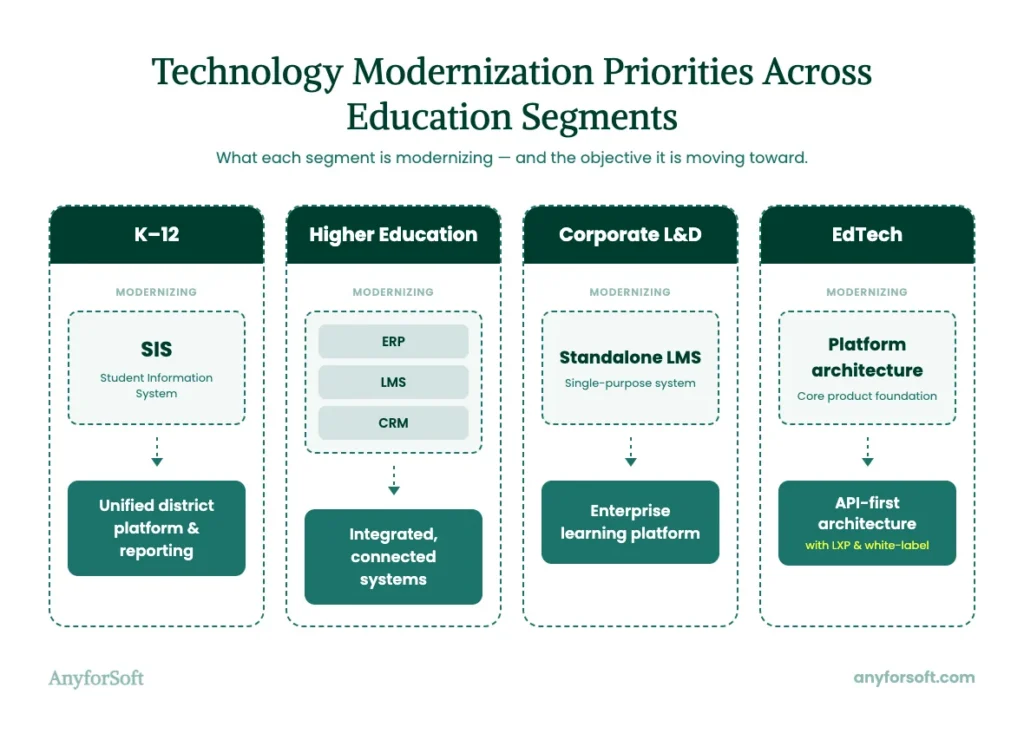
Each segment covered in this article runs on a different stack, answers to different regulatory bodies, and measures success against different outcomes. The starting point for application modernization is what each segment is actually replacing and why.
K-12 Schools and Districts
Student records and state reporting pipelines evolved in isolation.
Most K-12 environments are still running the accumulated result. At the center sits the Student Information System (SIS) for K-12, connecting enrollment, attendance, grades, and regulatory reporting across a district. Stricter FERPA/COPPA requirements and more granular state reporting mandates have added pressure from the regulatory layer.
Done well, upgrade at the K-12 level delivers:
- Unified district platform
- Integrated SIS
- Real-time reporting
- Reduced compliance exposure
Hybrid learning has exposed gaps in classroom technology that remote instruction made impossible to ignore. The goal of district IT modernization is a unified environment where information flows without manual reconciliation.
Higher Education Institutions
Universities and colleges carry some of the most complex inherited architectures in any sector.
Enrollment pressure has made enrollment management a board-level priority. Research compliance requirements have grown more demanding. A generation of students expecting digital-first services has made the gap between institutional infrastructure and user expectations impossible to ignore. Taken together, these pressures call for technology modernization in higher education as a connected upgrade program.
For universities reaching the limits of an inherited ERP platform, cloud modernization for higher education is the most common path forward. A cloud-native ERP connected to a modern Learning Management System (LMS) gives institutional teams a shared foundation. Adding a CRM for higher education extends this foundation into enrollment management.
Corporate Learning & Development (L&D)
Corporate L&D environments were built around a single tool: the standalone corporate LMS.
Remote work and accelerating skills gaps have exposed its limits.
The enterprise learning platform replaces the standalone corporate LMS with a connected environment where onboarding and skills development sit alongside compliance training records.
Applying onboarding automation reduces the manual coordination that HR and L&D teams currently absorb. Connected skills tracking surfaces workforce development gaps before they affect business performance.
At the corporate level, a well-executed upgrade produces measurable returns:
- Reduced onboarding time. Automated workflows replace manual coordination across HR, IT, and L&D teams.
- Skills visibility. Connected tracking surfaces gaps before they affect business performance.
- Compliance coverage. A unified platform maintains training records across distributed teams without manual consolidation.
- Scalability. An enterprise learning environment grows with the workforce without requiring additional administrative overhead.
Mandatory compliance training across distributed teams has made the limits of standalone tools impossible to work around. The case for a connected environment is now an operational one.
EdTech Providers and Online Course Platforms
For EdTech vendors, the platform being upgraded is also the product being sold. A rebuild affects not just internal operations but every client running content on top of it.
The core challenge is keeping existing integrations intact while the underlying architecture shifts. Client expectations have moved past it.
Demand has shifted toward Learning Experience Platform (LXP) requirements and API-first integration expectations. Client contracts increasingly require white-label LMS configuration that SCORM-only platforms were not built to handle. The gap between what most EdTech platforms currently support and what modern delivery requires is the SCORM-to-xAPI transition.
At the EdTech level, application modernization for education typically means shifting to an API-first architecture. Modular content delivery and white-label LMS configuration become possible once the platform is no longer built around a single delivery standard. For implementation support, LMS development and e-learning software development services cover the full delivery scope.
Technology Modernization Best Practices for Education
Across K-12, higher education institutions, corporate L&D, and EdTech, the path to successful modernization follows a recognizable sequence. The steps below apply regardless of segment, though deliverables and timelines differ at each level.
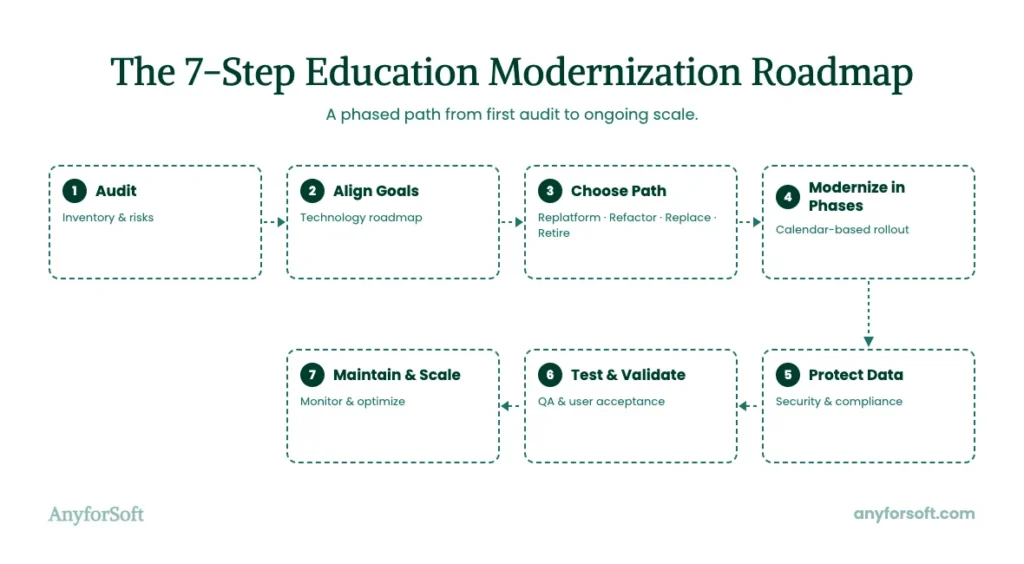
Step 1. Audit Legacy Systems Across the Organization
Sound planning begins with an honest inventory.
Without the full picture, any roadmap built on top will inherit the same blind spots. The audit covers four areas:
- Asset inventory
- Technical debt assessment
- Integration mapping
- Compliance gap review
Each one surfaces a different category of risk before migration begins.
Scope differs by segment. For K-12 districts, the audit centers on the SIS and the tools connecting classroom activity to state reporting. For universities, it covers the full ERP platform and Learning Management System (LMS) stack. Corporate L&D audits focus on the standalone corporate LMS and its connections to HRIS. EdTech vendors audit their platform architecture against current client delivery requirements.
The deliverable is an audit report that makes legacy system modernization visible as a financial argument. Technical debt reduction becomes a concrete number decision-makers can act on. Assets no longer fit for purpose carry recoverable costs — staff hours and licensing overhead that fund the case for moving forward. Together, these figures make the financial argument for modernization.
The same report maps data platform modernization for education scope, identifying assets for migration and those flagged for retirement. Network and security layers underpinning the entire operation are confirmed as part of IT infrastructure modernization scope at this stage.
Step 2. Align Modernization Goals with Institutional or Business Strategy
The audit report is the input. Without a structured alignment process, the resulting priority list reflects whoever spoke loudest.
A structured alignment process runs in three stages:
- Stakeholder mapping. Identifying the owners of each affected component and the outcomes required from the upgrade.
- Goal-setting workshop. Translating institutional KPIs into segment-specific upgrade priorities.
- Governance framework. Giving each stakeholder group a defined role in decision approval and progress review.
Enrollment targets, state reporting requirements, skills gap closure, and client contract obligations each anchor the priorities for their respective segments.
The output is a technology roadmap. It sequences initiatives by dependency and budget cycle. From the roadmap, vendor evaluation becomes a structured process. Each initiative points to a procurement decision, and evaluators have the context to assess fit against institutional requirements.
Step 3. Choose the Right Modernization Path for Each System
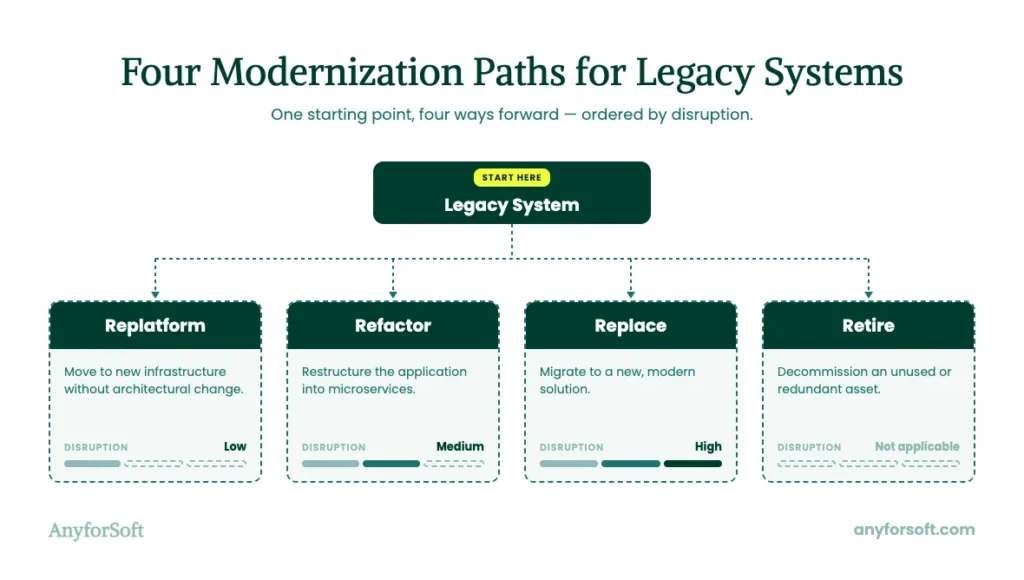
Four paths exist for every asset identified on the audit inventory.
Choosing the wrong one adds cost without solving the underlying problem. The technical criticality and the complexity of its integrations carry the most weight. The available budget determines which path is feasible. Laid out plainly, each path produces a different outcome:
- Replatform. Move the current application to a new hosting environment without changing its architecture. Fastest path, lowest disruption, limited long-term gain.
- Refactor. Restructure the existing codebase into microservices without replacing the entire application. Preserves institutional knowledge while reducing architectural debt.
- Replace. Retire the outdated asset and migrate to a new solution. Highest disruption, highest long-term gain. The right choice when the legacy configuration can no longer be extended.
- Retire. Decommission without replacement. Applies to legacy assets with no active users or redundant functionality covered by another platform.
Across all four segments, phased migration is the default recommendation. A full cutover during an active academic term or training cycle creates disruption that institutional stakeholders will not accept.
Where full cloud migration is not yet feasible, a hybrid cloud model provides an intermediate path. Sensitive data stays on-premise while lower-risk workloads move to cloud infrastructure. When cloud migration is paired with a phased approach, institutions get modern infrastructure benefits without a single high-risk transition event.
Step 4. Modernize in Phases Around the Academic or Training Calendar
Deployment windows chosen to minimize disruption are what make modernization succeed. The right window varies by segment. Summer breaks serve K-12 districts. Universities target semester gaps. EdTech vendors and corporate L&D teams align releases to contract milestones and non-peak training periods.
A well-sequenced phased rollout turns a high-risk cutover into a series of manageable transitions. Each phase has a defined scope, a rollback plan, and a stakeholder sign-off point before the next one opens.
Step 5. Protect Learner and Institutional Data Throughout Migration
Data protection is a design requirement built into every phase from the start.
Data encryption and access controls are established before any migration begins. At each checkpoint, risk assessment validates that learner records and institutional information meet compliance requirements before the next phase opens.
Rollback procedures are defined in advance. Tested before they are needed, they give institutions a recovery path. This path does not depend on decisions made under pressure.
Step 6. Test and Validate Before Full Rollout
Functional testing confirms each component performs as specified. Through integration testing, connections between internal nodes are validated against expected data flows. Stakeholder sign-off at each stage gives institutional leaders a defined point to confirm readiness before the next phase opens.
While technical validation runs, change management planning prepares training and adoption support before users encounter the new environment.
Technical validation alone is insufficient. A rollout skipping adoption preparation will still underperform.
Step 7. Plan for Long-Term Maintenance and Scalability
Post-launch monitoring protocols are defined before go-live. Against institutional uptime and support requirements, vendor SLAs are reviewed at this stage.
System interoperability standards, documented from the start, ensure future integrations do not require architectural rework. Scalability built into the architecture early prevents a second major overhaul. Both decisions are cheaper to make once than to fix later.
The maintenance roadmap is reviewed annually against institutional growth targets. What works at current scale may need adjustment as the organization expands — catching that early is what makes the architecture last.
AI-Powered Technology Modernization for Education
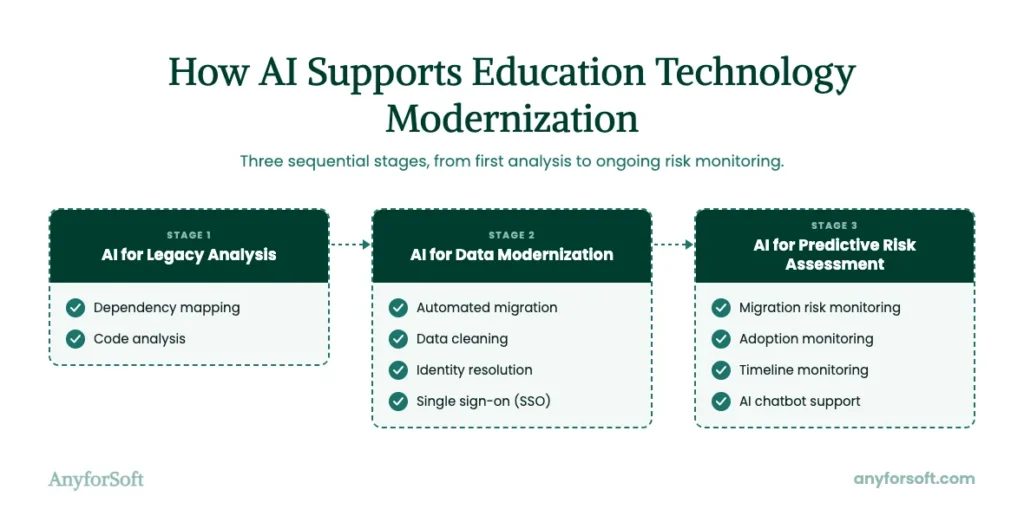
AI is changing three aspects of work: the ones historically consuming the most time and carrying the most risk. For infrastructure analysis, months of manual effort now compress into days. Data migration depending on hand-mapped schemas can be automated at scale. Built into the delivery process, risk monitoring now has a predictive layer that project manager judgment alone could not sustain.
AI for Legacy System Analysis and Data Migration
Before AI tooling, auditing a university ERP stack meant weeks of manual dependency tracing. Which modules connected to which APIs was rarely documented. Where a change in one layer would break something three layers down was rarely known until it happened. Automated analysis tools now produce the dependency map in a fraction of the time, and AI-assisted modernization makes this speed available across every segment.
For technology modernization in higher education, the impact is clearest in ERP and SIS projects. A university replacing a monolithic ERP carries thousands of data relationships that manual schema analysis cannot sustain without errors. AI-assisted codebase analysis surfaces these relationships systematically and flags migration risk before it becomes a project delay. The output is documentation the implementation team can act on immediately. At the execution level, automated data migration pipelines take this capability further. Field-level transformation and validation run across large record sets without manual intervention.
What previously required multiple sprints of dedicated migration work can be compressed into a governed, automated process.
AI-Driven Learner Records and Data Modernization
Learner records are among the most fragmented data sets. At the K-12 level, student records accumulate across SIS platforms and assessment tools that were never designed to share data. In universities and corporate L&D, records sit in separate aging modules with no shared schema.
Across all three contexts, AI tooling now produces the clearest gains at the data integration layer. Cloud modernization for higher education creates the foundation this work requires.
Once records move to a cloud-native environment, AI tools clean inconsistent field values and resolve duplicate identities across applications. With single sign-on (SSO) integration, the cleaned record set connects to the platforms learners and administrators use.
Added to the migrated record set, predictive analytics for education produces a forward-looking layer that static records cannot support.
Unified learner records become the training data for models surfacing at-risk students and forecasting enrollment trends.
Skills gaps are identified before they affect workforce outcomes. The record migration is the prerequisite. The predictive capability is what institutions are increasingly building toward.
Predictive Risk Assessment for Modernization Projects
Large-scale projects fail for a small number of recurring reasons.
Most commonly, dependency risks are underestimated. Data is lost during migration. Adoption falls short of projections. Timelines slip when calendar constraints are not built into the delivery plan.
AI-powered intelligent risk assessment addresses each of these failure modes with a monitoring layer that runs throughout delivery. Dependency risk is tracked against the automated map produced during technical analysis. At each migration checkpoint, automated validation against predefined thresholds monitors data loss risk.
Adoption risk surfaces through usage signals in the new environment. Project teams get early warning before low engagement becomes a rollout failure. When task completion rates diverge from the delivery plan, timeline risk is flagged before the schedule breaks.
During rollout, AI chatbots for education handle the change management layer. At peak, a new solution generates a surge of support queries human teams cannot absorb.
AI-assisted support handles routine queries and escalates edge cases to human agents.
Lower adoption friction at this stage prevents users from reverting to workarounds.The destination architecture in most of these projects is cloud-native infrastructure. The risk tooling that monitors delivery operates in this environment natively, making it a permanent feature of the post-launch architecture.
Team and Process Best Practices
Technical decisions determine what gets built. Whether it works depends on the organizational layer beneath them. The human and structural layer is where well-designed projects most often stall. A rollout can deliver technically and still fail in practice. This layer is where that gap opens.
Align IT, Academic, and Business Stakeholders
When overhaul projects fail organizationally, the cause isn’t technology.
More often, different parts of the organization are optimizing for different outcomes with no shared mechanism for resolving the conflict.
Each function arrives with a different set of priorities:
- Stability and security of digital operations
- Instructional continuity and faculty workflows (Academic)
- Cost control and reporting capability (Business)
Pursued independently, these priorities produce a program with three competing agendas and no shared definition of success. Each set is legitimate. The problem is the absence of a structure for resolving conflicts between them.
A steering committee with representation from all three functions is the structural fix. Meeting on a defined cadence, it reviews progress against shared KPIs. The steering committee holds the authority to resolve conflicts before they become delays.
Shared KPIs are the operational mechanism that makes the committee functional. Without agreed metrics, each function defaults to its own internal measures. The steering committee becomes a reporting session.
Visible in staff and instructor productivity, the outcome of that alignment is a technical environment configured around how people actually work.
Establish Governance Across Departments
Multi-year initiatives without a formal governance structure tend to drift. Scope expands incrementally as vendors gain influence over architectural decisions the institution should retain.
Budget overruns accumulate before any single decision point triggers a review.
Defined before the work begins, the framework establishes decision rights and escalation paths. Decision rights clarify which changes can be approved at the project level and which require institutional sign-off.
Small scope additions accumulate until the whole effort goes off track. Formal review requirements prevent it.
For unresolved conflicts, escalation paths route the issue to the right authority before it affects the delivery timeline. In long-running projects, cost reduction follows from governance discipline. Uncontrolled scope expansion is where costs accumulate first. Vendor dependency adds a second accumulation layer that is harder to reverse.
Plan for Staff and Instructor Training Early
Under-investment in training is one of the most consistent failure patterns in technology rollouts of this kind.
The rollout occurs without user preparation.
The workarounds that the modernized architecture was meant to eliminate are often rebuilt in the gaps.
Training anchors differ by segment:
- K-12 teachers. Classroom workflows drive every training decision. A teacher who cannot move fluently through attendance, grading, and lesson delivery within the updated environment will revert to workarounds within weeks of launch.
- University faculty. Research continuity is the first priority. Course delivery proficiency follows, with LMS navigation as the baseline skill the training must establish before go-live.
- Corporate L&D managers. Reporting and compliance functions are where training investment produces the fastest return for this group.
A training session scheduled for the week before go-live is insufficient. Embedding training planning in the roadmap from the start means content is developed in tandem with the solution itself.
The platform stack should include employee training software, configured and ready before the new configuration goes live.
For EdTech vendors and institutions with significant instructor-facing tooling, course authoring tools are included in the training scope. Faculty need to be proficient in content-building tools before the new environment goes live.
Whether adoption holds after launch depends on how well segment differences are built into the training design from the start.
Technology Modernization in Practice: Anyforsoft Case Studies
Anyforsoft’s education software development services span the full scope, from platform stabilization to building a custom solution.
Higher Education: Imperial College Business School
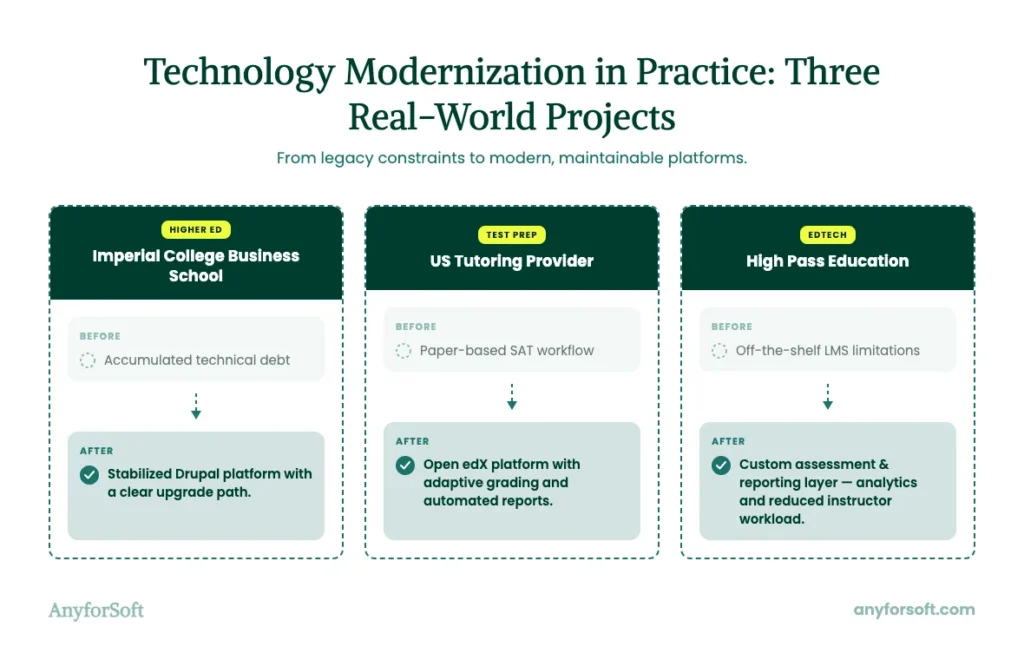
The website serving Imperial College Business School had accumulated technical debt across several years of incremental changes. Backend inconsistencies and deferred maintenance had begun affecting platform reliability. The harder challenge was upgrading the solution as a whole. It meant doing that without disrupting the workflows of students, faculty, and staff who depended on it daily.
Anyforsoft stabilized the platform by resolving backend issues and restructuring navigation using supported Drupal modules. Security patch coverage improved. A full assessment of the work required to reach Drupal 10 gave the institution a clear, low-risk path forward. For a platform serving as the primary digital presence of a leading business school, this outcome carries institutional weight. It is what technology modernization in higher education delivers at the infrastructure layer.
EdTech: Digital Testing Platform for a US Tutoring Provider
A private US tutoring company had been running its entire SAT preparation operation on paper. Printed materials and manual grading consumed significant staff time. Labor-intensive reporting added to the overhead. A preparation gap remained. Students were training in a paper environment for an exam they would take digitally.
Open edX formed the core. On top of the Open edX core, Python and React handled the custom layers the standard platform could not support.
Adaptive difficulty adjusted question complexity based on prior responses. A custom grading scheme produced score ranges mirroring the actual SAT scoring logic. After each attempt, automated PDF reports gave students detailed performance data.
Previously manual tasks were automated, freeing staff time.
The tutoring workflow moved from paper to a digital environment built for the exam format students would actually encounter.
Corporate L&D: High Pass Education
High Pass Education is a professional training provider operating in a high-stakes certification market. Its programs had strong content and a realistic testing approach.
The off-the-shelf Learning Management System (LMS) it ran on had reached its ceiling. Configurable test formats and multi-attempt reporting were beyond what the standard software configuration could handle. Personalized guidance between attempts was not possible at all.
A custom assessment and reporting layer, built on e-learning software development services, extended the existing platform without replacing it. The core LMS stayed in place. On top of it, configurable test mechanics allowed per-learner settings across time limits and passing thresholds. Speedrun formats trained accuracy under time pressure, mirroring real certification exam conditions.
Comparative analytics across multiple attempts surfaced performance trends and recurring mistake patterns. For learners, the key gain was visibility into whether missed results reflected knowledge gaps or exam-taking behavior. This distinction is what isolated test scores cannot provide. With the reporting layer replacing manual data review, instructor consultation time dropped.
High Pass Education reported its strongest Q1 performance in the company’s history following the launch. Without adding instructional staff, the business was able to support growth. The CEO noted that exam candidates specifically credited the platform’s guidance as a competitive advantage in their certification results.
Why Education Organizations Choose Anyforsoft for Technology Modernization
The Anyforsoft projects above share a delivery approach built around continuity. Measurable outcomes arrived without disrupting the institutions depending on the legacy architecture being changed.
Track Record and Segment Depth
Founded in 2011, Anyforsoft has delivered more than 150 custom builds across industries. Education and e-learning run deep in the portfolio, from K-12 and universities to corporate L&D and EdTech. Functioning tools are preserved first. Building on them takes priority over replacing them.
This discipline requires a specific kind of knowledge. It comes from seeing the same failure modes appear across K-12 districts, universities, corporate L&D teams, and EdTech vendors. Knowing which parts of an inherited configuration are worth keeping before any upgrade begins is what the exposure produces.
Anyforsoft’s legacy modernization services are built on this accumulated exposure.
The delivery approach follows from the inherited environment’s actual condition — its strengths, its debt, and its integration dependencies.
Engineering and Delivery Approach
AI handles the analysis and migration work where manual methods introduce errors derailing timelines. Automated dependency mapping and schema extraction run faster and with fewer errors than manual methods.
During rollout, custom AI agents for education handle adoption support, reducing the friction that causes users to revert to workarounds. Scoping is done by engineers who have rebuilt complex architectures before, which is why estimates hold.
Delivery is organized around institutional calendars as the primary constraint.
K-12 districts have summer windows. Universities work around semester gaps. Corporate L&D teams avoid peak training periods.
Building these constraints into the delivery plan from the start determines whether the rollout creates disruption or prevents it.
Engagement Model
A single coordinated team carries the platform work and data layer across the full upgrade cycle.
For K-12 districts, universities, corporate L&D teams, and EdTech vendors, this continuity matters. At the start of the engagement and at go-live, it is the same team. Without it, knowledge transfer gaps open every time a team rotates between phases.
Platform scope and ongoing improvements stay with one team.
Handoff points stop being stall points. Decisions stay clear.
Early in the upgrade cycle, complexity is manageable. It peaks mid-program, when inherited dependencies surface and integration decisions compound. Team stability matters most when complexity peaks. A rotating or fragmented engagement model breaks down at precisely this point.
FAQs
What is technology modernization in education?
Technology modernization in education upgrades outdated institutional frameworks with infrastructure built for current operational demands. At its core, legacy system modernization addresses the accumulated technical debt carried by technologies created for a different era. The goal is a deliberate upgrade of components that can no longer be extended, while preserving those continuing to function.
How does technology modernization differ across K-12, higher education, and corporate L&D?
The starting point differs by segment. K-12 districts typically modernize around the SIS and compliance infrastructure first, driven by FERPA and state reporting mandates. Higher education institutions carry more complex inherited stacks. Universities carry an additional layer of complexity through enterprise research administration (ERA) requirements. Corporate L&D environments focus on replacing standalone training systems with connected platforms covering onboarding and compliance training in one environment.
Why can't schools, universities, and training providers afford to delay modernization?
Every cycle without action adds to the technical debt the institution will eventually have to absorb.
Compliance exposure grows as regulatory requirements tighten around data security and learner privacy. Maintaining inherited codebase compounds in cost. Staff time and licensing overhead accumulate faster than institutions typically account for.
What are the biggest risks of outdated systems in education and corporate training?
Data security is the most immediate exposure. Inherited tools running without current security patch coverage create vulnerabilities compliance audits will surface before IT teams do. Cybersecurity hardening added onto aging architecture costs significantly more than controls embedded into a planned replacement from the start. Beyond security, the productivity loss is measurable. IT teams maintaining inherited infrastructure spend capacity on upkeep at the expense of institutional priorities.
How long does a technology modernization project typically take for an education organization?
Scope determines timeline more than segment does. A targeted platform stabilization covering technical debt resolution and security improvements can be completed within a few months. A full ERP replacement for a university typically runs across multiple academic cycles. Integration complexity surfaced during the audit phase is a more reliable timeline indicator than institutional size.
What systems are most commonly modernized first — SIS, LMS, or ERP?
The answer follows segment logic. For K-12 districts, the Student Information System (SIS) comes first. It connects enrollment data to compliance reporting across the district. For colleges and universities, the ERP typically comes first. It underpins financial and academic functions simultaneously. Corporate L&D environments start with the learning platform, replacing standalone tools with connected environments.
How can institutions modernize without disrupting the academic year or training calendar?
Phased delivery built around institutional calendar windows is the standard approach. K-12 districts deploy during summer breaks. Universities target semester gaps, and corporate L&D teams align to non-peak training periods. Each phase carries a defined scope and a rollback plan. Stakeholder sign-off is required before the next phase opens, giving the institution control at every transition.
What is the difference between digital transformation and technology modernization in education?
Technology modernization targets the underlying infrastructure institutions rely on.
Digital transformation is a broader organizational shift covering strategy and culture alongside solutions. Modernization is a prerequisite for transformation. The two are related but distinct. A fully modernized platform leaves strategy and culture untouched. Transformation addresses both.
How can AI support technology modernization across education segments?
AI-assisted modernization reduces both error rate and timeline on analysis and migration work that manual methods handle slowly. Dependency mapping and schema extraction run faster when automated, compressing the timeline between audit and execution. During rollout, AI-powered adoption support reduces the friction causing users to revert to workarounds. The human layer requires the same adoption support alongside technical delivery.
What AI tools help schools, universities, and training providers modernize legacy systems?
AI code analysis tools automate dependency mapping and flag migration risk before it affects timelines. Automated data migration pipelines handle field-level transformation and validation across large record sets without manual schema work. Migrated learner records are enriched by predictive analytics for education platforms, with models surfacing at-risk students and forecasting enrollment trends. AI-powered risk dashboards monitor delivery against predefined thresholds, giving project teams early warning before timeline or adoption risk compounds.