







A course file that plays perfectly on one platform can fail on another. The difference often comes down to a single technical standard: SCORM. The specification defines how learning content packages communicate with the system delivering them. It covers launch behavior and how progress gets recorded.
For teams weighing their options in 2026, the distinction carries consequences. Vendors often claim conformance without proof, and gaps can surface only during an audit or migration.
What Is a SCORM Compliant LMS?
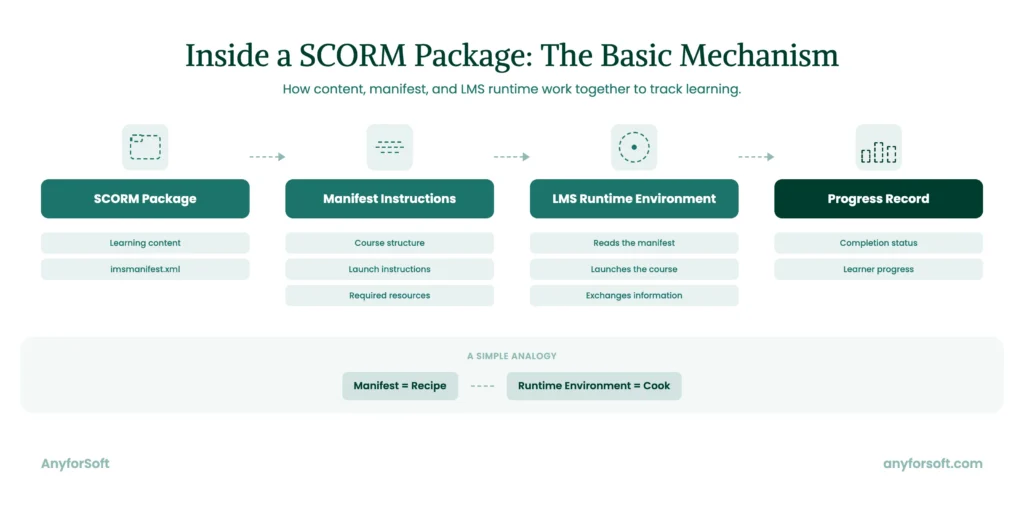
In practical terms, a compliant learning management system reads a manifest file and records progress the way the package instructs. The file is technically a SCORM package, a zipped bundle holding the content and a manifest.
The term means the system reads the instructions correctly and keeps an accurate record of progress.
Think of the manifest as a recipe and the runtime environment as the cook. The recipe lists what needs to happen, and the cook follows it step by step, producing the same result every time.
Anyforsoft has built and integrated platforms for learning for over 15 years, including corporate and educational deployments.
The article draws on Anyforsoft’s experience directly. The work includes extending a healthcare training provider’s assessment capabilities. It also includes building custom tracking logic for an EdTech tutoring service.
Why Does SCORM Compliance Matter for Your Organization in 2026?
Vendor claims rarely hold up under real use. Once a claim is inherited, testing it firsthand becomes the CTO’s job. A vendor’s claim ultimately comes down to whether the platform is standards-aligned, tested against real behavior. Underneath the claim lies interoperability, which determines whether training material moves cleanly between systems.
Whether a course launches correctly elsewhere depends on content portability. Without portable training material, a team faces vendor lock-in, forced to rebuild its entire library just to switch providers.
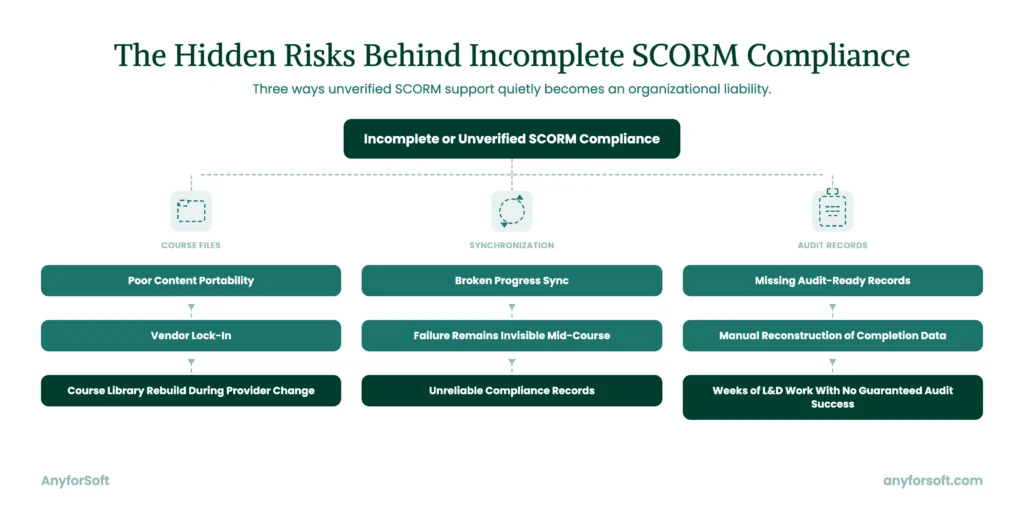
An L&D lead who has faced a broken sync recognizes the risk instantly: compliance training tracking can fail silently, without warning. Mid-course, progress data can stop syncing, and nothing in the interface signals the failure.
Without audit-ready training records, a routine audit can turn into weeks of manually reconstructing completion data. Manual reconstruction pulls L&D staff away from training design, and the audit still might not pass.
SCORM vs AICC vs xAPI vs cmi5: What’s the Difference?
Several standards govern how learning content communicates with the systems delivering it, and they get confused often.
1EdTech, formerly IMS Global, now maintains many of today’s interoperability specifications. SCORM itself originated with the Advanced Distributed Learning initiative. The program, run by the U.S. Department of Defense, was built to standardize military and corporate training content.
Passing SCORM certification confirms a platform meets one version’s exact technical requirements, which is a narrower claim than general standards-aligned marketing language.
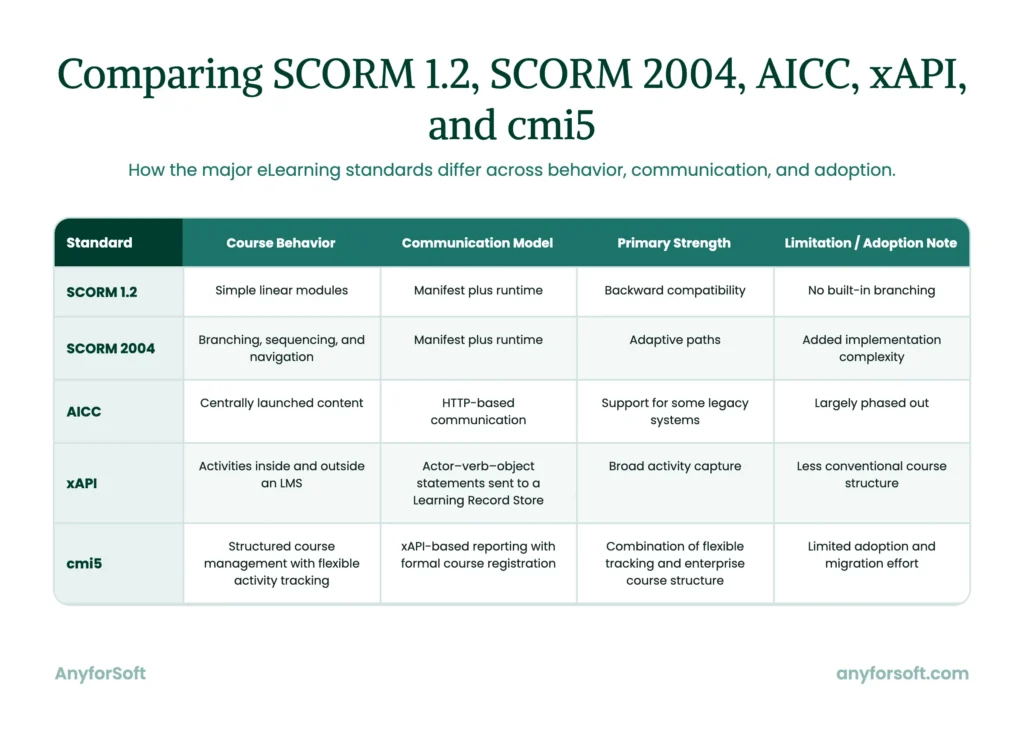
SCORM 1.2 — The Legacy Standard
Released in 2001, this version introduced the manifest-and-runtime model still in use today.
It handles simple, linear courses well, launching one module after another without built-in branching logic.
Its simplicity is also why it remains the most widely deployed version among older corporate training libraries. Many solutions still support it purely for backward compatibility with content built decades ago.
SCORM 2004 — Sequencing and Navigation
This update lets content control its own branching logic instead of playing in a fixed order. A course can adjust the learning path based on quiz scores and completion status, or on specific learner choices.
The added flexibility came with complexity as well, and two tools claiming support don’t always behave identically.
It remains the most widely implemented version among enterprise solutions today.
AICC — The Predecessor Standard
Predating SCORM, this earlier standard used HTTP-based communication instead of the JavaScript API that later became common.
Training departments in the early 1990s needed a way to launch content from a central location. They avoided embedding a full browser-based runtime.
Most modern platforms have phased it out in favor of newer formats. A few legacy government and aviation training systems still rely on it.
xAPI (Tin Can API) — Beyond the LMS
This newer specification tracks activity beyond a single tool. It captures actions from simulations, mobile apps, wearable devices, and real-world tasks performed away from a screen.
Each recorded action follows a simple structure: an actor performs a verb on an object, which a Learning Record Store then collects.
This actor-verb-object structure lets organizations track training that never touches a training tool at all, such as a technician completing a task in the field. SCORM vs xAPI compares the two approaches for teams evaluating which tracking model fits their content.
cmi5 — The Modern SCORM Alternative
Built on the same activity-tracking foundation described above, this newer alternative adds structured course management within a single training tool.
Launch and registration follow the process earlier standards required. Learner activity still reports using the newer tracking model. It aims to combine flexible tracking with the structure many enterprise platforms still expect.
Adoption remains limited compared to older standards, largely because migrating existing course libraries takes deliberate planning.
What Makes an LMS Truly SCORM Compliant in 2026?
A vendor’s compliance claim means little without proof behind it.
A genuine compliant learning management system meets seven specific technical requirements, each verifiable through direct testing rather than a spec sheet. Getting them right also has a business case attached: reduced re-authoring costs, since training materials built once continue to work as the tool evolves.
A true SCORM compliant learning management system satisfies every item below, not most of them.
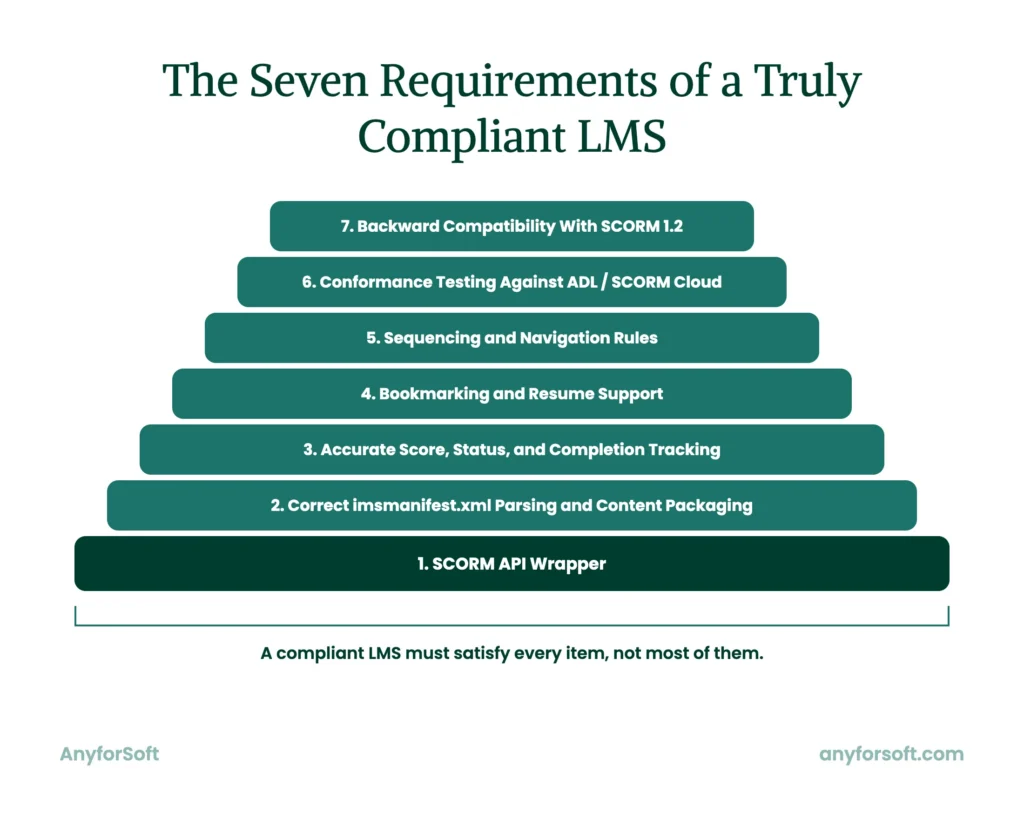
Support for the SCORM API Wrapper (JavaScript runtime)
Every course built to the specification expects a small piece of code to exist in the browser before it launches.
The wrapper handles communication between the training material and the solution playing it. It passes data like completion status back and forth in real time.
Without it correctly implemented, a course can fail to launch at all, or launch without ever reporting progress.
This is one of the clearest signs of an LMS that is SCORM compliant: the wrapper works invisibly, and nothing calls attention to it.
Correct imsmanifest.xml Parsing and Content Packaging
A course built to the specification arrives as a zip file with a specific internal structure. The system must read the structure correctly on upload.
Misreading the internal structure causes broken navigation or missing assets. Import can also succeed while launch still fails.
Popular course authoring tools export this structure automatically, including Articulate Storyline, Adobe Captivate, and Rise 360.
Each tool packages files a little differently, and a truly compliant solution needs to parse all of their outputs correctly, not just one.
Accurate Score, Status, and Completion Tracking
A compliant system logs three data points reliably: the learner’s score, their completion status, and how far through the course they got.
Completion and score tracking has to work the same way every time. The consistency holds whether ten learners are involved or ten thousand.
A tool that logs this data inconsistently produces reports nobody can trust.
Bookmarking and Resume Support
Learners rarely finish a course in one sitting, and a compliant solution has to remember exactly where they stopped. It means saving position within a video, progress through a set of slides, or answers already given on a quiz.
Losing the data forces learners to restart, which quietly damages completion rates across an entire learning library.
Sequencing and Navigation Rule Support (SCORM 2004)
Some courses need to enforce an order: a quiz that only unlocks after a module finishes, or content that adapts based on an earlier answer.
Supporting this logic correctly means a system can’t simply play files in sequence: it has to evaluate rules and change the learner’s path in response.
Software that only handles simple, linear courses often claim broader support than they actually deliver.
Conformance Testing Against ADL / SCORM Cloud
A written specification only proves what a system is supposed to do, not what it actually does under real conditions. Running a course through independent testing tools verifies the claim directly, checking manifest parsing, data reporting, and sequencing behavior against the official reference implementation.
This is where a compliance claim either holds up or doesn’t.
Skipping this step is how gaps stay invisible until a real audit finds them, and SCORM cloud testing is the most common way engineering teams close the gap before launch.
Backward Compatibility with SCORM 1.2 Content
Plenty of organizations still run training material built on the older specification years ago, and a modern system has to keep supporting it. It means correctly reading older manifest structures and tracking data the same way newer courses expect.
Losing this compatibility forces a costly rebuild of an entire legacy course library just to keep it running.
scorm certification built for 2026 needs to run both the old and the new without forcing that choice.
How Is AI Used in SCORM-Compliant LMS Platforms in 2026?
AI now touches training at several points across its lifecycle.
Before a course launches, automated tools check package structure for errors. Once training runs, other tools analyze the data a solution already collects, surfacing patterns a manual review would take hours to spot.
AI also reviews course quality before deployment, catching problems before learners ever see them.
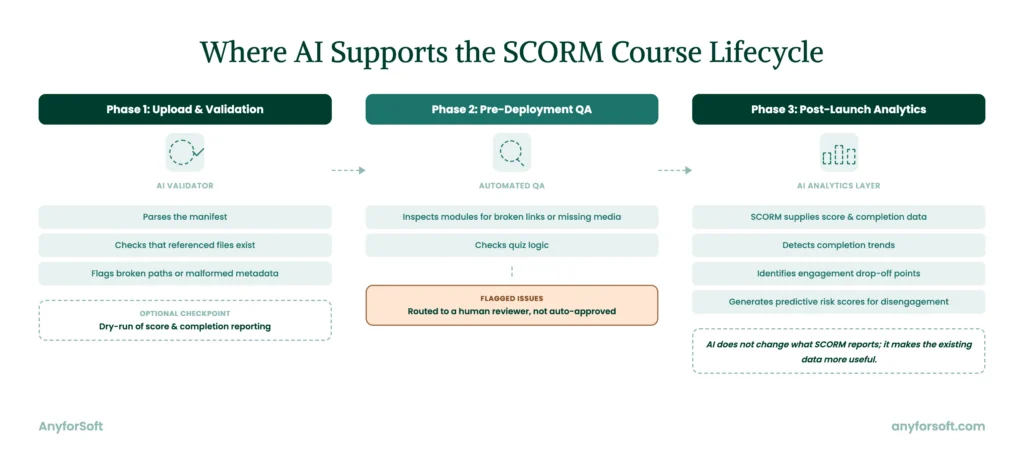
AI-Assisted SCORM Package Validation
An AI-based validator checks a package’s internal structure the moment it’s uploaded, without waiting for a human reviewer to open it. It parses the manifest and confirms every referenced file actually exists inside it, flagging broken paths or malformed metadata immediately.
Some tools go further, testing whether score and completion data report correctly during a dry run before the course goes live. This catches errors an engineering team would otherwise find only after learners start reporting broken courses.
AI-Driven Learning Analytics on Top of SCORM Data
Once a course reports its usual score and completion data, AI layers pattern detection on top of it.
Analytics tools surface completion trends across large groups of learners. The data shows where engagement consistently drops.
The same tools flag engagement patterns within individual courses. Separately, they generate predictive risk scores, identifying learners likely to drop off before they do.
None of this changes what SCORM reports. It simply makes the existing data more useful.
Automating Content QA Before Deployment
Manual QA on a large course library takes real time.
By hand, someone has to click through every module, checking links and media, then testing quiz logic separately. AI-assisted tools now automate much of this manual work. They flag broken links or missing media before a human reviewer ever takes a look.
Projects then move from build to launch sooner, producing faster course deployment without cutting the review step entirely.
Teams still verify flagged issues manually; AI just narrows what needs a human look.
How Do You Choose and Implement a SCORM Compliant LMS?
Choosing carefully involves two things before rollout even starts. The two priorities are testing vendor claims and planning for material that can move between systems.
Getting L&D and IT teams aligned rounds out the process. SCORM compliance holds up only when someone verifies it directly, through hands-on testing. This section works through each step as independent LMS consulting, grounded in direct engineering evaluation.
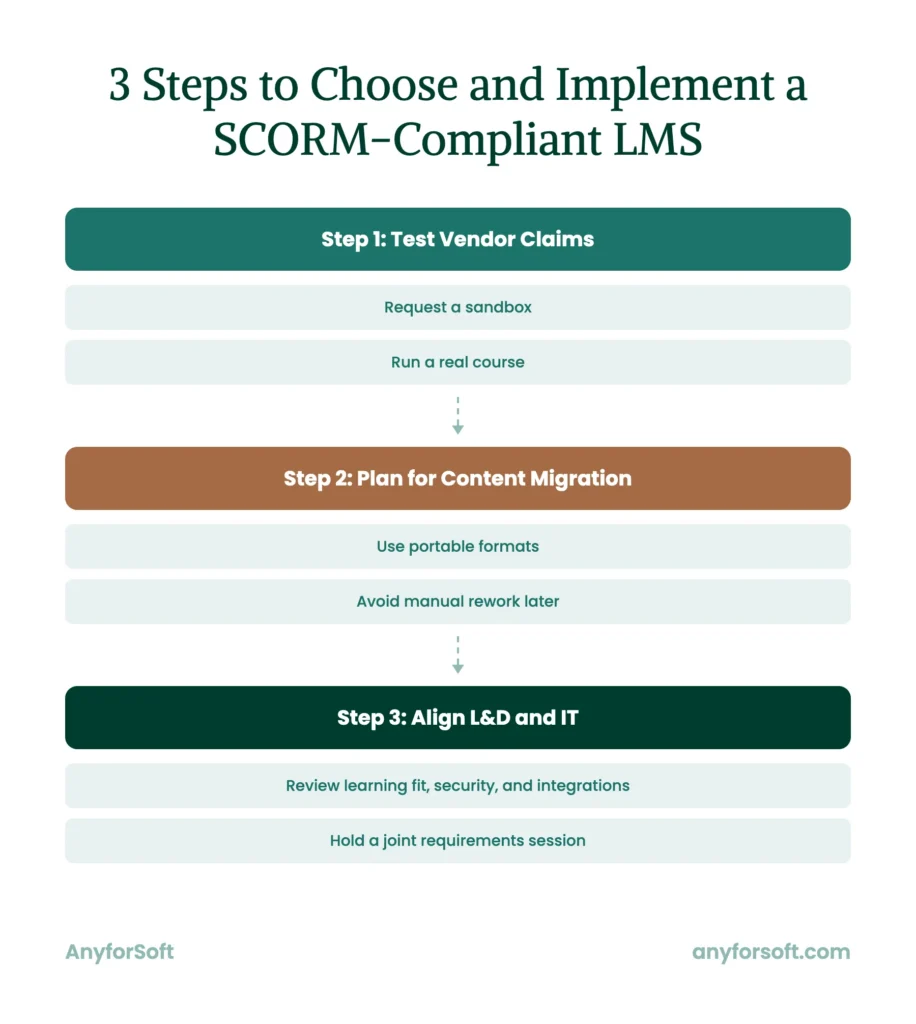
Evaluate Vendor Claims Against Real Conformance Tests
A vendor’s documentation describes intended behavior. Actual behavior sometimes differs once a team begins building on top of it.
Anyforsoft has encountered cases where a solution’s documented capabilities didn’t match a project’s actual requirements once implementation began.
Independent testing closes the gap early, before a mismatch becomes a costly rebuild. Requesting a sandbox environment and running a real course through it gives a team direct proof before signing a contract.
Plan for Content Migration from Day One
Planning for LMS migration from the earliest stage keeps a team’s options open later. Building on vendor-agnostic content avoids tying an entire library to one proprietary format.
Teams that skip this step often discover the cost later. Switching providers can mean thousands of files need manual rework.
Starting with portable formats keeps this eventual switch straightforward, even years later.
Why Do Engineering Teams Choose Anyforsoft for SCORM-Compliant LMS Development?
Anyforsoft has spent over 15 years building and integrating instructional solutions across corporate and educational settings. Custom development is one of the company’s core strengths, with systems engineered around each client’s specific requirements from the ground up.
Full-Cycle LMS Development and Integration
Anyforsoft builds and integrates learning environments across several established platforms. The list includes Moodle and Canvas, alongside Open edX. Each one has its own architecture, and integration work looks different depending on which one a client already runs. Custom LMS development covers projects built from scratch.
One Anyforsoft portfolio project illustrates full-cycle work directly.
Exam prep certification programs depend heavily on personalized feedback between attempts.
High Pass Education’s existing learning management system handled course delivery well. It had no way to compare a learner’s results across multiple test attempts or personalize guidance between them.
Bringing in a replacement risked disrupting instructional workflows already in place.
Anyforsoft’s engineers layered custom assessment and reporting logic on top of the solution already running. Day-to-day instruction delivery stayed untouched.
Learners gained attempt-by-attempt comparisons across multiple tests. Administrators gained one consolidated report replacing several scattered ones. This produced reduced content re-development, since the team kept its established course material intact.
Business results followed. The client’s own account credits the change with its best first-quarter performance on record, achieved while growing enrollment without adding instructional staff.
Proven eLearning Platform Track Record
Anyforsoft’s engineering work covers scalable corporate training builds and consumer-facing exam preparation tools alike. The range shows up in e-learning platform development, where project requirements rarely match the environment originally scoped for them.
A tutoring company preparing students for the SAT wanted to retire a manual, paper-based prep process.
The goal was a digital system built to feel like the exam’s own official app, tightly connected to the client’s Salesforce environment.
Anyforsoft scoped Open edX as the foundation going in, expecting its existing features to cover most of the requirements. Early discovery work showed a gap.
Open edX’s built-in capabilities didn’t reach far enough for this client’s grading logic or its adaptive test structure.
Engineers built substantially custom code on top of it, with Python handling the backend and React handling the interface.
The resulting solution functions as a purpose-built custom LMS. It runs its own grading formula and adjusts difficulty to each learner’s performance, with a live connection feeding data back to Salesforce.
AI-First Engineering Approach
Engineering teams at Anyforsoft build automated validation and analytics directly into projects from the start. The same reasoning behind automated package checks and completion-pattern analysis shapes how new deployments take shape from day one.
Flexible Engagement Models
Anyforsoft works across three engagement types, matched to what a team already has in place. Some teams need a full build from the ground up. Others need LMS integration services layered onto a system already running, or advisory consulting before committing to either path.
Align L&D and IT Stakeholders Before Rollout
L&D teams evaluate a course’s pedagogical fit, while IT evaluates security and integration requirements. Bringing both groups into the same evaluation early avoids a system that satisfies one side’s checklist and fails the other’s.
Once IT confirms integration requirements, L&D can weigh in on how those constraints affect the learning experience learners will actually see.
Scheduling a joint requirements session before any vendor demo keeps both perspectives in the room from day one.
FAQs
What is a SCORM compliant LMS?
Correct manifest parsing and accurate progress recording together define compliance with the specification. Course material launches properly, and completion data reports back accurately.
What's the difference between SCORM 1.2 and SCORM 2004?
SCORM 1.2 supports simple, linear courses without built-in branching logic. SCORM 2004 adds sequencing and navigation rules. Content can adjust the learner’s path based on quiz scores or specific choices.
Are all LMS platforms SCORM compliant by default?
Compliance varies significantly between off-the-shelf tools. Each platform’s runtime environment handles manifest parsing and progress reporting differently. The difference matters. It separates a true SCORM compliant learning management system from one that only partially supports the specification. Vendor differences are easy to see among named solutions such as TalentLMS, Docebo, Absorb LMS, and Cornerstone. Each varies in how completely it supports the specification.
How do you test whether an LMS is truly SCORM compliant?
Testing starts by running a course through an independent conformance tool, such as ADL’s SCORM Cloud. The tool checks manifest parsing and progress reporting, along with sequencing behavior, against the official reference implementation. Passing this process is what SCORM certification actually verifies.
What is the difference between SCORM, AICC, and xAPI?
SCORM and AICC both rely on a host launching learning material directly through a manifest or course structure file. xAPI removes the requirement to launch through a single host at all.
It tracks learning activity anywhere a compatible tool sends data.
Can SCORM content be moved between different LMS platforms?
Moving a course file between learning environments generally works. The standard defines a common structure every compliant system should read. Actual results still depend on how completely each host implements the specification. A course built for SCORM 2004 sequencing may not behave identically in an environment that only supports SCORM 1.2.
What is cmi5 and how does it compare to SCORM?
A newer specification called cmi5 combines structured course management with the activity-tracking approach introduced by xAPI. Unlike SCORM, it does not rely on a manifest file to launch material. It still requires formal registration within a system before activity gets reported.
What happens if an LMS only partially supports SCORM?
Partial support usually shows up in specific failures. Bookmarking might not save correctly, or sequencing rules might get ignored entirely. Progress data can also report inconsistently between different course types. These gaps often stay invisible until a real audit or a migration exposes them.
How does AI help validate SCORM packages before deployment?
AI-based tools check a course file’s structure automatically the moment it uploads, without waiting for manual review. They confirm referenced files exist and flag broken paths or malformed metadata immediately. Some tools also run a dry test of score and completion reporting before the course goes live.
Can AI improve learning analytics on top of SCORM tracking data?
Yes. Once a course reports its usual score and completion data, AI layers pattern detection on top of it. Analytics tools can surface trends across large groups of learners. They can also flag individual learners likely to disengage before they do.