









Hiring the wrong Drupal developer costs more than salary. It derails timelines, creates technical debt, and forces your team to clean up messy code. Finding the right talent means asking questions that reveal practical problem-solving ability.
This guide helps you evaluate Drupal developers through:
- Testing expertise in Drupal fundamentals, module development, theming, and security.
- Assessing Drupal 11 readiness with questions covering Single Directory Components, Recipes, modern workflows, and configuration management.
- Differentiating skill levels with separate question sets for beginner and advanced developers.
- Assessing real-world skills through scenario-based questions and practical coding assignments.
AnyforSoft has delivered 150+ projects, with a significant portion built on Drupal across industries ranging from higher education to FinTech. Our experience hiring and working with Drupal developers informs every question in this guide:
- FinTech (Verifone) – Enterprise rebranding with multi-language architecture and coordination across 30+ stakeholders.
- Higher Education (Delaware County Community College) – Secured three college websites through comprehensive security audits and encryption.
- Digital Media (BizClik) – Built high-performance Drupal 9 site achieving perfect Lighthouse scores.
Whether you’re hiring your first Drupal developer or building an entire team, the questions ahead will help you identify candidates who can actually deliver.
What You Should Pay Attention To While Choosing A Developer
The main challenge lies in distinguishing the right talent for your project or team. Consider several options and core characteristics, including hard and soft skills and experience in a particular niche or industry.
Once you’ve decided on your scope and put it down in words for a job description, you can start looking for candidates. If you are looking for general specialists, starting with Drupal site builders might be a good idea. The skills of a site builder should, of course, include knowledge of PHP codes and JavaScript, frameworks, and basic project management. Business analysis and customer-related skills can be an advantage.
On the other hand, back-end developers should be skilled in coding and have knowledge of architecture, design, and development. They are generally capable of modifying or improving existing modules. And it’s definitely typical for a good developer to know HTML, CSS, Object-oriented PHP, and JavaScript. Also, before hiring a Drupal developer, you should ensure they have an existing history of contributing to the code.
Build your dream team — hire experienced Drupal developers ⇨
The other Drupal-oriented specialists’ skills depend on their position and the aims of your project. Front-end developers should be mainly concentrated on the appearance of your platform, they might not be as proficient in coding as back-end devs, but they should know basic PHP, CSS, HTML, JS, and basic Drupal architecture. They also should take reasonable care to test across operating systems and devices.
You might ask, “What about the education of a candidate?” While a computer science or engineering background can be a great advantage, it’s not an obligatory condition nowadays. Many developers have learned most of the necessary skills by reading and practicing. At times, this kind of education might be more extensive than the university one, as the specialists can pick up on the newest technologies and any technological changes.
General Topics To Discuss With Candidates
When choosing a potential team member, it is necessary to assess his skills and knowledge comprehensively. Soft skills can often be seen during the interview process, and it is only sometimes worth focusing on. However, when it comes to experience, skills, and ability to apply them, you should be more attentive and precise in questioning.
It would be easier to divide the interview into several blocks and learn more about your candidate and their depth of knowledge of the technology, industry, and specific niche.
Block 1: Drupal CMS, Installation and Module Development
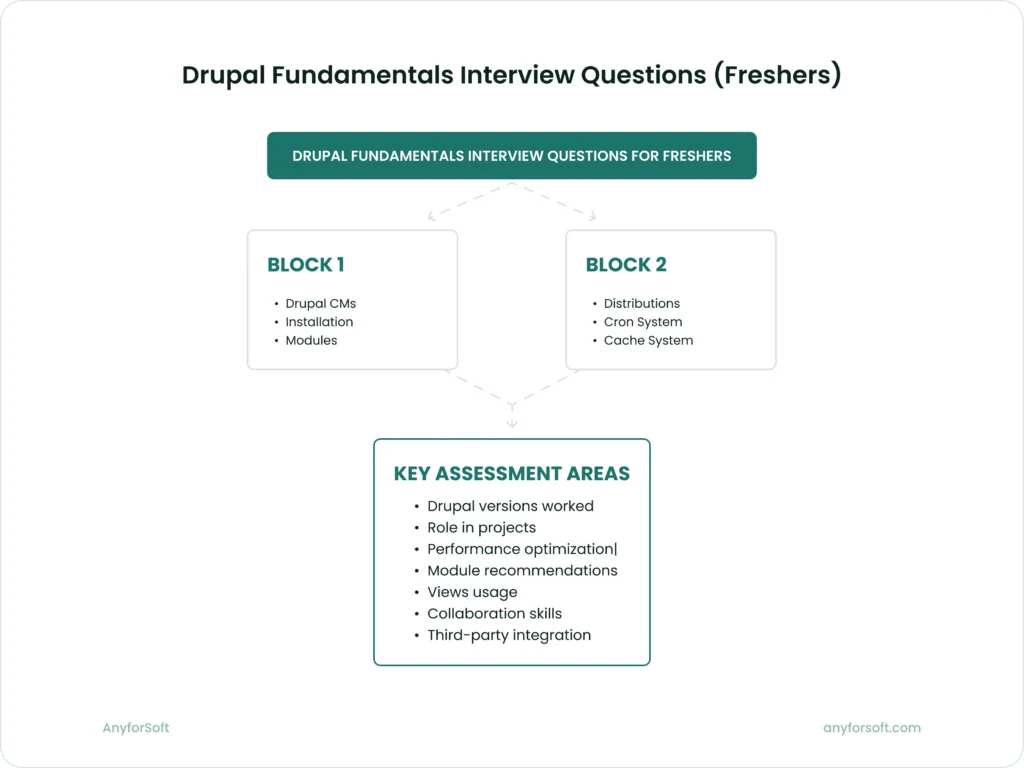
First, gauging a candidate’s understanding of the Drupal installation process is essential. Ask about their familiarity with the necessary prerequisites and recommended configurations for a successful installation. Additionally, delve into their knowledge of Drupal as a content management system, highlighting its key features and advantages. Explore their experience developing custom Drupal modules, their understanding of contributed modules, and how they extend Drupal’s functionality using PHP.
Block 2: Drupal Distributions, Cron, and Cache
Moving forward, evaluate a candidate’s expertise in working with Drupal distributions. Inquire about their understanding of the differences between a standard installation and distributions and if they have hands-on experience with specific distributions. Assess their knowledge of Drupal’s cron system, including configuring and managing tasks efficiently. Furthermore, explore their understanding of the Drupal caching system, including best practices for configuration and management to optimize performance.
Block 3: SEO, User Permissions, and Security
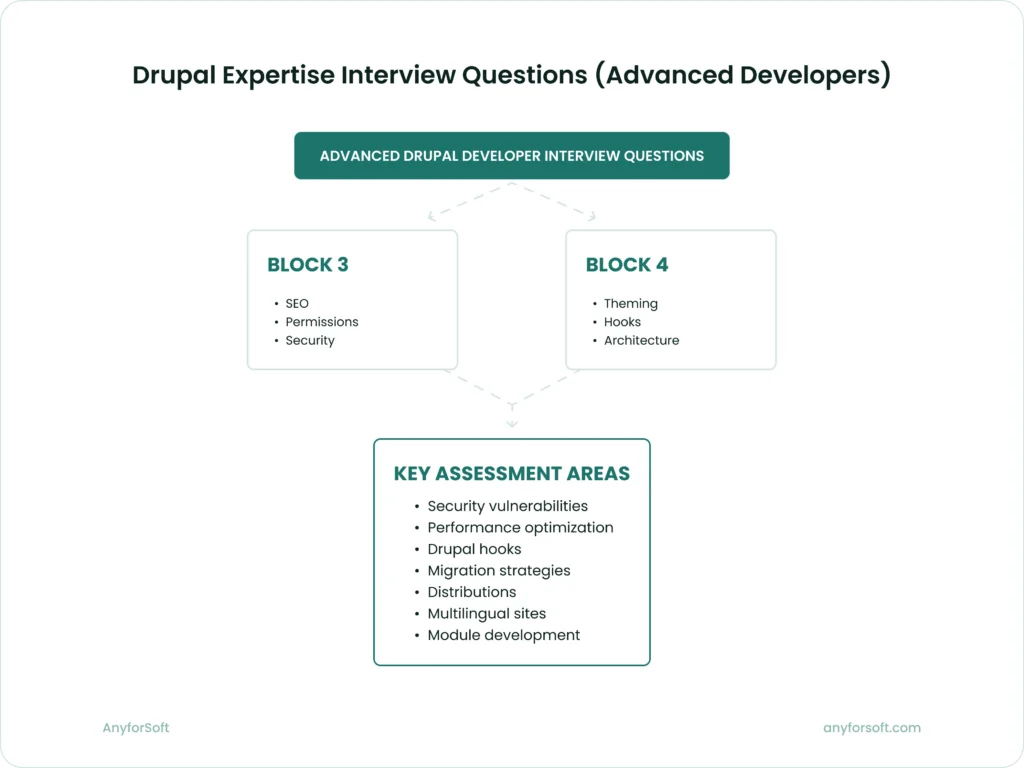
Search Engine Optimization (SEO) is a crucial aspect of any website. Ask candidates how Drupal supports SEO and what strategies they would employ to improve a site’s search engine visibility. Inquire about their approach to managing user permissions and access control within Drupal, ensuring they fully grasp Drupal’s permission system. Additionally, assess their understanding of security measures and best practices in Drupal, including their familiarity with common vulnerabilities and how to mitigate them.
Block 4: Theme and Templates, Hooks, and System Architecture
A candidate’s proficiency in Drupal theming and template customization is essential. Ask about their experience creating and customizing Drupal themes and whether they have worked with popular theme frameworks. Gauge their knowledge of Drupal hooks and how they are used to interact with core modules and functionality. Furthermore, delve into their understanding of Drupal’s system architecture, including conceptual layers, database systems, and the relationship between custom modules and core functionality.
Drupal Interview Questions for Freshers
To ensure your desired candidate fits perfectly within your organization, ask them some specific questions. These Drupal developer interview questions are designed to assess a fresher’s familiarity with the technology, their ability to apply their knowledge in practical scenarios, level of collaboration and communication skills, and problem-solving approach. Additionally, you can consider practical coding exercises or assignments to evaluate their technical abilities further. And, of course, don’t forget to ask for portfolios and feedback from previous projects.
- What versions of Drupal have you worked with during your training or personal projects?
Look for candidates with experience with the latest version of Drupal, as it indicates they are up-to-date with the platform’s advancements and improvements. - What was your role or responsibility in the development of those Drupal projects?
Freshers should clearly articulate their role in the development of sites. They should demonstrate knowledge of site building, theming, custom module development, or other relevant tasks. - How would you approach optimizing a website’s performance to improve its speed and efficiency?
Developers should offer strategies to optimize Drupal performance, such as implementing caching techniques, utilizing content delivery networks (CDNs), optimizing database queries, or leveraging Drupal’s built-in performance optimization features. - Based on your learning experience, which Drupal modules do you find helpful and would recommend to customers? Why?
Drupal engineers should suggest Drupal modules based on their understanding of specific customer needs. Look for candidates who can explain the benefits and features of the modules they recommend. - Have you worked with Views in Drupal? If yes, please provide an example of how you used Views in a project or describe its purpose and functionality.
Developers should describe their experience using Views, a powerful module in Drupal for creating custom queries and displaying data. They should provide an example of utilizing Views to meet a specific project requirement. - Did you collaborate with individuals or teams during your training or personal projects? If yes, describe the nature of the collaboration and your role in the project.
Newbies should describe their experiences collaborating with others, such as designers, developers, or clients. Look for effective communication, teamwork, and the ability to work well with diverse stakeholders. - Have you integrated any third-party applications or web services with Drupal during your training or personal projects? If yes, which ones did you work with, and how did you handle the integration?
It will be a plus if engineers mention any experience integrating third-party applications or services with Drupal. Look for candidates who can explain the integration process and its benefits to the project.
Remember, the Drupal interview questions and answers may vary based on your specific project requirements and the skill level you are looking for. Consider these guidelines as a starting point and tailor your evaluation criteria to meet your needs.
Don’t settle for less. Hire top-tier Drupal experts to fuel your digital success.
Drupal Interview Questions For Experienced
When you are looking for someone more mature in Drupal technology, you’ll need a bit more specific information about a candidate. We’ve collected and explored some common interview questions for an experienced Drupal developer. These questions aim to assess the candidate’s knowledge and proficiency in handling various aspects of Drupal development, security, performance optimization, migration, and more. By providing short preferable answers to these Drupal interview questions, we can gain insights into the candidate’s expertise and ability to apply Drupal best practices in real-world scenarios.
- How would you handle security vulnerabilities in Drupal?
The short answer is to stay updated with Drupal’s security advisories and promptly apply patches or updates. Also, follow secure coding practices, use strong passwords, and implement necessary security modules like the Security Kit (SecKit) or the Drupal Security Review module. - What are the critical considerations for optimizing Drupal performance?
Key considerations for optimizing Drupal performance include implementing caching techniques, utilizing a CDN for static assets, optimizing database forms and queries, enabling performance-enhancing modules like Boost or Varnish, and using CSS/JS aggregation for faster page loading. - Can you explain the concept of Drupal hooks and provide an example?
Short answer: Drupal hooks allow modules to interact with core functionality or other modules. An example is hook_form_alter(), which allows modifying form elements and behaviors. It’s commonly used for altering form submissions, adding validation, or customizing form elements. - How would you handle a Drupal website migration from one version to another?
The candidate should stand for a comprehensive approach by thoroughly analyzing the existing site and modules to identify compatibility issues. Then, plan a step-by-step migration strategy, ensuring data integrity and compatibility with the new Drupal version. It is recommended to leverage migration tools like the Drupal Migrate API and custom scripts as needed. - Explain the concept of Drupal distributions and their advantages.
Drupal distributions are pre-packaged installations that include Drupal core, contributed modules, themes, and configurations tailored for specific use cases (e.g., e-commerce, education). Their advantages include saving time by providing a starting point, ensuring best practices, and offering a feature-rich platform without requiring extensive configuration. - How would you handle multilingual functionality in Drupal?
The short answer is to enable the multilingual features in Drupal core and configure language settings, use the Entity Translation or Content Translation modules to translate content, implement multilingual menus, and use language-specific blocks or views to provide a localized experience. - How do you approach Drupal module development, and what development tools do you prefer?
Following the Drupal coding standards and best practices would be preferable while developing modules. For example, use Drupal Console or Drush for command-line interactions and tools like Git for version control, and leverage debugging tools like Xdebug or Drupal’s built-in error reporting to troubleshoot and ensure custom code quality.
Conducting a well-structured interview with an experienced Drupal developer is recommended to provide valuable insights into their skill set and suitability for your project. Remember to customize the Drupal interview questions based on your specific project requirements to ensure a successful hiring process. By selecting the right candidate, you can confidently move forward with your Drupal project, knowing that you have a skilled professional who can contribute effectively to its success.
Assessing Drupal 11 Expertise: Questions for the Modern Era
Drupal 11 changes the rules. Single Directory Components, Recipes, and the Access Policy API fundamentally change how we build, compose, and secure Drupal sites. The questions below test whether candidates grasp not just what changed, but why it matters in production.
Drupal 11 technical interview questions for Freshers
Fresh developers won’t have production Drupal 11 experience yet, that’s expected. Look for candidates who understand the “why” behind new features, not just memorized definitions.
- What are Single Directory Components (SDC), and why does Drupal 11 emphasize them?
Everything in one folder: templates, styles, scripts, metadata. All is self-contained. SDC means Drupal finally adopts component-based architecture native to the platform. Look for candidates who grasp the shift; they’re thinking in modern patterns even without hands-on experience yet.
- Can you explain what Drupal 11 Recipes are and how they differ from installation profiles?
Recipes are composable building blocks. Need a blog? Apply the blog Recipe. Corporate intranet features? There’s one for that too. Unlike monolithic installation profiles that bundle everything, Recipes let you mix configurations, such as content types, views, roles, like LEGO pieces. Candidates who mention “modular” or “reusable” get it.
- What’s the minimum PHP version Drupal 11 requires, and why does this matter for developers?
PHP 8.3 or higher; Symfony 6+ as well. The upgrade brings modern language features, JIT compilation performance, and positioning for Symfony 7 compatibility. Awareness that Drupal tracks modern dependencies shows understanding: the platform moves forward, not backward.
- How does Drupal 11’s approach to configuration management support team collaboration?
Configuration exports to YAML; YAML lives in version control alongside code. Changes get reviewed, tested, deployed consistently across environments. No more “works on my staging site” mysteries. Look for freshers who recognize this makes configuration predictable rather than hoping everyone clicked the right buttons.
- What improvements does Twig 3 bring to Drupal 11 templating?
Cleaner syntax. Deprecated filters removed, stricter enforcement, error messages that actually help. Security improvements matter: automatic output escaping gets more robust, making XSS vulnerabilities harder to introduce accidentally. This isn’t syntax pedantry; it’s maintainable themes and fewer security headaches.
Drupal 11 interview questions for experienced developers
Advanced Drupal 11 questions go beyond syntax. They reveal how candidates approach architecture, solve production challenges, and make decisions that impact long-term maintainability.
- How would you architect a Single Directory Component library that multiple Drupal sites can share?
Create a base theme or custom module housing reusable components; each gets its own SDC directory. Use namespaces or components.yml for global registration. The key insight: SDC enables true design systems, not just theme inheritance tricks. Advanced developers should discuss component documentation, version control for the shared library, handling site-specific variations without forking everything. Storybook integration for previews? Automated testing in CI/CD? These separate strong candidates from those who’ve only read the docs.
- Describe a scenario where Drupal’s Access Policy API provides a better solution than traditional role-based permissions.
Traditional permissions lock you in: Editor, Administrator, Contributor. Rigid. The Access Policy API lets you define conditional access based on context—content type, taxonomy, user attributes, request routes, even time. University faculty editing courses only for their departments? Media editors accessing content by geographic region? Policy-based access control (PBAC) decouples logic from hard-coded roles. Strong answers mention when NOT to use it; simple permission checks still work fine for basic needs.
- Your team works on multiple Drupal 11 projects. How do you enforce Composer hygiene across all of them through CI/CD?
Automate everything. Run composer validate to catch malformed files; composer audit detects vulnerabilities. Lock files must be committed—they ensure identical dependency versions everywhere, eliminating “works on my machine” disasters. Advanced developers discuss pinning critical packages, private repos for proprietary modules, pre-commit hooks preventing direct vendor edits. Tools like Dependabot that automatically propose dependency updates as pull requests? Testing those updates in isolation before merging? That’s advanced thinking.
- How would you define, implement, and monitor performance budgets for a high-traffic Drupal 11 site?
Budgets need teeth. Define metrics: Time to Interactive under 3 seconds, First Contentful Paint under 1.5, page weight under 2MB. Measure with Lighthouse, WebPageTest, New Relic. Here’s the critical part—integrate checks into CI/CD so builds exceeding thresholds fail. Otherwise? Aspirational nonsense. Strong candidates discuss feature-versus-speed trade-offs, lazy loading strategies, CDN optimization. They mention PHP 8.3’s JIT improvements; they know Drupal 11’s query optimizations matter.
- What does Symfony 7 readiness mean for a Drupal 11 developer, and how do you prepare custom modules?
Avoid technical debt. Custom modules using deprecated Symfony methods will break when Drupal adopts Symfony 7. Audit code for deprecated routing, service definitions, event dispatchers, middleware. Follow Symfony’s deprecation notices; understand PSR standards. Strong answers mention dependency injection best practices, event subscriber patterns, why tight coupling to Symfony internals creates maintenance nightmares. HttpKernel, DependencyInjection, EventDispatcher—these aren’t abstractions for experienced devs.
- Walk through your approach to configuration management in a Drupal 11 CI/CD environment with multiple deployment targets.
Export with drush cex, commit YAML to version control, apply via drush cim on staging and production. Simple in theory; messy in practice. Advanced developers discuss configuration splits—different settings per environment, managing secrets outside version control, partial imports for specific changes. They need strategies for conflicts when multiple developers modify the same entity, rollback procedures, validation before imports. Strong answers mention automated testing verifying imports succeed, update hooks for complex sequenced changes, separate storage paths for environment types.
A Word from AnyforSoft’s Tech Lead: The Scenario-Based Alternative
While this guide provides structured questions across expertise levels, Oleg Bogut, CTO at AnyforSoft, takes a different approach during interviews.
“I rarely rely on purely theoretical questions,” Oleg explains. “Instead, I simulate real situations and ask candidates how they would solve specific problems. A chain of practical, scenario-based questions validates hands-on experience far more effectively — and it’s nearly impossible to fake. You either have practical experience or you don’t.”
This method goes beyond technical knowledge. You see how candidates think when they hit unexpected problems — their actual problem-solving approach, not rehearsed answers. Notably, Oleg avoids live coding sessions entirely.
“Let’s be honest. Nobody codes ‘from memory’ anymore. We have autocomplete, Google, AI. Live coding creates stress without validating real-world ability. The results are always conditional at best.”
The interview adapts based on who you’re talking to. Their experience, their skill level. It turns into a real conversation rather than checking boxes. If scenario-based interviews don’t suit your hiring process, the coding assignment offers another option. It’s a take-home task where candidates work at their normal pace, showing you not just what they build but how they document decisions and handle edge cases.
Conclusion: From Interview Questions to Hiring Confidence
You now have a complete framework for evaluating Drupal developers — from identifying technical expertise to assessing production readiness. But it’s more than that, really. You’ve got three evaluation approaches that work better together: structured questions when you need consistency, scenario-based interviews when you want to see adaptability, and practical assignments for validating real-world skills.
Here’s the thing most teams get wrong: treating hiring like there’s one right way to do it. Strong candidates reveal themselves differently depending on how you test them. Some articulate architectural decisions perfectly but completely freeze under live pressure. Others solve actual problems in minutes but can’t explain the theory cleanly. Your job isn’t hunting for the mythical “perfect” developer — it’s figuring out which evaluation style matches what your project actually needs.
Our framework lets you:
- Separate real expertise from memorized scripts with questions that show how someone tackles problems, not what they’ve crammed. Watching a candidate think through a challenge? That beats hearing them recite Drupal hooks.
- Spot who’s actually working with Drupal 11 by testing their understanding of Single Directory Components, Recipes, modern configuration workflows — the things that separate people using current tools from those repeating old patterns.
- Match candidates to what you’re building with questions tailored for beginners versus advanced developers. Don’t over-hire for a basic site. Don’t under-hire for a gnarly migration.
- Test hands-on ability through practical assignments that expose whether someone handles messy edge cases or only codes when everything’s perfect.
- Check for long-term thinking by asking how they approach component libraries, security decisions, performance budgets, maintainability — not just “can you ship this feature fast?”
The developers who get through this framework don’t just write code that works today. They make choices that cut down technical debt, catch maintenance headaches early, and build stuff your team can actually work with six months down the line. That’s the difference between filling an open position and genuinely making your team stronger.