



Building a Learning Management System (LMS) on Drupal is driven first by architectural and product decisions, with technical expertise supporting their implementation.
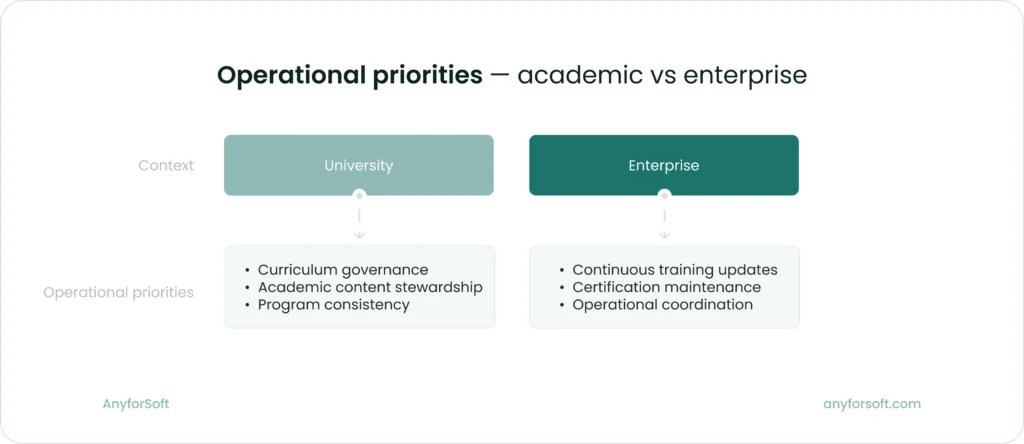
When architecture decisions lead the process, one principle stands out. Whether you’re structuring an academic learning environment or an enterprise training system, the decision framework is shared — only the priorities differ.
In this guide, you’ll learn how to:
- clarify what kind of learning platform you are actually building
- define scope and priorities before development begins
- recognize decisions that affect architecture, integrations, and cost
- translate business or academic goals into platform structure
- prepare for productive collaboration with development teams
- plan a realistic rollout instead of an abstract wish list
AnyForSoft has built and maintained educational platforms for institutions including Imperial College Business School, where we managed platform evolution, Drupal migrations, and technical debt resolution while preserving user experience. Our work with universities on Drupal foundations informs this approach to LMS implementation.
If you already understand the advantages of a Drupal-based LMS, this guide shows how to move from intent to architecture, step by step.
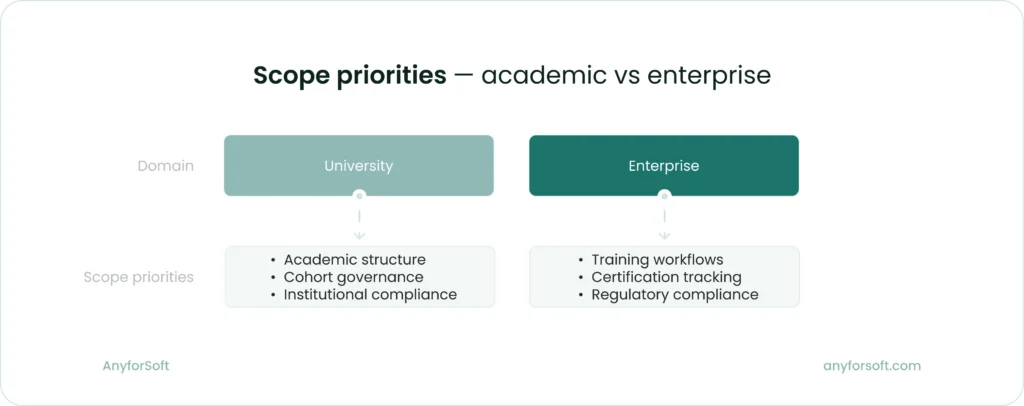
Step 1. Discovery and scope framing: defining what you are really building
The project discovery phase defines what you are building before technical work begins. Business goals are translated into platform intent, clarifying the purpose of the LMS and the boundaries of the first release.
The result is a clear architectural direction that keeps development aligned with the original objectives.
At this point, you establish the decisions that shape the platform’s structure and scope:
- the type of LMS you are building
- what belongs in the first release
- reporting expectations
- access or monetization model
Drupal developers focused on higher education, interpret these decisions as architecture boundaries and module strategy. Defined scope allows the system structure to reflect real priorities instead of expanding unpredictably during implementation.
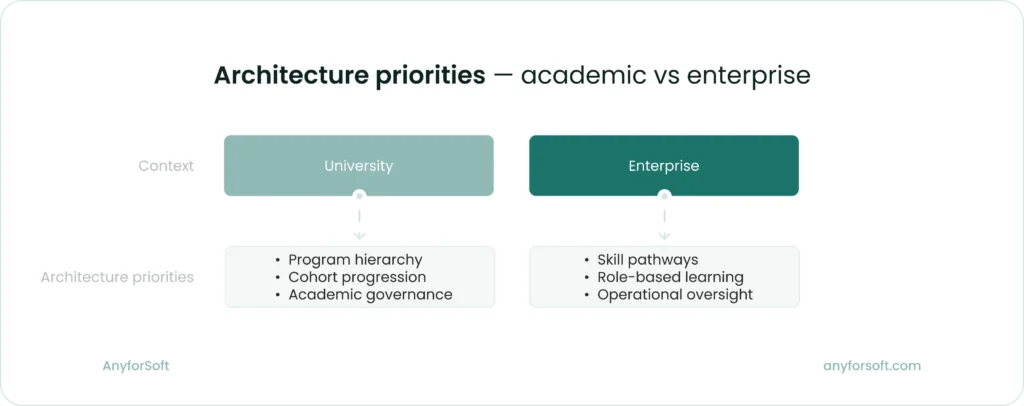
Step 2. Drupal e-learning platform architecture: structuring content and roles
This stage shapes the structure that governs content relationships, user roles, and institutional rules.
Drupal’s content modeling capabilities, including improvements in Drupal 11, support layered hierarchies without fragile workarounds. A deliberate architecture keeps growth predictable as new content and policies are introduced.
At this point, you establish the decisions that determine how learning content and responsibilities are organized:
- learning content structure and grouping
- roles, permissions, and platform responsibility
- progression and oversight model
These decisions clarify how learning flows through the Drupal LMS modules and who controls each stage. They define authority and progression paths so the system reflects operational reality.
Developers translate these decisions into Drupal entity structures and workflow configuration.
When features expand, permissions and content relationships follow organizational rules instead of being improvised.
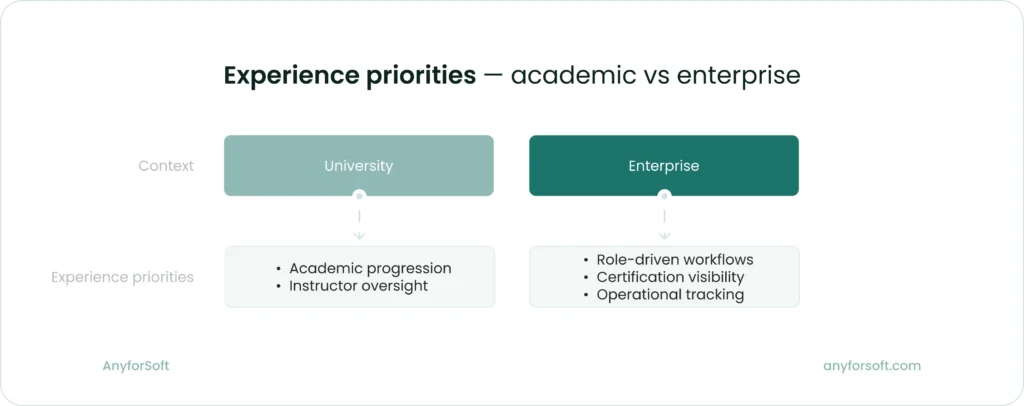
Step 3. Learner and admin experience: designing system flows
The following step defines how learners progress, how administrators supervise activity, and how information appears in everyday workflows.
Clear experience design connects system rules with human behavior. It ensures navigation, and oversight feels consistent.
At this point, you establish the decisions that shape user interaction and operational flow:
- learners progress through courses and milestones
- administrative management of learning activities
- dashboard and reporting visibility for users
- review and approval moments for content or progress
These decisions determine how responsibility is shared between learners and administrators. They clarify how progress is tracked and how oversight is applied in routine use.
Developers translate these decisions into interface behavior and workflow logic. Defined interaction rules allow permissions and system responses to remain predictable as new scenarios appear.
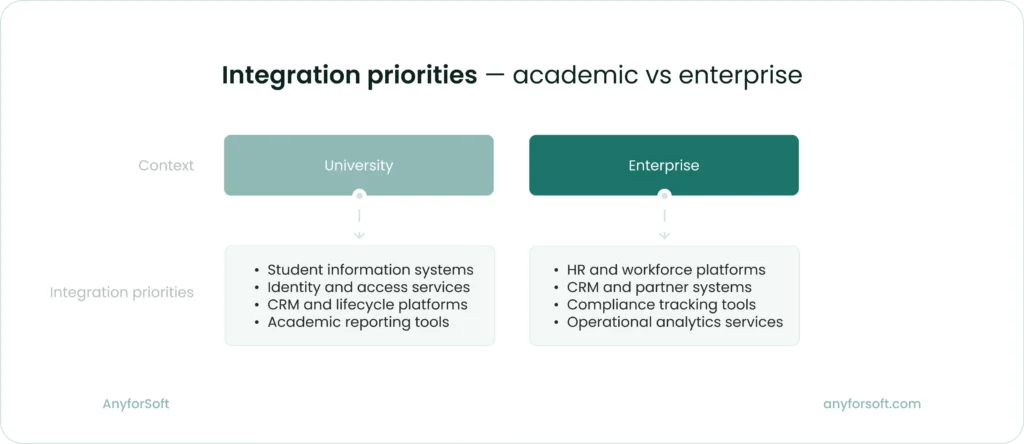
Step 4: Technical architecture and integrations: choosing how systems connect
This step establishes platform boundaries and clarifies how information moves between tools. Integrations affect system stability and long-term scalability, so architectural clarity prevents fragile dependencies as the platform evolves.
At this point, you establish the decisions that shape how the LMS interacts with external services:
- LMS connections to external platforms
- visibility of LMS data in reports and analytics
- user sign-in and access control
These decisions clarify what the LMS controls internally and what must coordinate across external platforms. They define technical boundaries that support reliable expansion.
Developers translate your decisions into integration architecture and data exchange patterns. A defined model allows the system to grow without repeated structural adjustments as new tools are introduced.
Step 5: Content migration and operational setup: making the LMS usable
This step focuses on bringing content into the system and establishing the content management workflows. A well-organized setup ensures that learning materials, editorial responsibility, and operational rules are aligned with how the organization actually runs.
At this point, you establish the content management decisions:
- moving existing courses and materials into the LMS
- ownership of content creation and updates
- review and approval of content changes
Developers use these decisions to build the tools and processes that move content into the LMS and support everyday management. A clear setup ensures that courses and workflows can be updated smoothly without disrupting operations.
Step 6: Launch and growth: planning evolution
The following step focuses on guiding improvement, responding to real usage, and expanding the platform with intention. A clear growth framework prevents reactive changes and keeps evolution aligned with organizational goals.
At this point, you establish the decisions that shape how the platform develops over time:
- measurement and success indicators for the LMS
- priorities for future enhancements and expansion
- feedback and learning from real platform use
These decisions define how progress is evaluated and how change is introduced. They keep growth deliberate instead of driven by ad hoc requests.
Developers translate these priorities into enhancement planning and scalable architecture adjustments. A defined evolution path supports continuous improvement without destabilizing the platform.
Technical approaches: how a Drupal LMS is structured
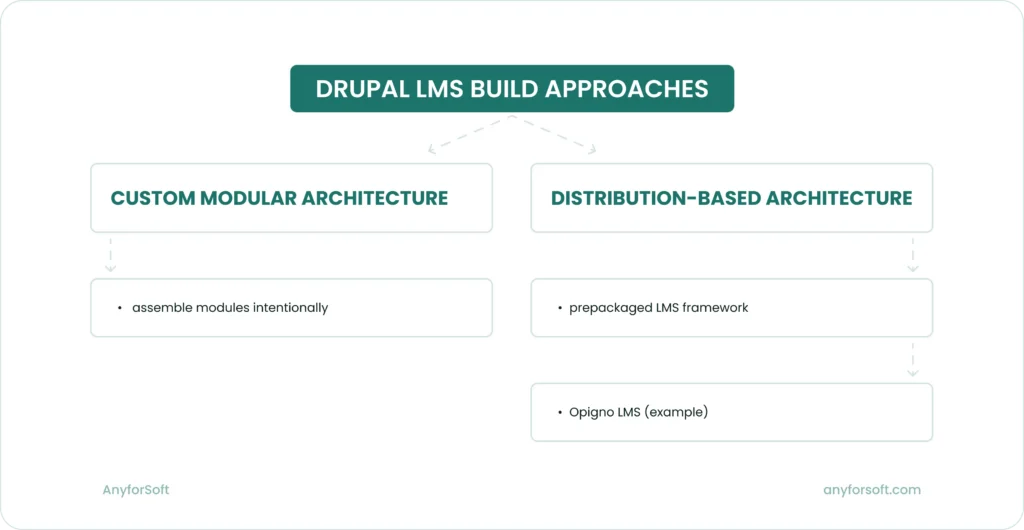
Drupal LMS projects typically follow one of two architectural paths. The difference is not about right versus wrong. It reflects how much structure you want upfront versus how much flexibility you want to design intentionally.
Understanding these approaches helps decision-makers evaluate tradeoffs before technical work begins.
Modular architecture built from Drupal components
A modular approach means adding each capability intentionally as the platform grows. Teams select and connect Drupal components themselves, shaping the system around how learning actually operates in their organization.
This approach requires early architectural clarity – you make structural decisions deliberately from the start. When workflows or permissions evolve later, the system adapts easily because it wasn’t built on preset assumptions. That flexibility proves valuable when learning requirements expand over time.
Modular builds work best when you expect ongoing customization and growth. The architecture evolves with your organization. It supports growth without imposing structural limits.
Distribution-based architecture
A distribution is a ready-to-use LMS built on Drupal. Popular options like Opigno LMS and Anu LMS arrive with learning features already set up: course management, user roles, and common workflows all configured.
Teams start with a working system designed for typical learning scenarios. This speeds up launch because the foundation exists from day one.
The tradeoff shows up when your needs don’t match what the distribution assumes. You’ll adapt what’s already there instead of building exactly what you need from the beginning.
Some teams value the faster start. Others find the preset structure limiting as their requirements grow.
Practitioner perspective
A developer shared that their experience with a prepackaged LMS distribution involved customization challenges, particularly around theming and structural adjustments. In their case, assembling the LMS directly from Drupal modules offered more control as requirements evolved.
This represents one practitioner’s experience rather than a universal conclusion.
Some teams value the speed and structure a distribution provides. Others prioritize adaptability and prefer modular architecture.
The right choice depends on how closely your learning model aligns with a predefined framework and how much evolution you anticipate.
Common bottlenecks and where they come from
Bottlenecks in LMS projects usually come from unclear decisions rather than technical limitations. Clarifying intent early prevents avoidable complexity later.
AFS CTO Oleg Bogut perspective
“Think of decision-making as the blueprint for your LMS. When the blueprint is clear, development moves smoothly. When it isn’t, complexity fills the gaps.”
Scope ambiguity
When the purpose of the LMS is loosely defined, features accumulate without clear boundaries. Development becomes reactive. Timelines stretch, and architectural clarity suffers.
How to avoid it: Define which features are included in the first release and which are intentionally deferred. Shared boundaries keep decisions aligned.
Structural inconsistency
Learning content, permissions, and workflows evolve without a unified model. Navigation becomes confusing, and administrative ownership blurs.
How to avoid it: Establish a clear learning structure and responsibility model early. Consistent architecture prevents fragmentation as the platform grows.
Integration friction
External systems connect without agreed expectations. Data mismatches appear, reporting becomes unreliable, and access issues surface.
How to avoid it: Clarify system boundaries and data responsibilities before integration work begins. Predictable connections reduce downstream instability.
Operational ownership gaps
Content enters the LMS without a maintenance model. Updates stall, approvals drift, and materials fall out of sync with real processes.
How to avoid it: Define who owns content and how updates are governed. Clear operational responsibility keeps the platform trustworthy.
Reliability blind spots
Validation focuses on technical completion instead of real-world readiness. Under everyday use, performance or stability issues appear.
How to avoid it: Agree on acceptable reliability standards and test against real usage scenarios. Explicit expectations guide meaningful validation.
Conclusion
Building an LMS on Drupal succeeds when architectural decisions go first and development follows it. The right start is when you define scope before writing code and make deliberate choices at each implementation stage.
To move from planning to successful implementation:
- Start with discovery that defines your actual requirements
- Establish learning architecture that reflects how your organization operates
- Plan integrations early with clear expectations about data flow and system boundaries
- Build incrementally with focused releases
- Assign ownership for platform evolution, content governance, and ongoing maintenance before launch
Drupal lets you build a learning platform that fits your specific situation. But that flexibility only helps if you make clear decisions before development starts.
Organizations that invest time in planning, often with a higher education Drupal web development agency, build platforms that serve them well for years. Clear requirements upfront save time and budget later.
FAQs
How much does it cost to build an LMS on Drupal?
Drupal LMS projects typically range from $50,000 to $500,000+, depending on scope, integrations, and customization requirements.
A focused MVP with core learning features (content delivery, basic user management, simple reporting) usually falls in the $50,000-$150,000 range. Platforms requiring complex workflows, multi-system integrations, custom reporting, and extensive content migration typically cost $200,000-$500,000 or more.
The biggest cost driver is architectural clarity. Projects with well-defined scope and priorities stay within budget. Projects where requirements shift during development see costs expand rapidly. Discovery phase investment ($10,000-$25,000) pays for itself by preventing expensive mid-project changes.
How long does it take to build an LMS on Drupal?
A well-scoped MVP typically takes 3-6 months from discovery through launch. Comprehensive platforms with custom workflows, multiple integrations, and extensive content migration require 8-16 months.
Break it down this way:
- Discovery and planning take 4-8 weeks.
- Core development ranges from 8-20 weeks depending on complexity.
- Integration work adds 4-12 weeks.
- Content migration and testing require another 4-8 weeks.
Early decision-making affects timeline more than technical complexity. Projects starting with clear requirements move faster than those figuring out scope during development.
Do we need a full development team to build a Drupal LMS?
You need dedicated Drupal expertise, either in-house or through a development partner. A typical team includes a project lead, 2-3 backend developers, a frontend developer, and a UX designer. Larger projects add integration specialists and DevOps engineers.
Drupal provides strong foundations, but assembling an LMS requires architecture planning, custom module development, integration configuration, and workflow design. Organizations without Drupal expertise typically partner with agencies specializing in educational platforms rather than attempting builds with general web developers.
Can Drupal scale as our learning platform grows?
Drupal handles complex content systems and high-traffic environments effectively. Platforms built on Drupal support thousands of concurrent users, millions of content items, and extensive integration networks without hitting structural limits.
Scalability depends on architectural decisions made early. Proper database design, caching strategies, and infrastructure planning matter more than Drupal’s inherent capabilities. Poor architecture creates bottlenecks regardless of platform. Well-planned Drupal implementations scale smoothly as organizations grow.
How does Drupal LMS maintenance compare to packaged platforms?
Drupal requires active maintenance, including security updates, module updates, performance monitoring, content governance. Budget $2,000-$10,000 monthly depending on platform complexity and support level.
Packaged LMS platforms handle technical updates internally through subscription fees. Drupal gives you control over when and how updates happen, but that means assigning responsibility for platform health. Organizations maintaining Drupal LMS platforms typically dedicate internal resources or retain development partners for ongoing support and obtaining benefits from Drupal consulting services.
Both approaches require maintenance. Drupal maintenance involves more technical decisions but offers more control over platform evolution.
Can we integrate a Drupal LMS with our existing systems?
Drupal connects with most institutional systems: student information systems, CRMs, identity providers, analytics platforms, HR systems, assessment tools. Integration happens through APIs, webhooks, or direct database connections depending on requirements.
Success depends on planning. Define what data moves where, how often synchronization happens, who owns data accuracy, and what happens when systems conflict. Integrations designed upfront work reliably. Integrations added as afterthoughts create ongoing friction.
Common integrations include: Single sign-on (SSO) with campus or company identity systems, automated enrollment from student/HR databases, grade syncing to academic records, completion tracking to compliance systems, and reporting data to analytics platforms.
Who benefits most from building an LMS on Drupal?
Organizations needing learning platforms tailored to specific institutional workflows rather than adapting to generic templates.
Universities managing complex program structures, cohort progression, and academic governance processes find Drupal’s flexibility matches their requirements. Enterprises running certification programs, compliance training, or workforce development with unique operational workflows benefit from custom architecture.
Organizations already operating on Drupal infrastructure gain efficiency by adding learning to existing platforms. Those managing extensive educational content beyond courses (documentation, resources, reference materials) use Drupal’s content management strength.
Generic training delivery works fine on packaged LMS platforms. Unique institutional workflows require custom architecture, which is a key consideration when comparing a Drupal LMS vs Moodle.
Can we start small and expand later?
Many successful Drupal LMS implementations begin with focused releases. Start with core learning delivery for one department or program. Add features, content types, and integrations incrementally as you learn what users actually need.
This approach reduces initial investment, proves value quickly, and lets you refine architecture based on real usage. The foundation should support expansion, but you don’t need to build everything immediately.
Organizations starting small often launch within 4-6 months and expand over 12-24 months as adoption grows.
What happens if we outgrow our initial architecture?
Drupal architecture evolves through refactoring – restructuring content types, adjusting workflows, modifying integrations. Unlike platforms with rigid structures, Drupal allows fundamental changes without complete rebuilds.
Budget for architectural review every 18-24 months as your LMS matures. Growth often requires database optimization, caching improvements, or integration adjustments. Plan these as normal platform evolution, not emergency fixes.
Organizations that build with expansion in mind handle growth smoothly. Those treating initial architecture as final often face expensive refactoring.


