








Choosing a Drupal development partner places business and technical decision-makers under separate, often conflicting pressures.
A CEO without a technical background has to approve budgets and assess delivery risks for a project they can’t fully evaluate. A CTO needs evidence that the agency’s technical depth matches what’s on the proposal.
This article gives you concrete criteria to work through that process. It covers:
- How to define project goals before approaching any agency
- What to look for in a portfolio and client track record
- How to evaluate technical qualifications and Drupal expertise
- What pricing models mean in practice
- Which warning signs indicate a partner isn’t the right fit
- Questions to ask before signing
Our portfolio includes Verifone, a global payment technology company, and FilterSync, an AI-driven property management platform, both built on Drupal as the foundation, among dozens of other Drupal-based solutions. The criteria in this guide come from that work.
The sections that follow move from business evaluation to technical assessment, covering what both perspectives need to make the decision.
Why Choosing the Right Drupal Partner Is Critical for Your Business
Delivering a Drupal project well requires prior experience with the platform’s module ecosystem, architecture patterns, version upgrade cycles, and security configuration. An agency without genuine Drupal depth can produce a working website and still leave the codebase in a state that costs significantly more to maintain.
Problems from a poor partner choice rarely surface during development.
Technical debt, including poorly structured code or missing documentation, tends to appear months after launch, when the original agency may no longer be involved and a new team is inheriting the consequences.
Project scale shapes what’s at stake. A straightforward informational site and a multilingual enterprise platform with CRM integrations are both Drupal projects, but they require different levels of expertise and process maturity.
Choosing a partner calibrated to the wrong level creates friction from the start.
How to choose a Drupal development company: the cost of the decision
| Area | What goes wrong | Business consequence |
| Timeline | Missed milestones, scope disputes | Delayed launch, increased internal costs |
| Budget | Unplanned change requests, rework | Overspend beyond original estimate |
| Code quality | Technical debt, poor documentation | Higher maintenance costs post-launch |
| Security | Outdated modules, missing patches | Vulnerability exposure |
| Continuity | Poor handover, no post-launch support | Instability after launch |
This decision affects more than the immediate project:
- Budget predictability. An experienced Drupal partner scopes accurately from the start, reducing the risk of change requests that inflate costs mid-project.
- Long-term maintainability. Code written by developers who understand Drupal architecture is easier to extend and hand over to another team if needed.
- Security posture. Drupal’s security model requires ongoing attention: module updates and patch management that a non-specialist agency is likely to deprioritize.
- Post-launch stability. The first weeks after a Drupal site goes live are critical. A partner with post-launch support experience knows what to monitor and how to respond when issues emerge.
- Platform growth capacity. A well-structured Drupal build accommodates new content types and integrations without requiring rework before it can scale.
The right Drupal partner reduces these risks before the project starts — through accurate scoping and a clear post-launch plan. The sections below give you the criteria to identify them.
Define Your Project Goals and Requirements First
Before approaching any Drupal development agency, the people responsible for the decision need to agree on what the project is actually supposed to achieve. In many organizations, that agreement is harder than it sounds. Consider a conversation that happens often:
CEO: “We need this wrapped up by Q3 and we can’t go over $80K.” CTO: “That timeline won’t give us time to sort out the architecture properly. We’ll end up paying to fix it in six months.” CEO: “Then let’s find someone who can pull it off within budget.” CTO: “The agencies that fit that budget don’t have the Drupal depth we need.”
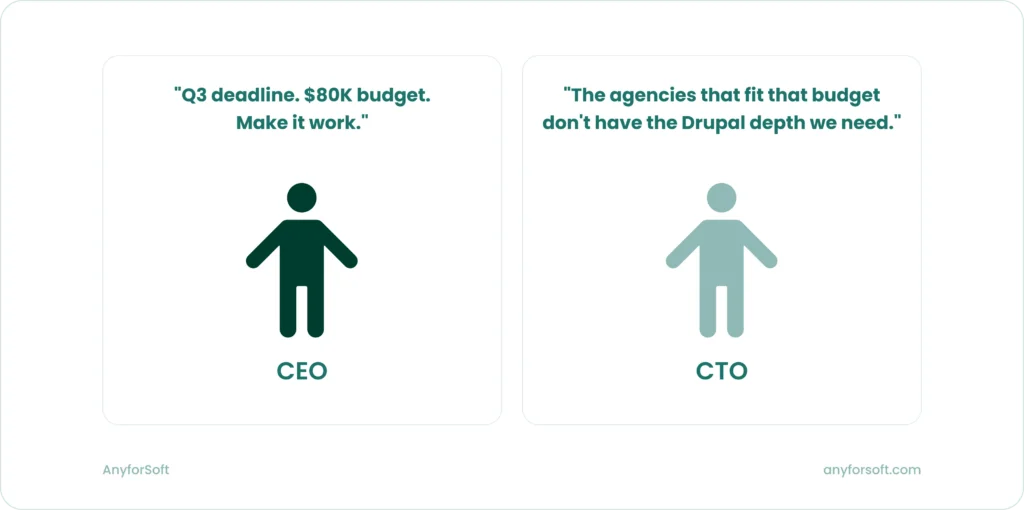
When these priorities are not reconciled before the search starts, they surface later as disagreements over shortlisted agencies or contract terms. Defining shared success criteria before the search starts gives the whole team a common basis for evaluation.
Project goals fall into two categories that require separate attention.
- Business goals define what the website or platform needs to deliver: more qualified leads or support for a new product line.
- Technical requirements, in turn, define the constraints the build must meet: Drupal version, integration with existing systems, performance benchmarks, and compliance obligations.
Both need to be documented before the first agency conversation.
Scope definition at this stage also protects the budget. Agencies price what they understand. A vague brief produces a vague estimate, which creates room for change requests once the project is underway. The more precisely the requirements are defined upfront, the easier it becomes to compare proposals on equal terms.
Before approaching any agency, the team needs honest answers to a few practical questions.
- Who has the final say, and what will it take to convince them?
- Is there an agreed budget range everyone can actually defend, or just a ceiling one side set and the other quietly disputes?
- Does the organization have internal Drupal capacity after launch, or will the agency need to stay involved?
And critically — what does a successful outcome actually look like six months after go-live, in terms the whole team agrees on?
A brief built on those answers gives any agency enough to scope accurately. It also makes comparing proposals straightforward, because every response gets measured against the same criteria.
Evaluating a Drupal Agency: Business Considerations
A Drupal agency’s technical claims are easy to make and harder to verify without the right evaluation framework. Business evaluation covers what the portfolio actually tells you, how client feedback reflects real working relationships, and how pricing structures shape project outcomes. The sections below give you concrete criteria for each.
Portfolio and Case Studies
A portfolio page is the first place most decision-makers look, and also the easiest place for an agency to present work selectively.
Start with the nature of the projects listed. Say the portfolio of the potential Drupal partner shows only short-term separate projects. It tells you less than one that includes complex, multi-phase work.
Look for projects where the scope required coordinated decisions across design, development, and integration.
Long-term client relationships are a reliable signal. When a client returns for a second or third project, or builds more complex features on what was already delivered, it usually means the first engagement delivered what was promised and the working relationship held up under pressure. That pattern is difficult to manufacture.
Look also for details that are hard to imitate in a case study:
- Specific technical constraint
- Unexpected problem
- Resolution approach
- Measurable outcome
A case study that covers these points is more credible than one that lists deliverables without context. When Wittenborg University returned to build an AI assistant on the Drupal 10 foundation we had delivered in the previous engagement, it demonstrated exactly this progression: a solid platform built first, then more complex technology added on top without rebuilding from scratch. That kind of architecture requires deliberate decisions in the first phase — and a client willing to trust the same team with the next one. We’re proud of that project for both reasons.
Client Reviews and Testimonials
A portfolio shows what an agency claims to have built. Client reviews show what it was actually like to work with them. The two don’t always tell the same story.
Genuine feedback tends to be specific. A review that describes the exact features delivered, the problems they solved, and what was missing before the project started tells you far more than a generic phrase about professionalism or timely delivery. Even a detailed list of features is more informative than “great team, highly recommended,” because specifics are harder to fabricate than general praise.
Look for reviews that describe the work in concrete terms. Here is what that looks like in practice:
“They built a smooth, logical flow for applications and registrations, which used to be a pain point for us.”
“Many students specifically mentioned the virtual tour when talking about what drew them to apply. It gave them a real sense of the space and culture, which is something we had struggled to convey online before.”
“Our website was built on Drupal and hadn’t been updated for 10+ years. New functionalities were introduced such as a program search, course search, and calendar listing improvements.”
Each of these describes a specific situation, a specific deliverable, and a specific outcome.
Pay attention to where the reviews appear. Verified platforms like Clutch attach reviews to named individuals with job titles and company details. A strong rating across dozens of verified reviews carries more weight than testimonials published on the agency’s own website without attribution.
Look for these signals in client feedback:
- Named reviewer with job title and company
- Reference to a specific feature or deliverable
- Description of communication under pressure
- Mention of post-launch experience
- Long-term or repeat engagement noted
One pattern worth noting. When multiple reviewers independently mention the same quality, such as responsiveness or honest communication, it is more reliable than a single glowing endorsement.
Pricing Models and Budget Planning
Pricing is where business and technical priorities meet most directly. Understanding how an agency structures its fees tells you as much about how it manages projects as the number on the proposal.
Most Drupal agencies work within two broad models.
- Fixed-price contracts define the scope, timeline, and cost upfront.
- Time and materials contracts bill for actual hours worked, with the scope remaining flexible.
Each model fits different project conditions, and neither is inherently better.
Fixed-price contracts work well when requirements are fully defined before development begins. They give the client budget certainty and put the delivery risk on the agency. Time and materials contracts work better when the scope is likely to evolve — a complex integration, an iterative product, or a project where requirements depend on earlier decisions. In these cases, a fixed price tends to produce change requests rather than flexibility.
Budget planning requires one more consideration beyond the model.
The cost of the initial build is rarely the total cost of ownership. Drupal sites require ongoing updates, security patches, and module maintenance. An agency that offers post-launch support as part of its model is worth more over time than one that delivers the project and steps away.
Fixed Price vs Time and Materials
Choosing the Right Pricing Model for Your Drupal Project
| Fixed Price | Time and Materials | |
| Best for | Well-defined scope | Evolving or complex scope |
| Budget certainty | High | Variable |
| Flexibility | Low | High |
| Risk distribution | Agency carries delivery risk | Shared between client and agency |
| Change requests | Common when scope shifts | Handled within the model |
| Post-launch changes | Requires new contract | Can continue under same agreement |
The model matters less than the fit between the model and the project. A fixed-price contract on a poorly defined scope produces disputes. A time and materials contract without clear milestones produces budget anxiety. Before signing, confirm that the pricing model matches the actual state of your requirements.
Cost vs Long-Term Value
The agency with the lowest day rate is rarely the least expensive option over a two-year horizon. Cost comparisons that focus on the initial proposal miss where the real spend tends to accumulate.
Technical debt is the most common hidden cost. Code written quickly by developers unfamiliar with Drupal architecture is harder to extend and more expensive to hand over to another team. A project delivered under budget can generate maintenance costs that exceed the savings within the first year.
Support continuity carries its own value. An agency that built the platform understands its structure and integration points. Replacing that knowledge after a difficult handover costs time and introduces risk. When evaluating proposals, factor in what ongoing support looks like and what it costs.
Platforms like Clutch publish verified pricing data based on real client reviews, broken down by agency and project type.

AnyforSoft Project Pricing: Data from Clutch
Before signing, check what a shortlisted agency’s typical project size looks like on a verified platform.
- A quote that is well above that range deserves a detailed explanation of what drives the cost.
- A quote that is well below it deserves equal scrutiny: a price that looks too low can mean the scope is underestimated.
Evaluate total cost of ownership over 24 months, including maintenance, support, and the likely cost of any rework. That comparison gives a more accurate picture than two project proposals placed side by side.
Red Flags When Choosing a Drupal Agency
Some warning signs appear before the contract is signed. Others surface during the proposal process. Both are worth knowing in advance.
An agency that cannot discuss your requirements in technical depth during the sales conversation is unlikely to manage them better once the project starts. Drupal projects require specific architectural decisions early. Vague answers to specific questions about module selection, version compatibility, or integration approach suggest the technical lead is not involved in the sales process.
Watch for these signals during evaluation:
- Proposal delivered without a discovery phase or technical questions
- Fixed price on a scope that is clearly not fully defined
- No named developers or team structure in the proposal
- Portfolio cases without client references available on request
- Post-launch support described vaguely or excluded from the proposal
- Pressure to sign quickly without time to review the contract
A reliable agency expects scrutiny. It can name the developers on your project and point to clients you can speak with directly. Reluctance on either point is worth taking seriously.
Evaluating a Drupal Agency: Technical Considerations
Technical evaluation requires a different lens than business evaluation. Where portfolio and pricing tell you how an agency operates, technical signals tell you whether the team behind the work actually knows Drupal at depth. The sections below cover what to look for and how to verify it.
Certified Drupal Developers and Community Contributors
A Drupal agency’s real depth shows up in places outside its own website. The Drupal community maintains public records of who contributes to the platform, and those records are worth checking before any contract is signed.
Look for these signals when evaluating a potential partner:
- Organizational profile on drupal.org. A serious Drupal agency maintains a public profile showing its contribution history: modules maintained and patches submitted to Drupal core.
- Developer profiles on drupal.org. Individual developer profiles show personal contribution records. A team whose members have active profiles has a verifiable track record that no portfolio page can replicate.
- Drupal Association membership. Member organizations have made a formal commitment to support Drupal’s development. It is a baseline indicator of platform investment worth confirming.
- Event participation. Agencies that attend and sponsor Drupal camps and DrupalCon stay close to how the platform is developing. Developers who participate encounter real architectural problems and version changes before they appear in client projects.
- Acquia-certified developers on the team. Acquia is the company founded by Dries Buytaert, the original creator of Drupal. It maintains the most widely recognized Drupal certification program that covers development and front-end specialization, among other tracks. Because Acquia’s business depends entirely on Drupal, its certification standards reflect platform requirements. A developer who holds Acquia certification has passed a structured assessment designed by the people closest to the platform’s development.
An agency that can point to several of these signals has a public, peer-reviewed record of Drupal involvement. One that cannot, has to be asked to explain why.
Experience with Drupal 10 and 11
Drupal’s major versions are not interchangeable. Drupal 10 introduced a fundamentally updated codebase, dropping legacy dependencies and requiring modules to meet stricter compatibility standards.
Drupal 11, released in 2024, continued that direction with further performance improvements and a tighter path toward modern PHP standards. An agency still delivering projects on Drupal 9 or earlier is working with a platform that has reached end of life and no longer receives security updates.
When evaluating a partner, ask which Drupal versions they have delivered in production in the past two years. A credible answer names specific projects and explains the architectural decisions that came with them. A vague answer about “extensive Drupal experience” without version specifics is worth pressing on.
Version currency matters most when a project has ambitions beyond its initial scope. A platform built on Drupal 11 with a modular architecture can accommodate new features, integrations, and compliance requirements without rebuilding from scratch. One built on an outdated version accumulates technical debt before the first line of custom code is written.
The FilterSync project made the cost of version inexperience concrete. The platform needed to support air-conditioner filter verification at launch, with the capacity to extend into other compliance categories without system-wide rework.
That architecture required decisions only possible with working knowledge of Drupal 11: how its module system handles new components, where its boundaries are, and how to build within them deliberately. An agency without that knowledge would have faced a choice between workarounds that accumulated debt or delays while the team caught up. Either path would have cost the client time and budget before the product reached its first real users. Building on Drupal 11 from the start removed that risk.
Related Technology Stack Expertise
Drupal handles content management well. Most production projects involve technologies that work alongside it: front-end frameworks, backend services, and cloud infrastructure. An agency whose expertise stops at Drupal’s boundaries will struggle when the project extends beyond them.
The more useful question is whether the team can make sound architectural decisions about when Drupal is the right tool and when another technology should carry part of the load. A headless Drupal build with a React front end, for example, requires the team to understand both how Drupal exposes content via API and how React consumes it. Resolving integration problems after launch is significantly more expensive than getting the architecture right upfront.
When reviewing a proposal, look for evidence that the agency has delivered projects combining Drupal with at least one adjacent technology. Ask specifically how the team decided which technology handled which part of the problem. An agency that can explain that decision clearly has thought about the architecture and can be pressed further on specifics.
Common stack combinations worth asking about include Drupal with React or Vue for front-end delivery, Python or Node.js for backend services, Elasticsearch for search, and cloud platforms like AWS or Acquia for hosting and deployment. The specifics matter less than whether the agency can discuss the tradeoffs between them.
XSPORT, a sports media platform, required exactly that kind of reasoning. The platform needed real-time sports data delivered without page reloads and content managed at editorial scale, alongside backend integrations with external data providers. Drupal handled content management and React powered the front end for live updates. Python managed the backend integrations separately. The architecture worked because each technology handled a distinct part of the problem, and the team understood where one tool’s role ended and another’s began.
Security, Compliance, and Performance
Security and compliance require decisions made during architecture and deployment, not adjustments applied after launch. An agency that treats them as afterthoughts produces platforms that are expensive to harden after the project closes.
Drupal’s dedicated security team publishes advisories and patches on a regular schedule. Following those advisories, applying patches promptly, and knowing which contributed modules have active security coverage are baseline expectations for any agency working seriously with the platform. When module updates fall behind, clients are exposed to vulnerabilities that are publicly documented and actively exploited.
Compliance requirements vary significantly by industry and region. A platform handling personal data in the EU, for example, operates under GDPR obligations that affect how data is stored, accessed, and deleted. In the US, healthcare platforms face HIPAA requirements that shape architectural decisions from the ground up. An agency with relevant compliance experience has encountered these constraints before — and knows where they surface in the build, not just in the documentation.
Performance is measurable from the start of a project. Google’s Core Web Vitals provide a concrete framework: page load speed, interactivity, and visual stability, each with a defined threshold. Before signing, ask the agency for Lighthouse scores from recently delivered projects. Numbers from real builds are more reliable than claims made during a pitch.
Security, Compliance, and Performance: What to Look for and What to Ask
| Area | What to look for | What to ask the agency |
| Security | Active module maintenance, patch history | How do you handle Drupal security advisories? |
| Compliance | Experience with GDPR, HIPAA, or relevant standards | Have you delivered projects with our compliance requirements? |
| Performance | Lighthouse scores from delivered projects | Can you share Core Web Vitals results from recent builds? |
| Hosting | Managed hosting with monitoring and backups | What does your hosting and incident response process look like? |
Final Checklist: How to Choose the Right Drupal Partner
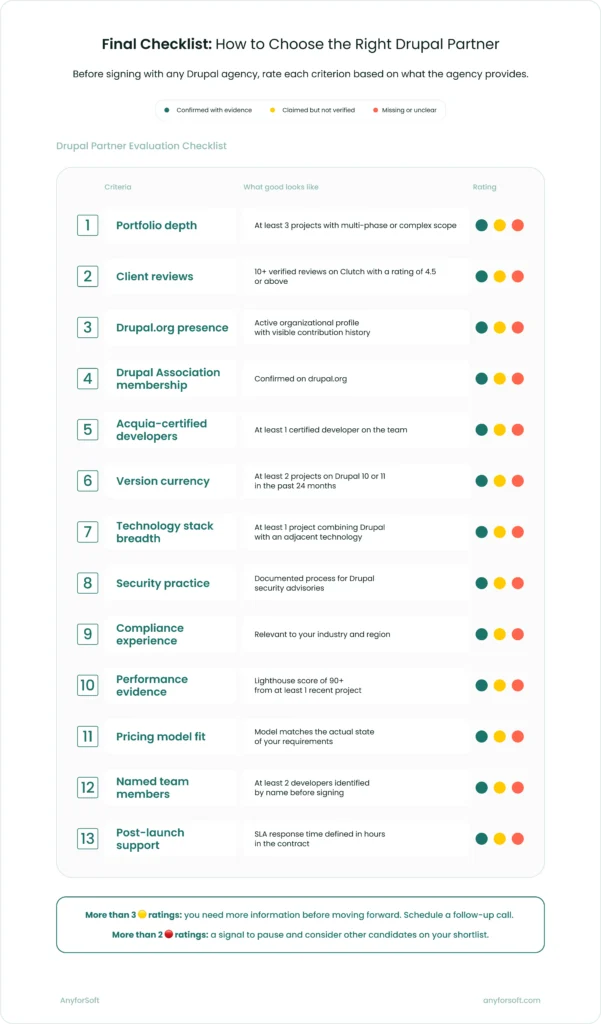
This checklist is an intuitive first-impression tool. It helps structure an initial conversation with a potential partner, not replace a thorough evaluation. A grounded decision about an agency’s reliability and technical expertise requires deeper analysis: reviewing actual code, speaking with past clients directly, and assessing the team assigned to your project.
Questions to Ask Before Hiring a Drupal Partner
How many Drupal projects have you delivered?
The number alone tells you little. What matters is the complexity and recency of the work. Ask for projects delivered in the past two years and request details on the technical decisions involved. An agency with a strong Drupal track record will answer this question with specifics, not a general count.
Do you provide post-launch support?
Post-launch support varies significantly between agencies. Some offer a short warranty period and step away. Others provide ongoing maintenance, security updates, and emergency response under a formal SLA. Ask what is included, what the response time commitment is, and whether support terms appear in the contract rather than in a verbal assurance.
Who will be assigned to my project?
The team presented during the sales process is not always the team that delivers the project. Ask for the names and Drupal experience of the developers who will actually work on your build. A reliable agency will answer this question before the contract is signed.
Which Drupal version did you use in your last three projects?
Drupal 9 reached end of life in November 2023 and no longer receives security updates. An agency still delivering projects on Drupal 9 or earlier is working with an unsupported platform. Ask for specific recent projects built on Drupal 10 or 11. A credible answer names the version and explains the architectural decisions that came with it.
What technologies have you combined with Drupal in production?
Most modern Drupal projects involve more than Drupal alone. Ask the agency to name a delivered project where Drupal worked alongside another technology and explain how the responsibilities were divided across the stack. An agency that can describe that decision clearly has thought about architecture and can be pressed further on specifics.
How do you handle Drupal security advisories?
Drupal’s security team publishes advisories on a regular schedule. Ask for a description of the agency’s process in writing. A reliable partner follows those advisories and applies patches promptly across contributed modules. A vague answer about “staying up to date” without a documented procedure is worth treating as a yellow flag in your checklist.
Have you worked on projects with compliance requirements similar to ours?
Compliance requirements affect architectural decisions, not just content policies. Where they surface in the build — data storage, access controls, deletion workflows — depends on decisions made early in the project. Ask for a concrete example of a project where compliance shaped how the platform was built. An agency with relevant experience will answer that question without hesitation.