



Learners preparing for a licensure or admissions exam want practice they can repeat until the format feels familiar: fresh question sets every week, full mock exams, an explanation for every wrong answer. Exam owners, meanwhile, revise their blueprints, and each revision sends editors back through the question bank. Writing every item by hand stops scaling somewhere between those two pressures.
An approved study guide goes in, and minutes later an AI question generator hands back a set of candidate questions. Whether they’re good enough for exam practice is decided after drafting, by expert review, learner testing and a bank that records every change.
What Is an AI Question Generator?
It’s software that uses a large language model (LLM) to turn lesson text, PDFs or video transcripts into draft questions, each with a stem, a proposed answer key, distractors (the wrong options) and an explanation. Older template-based methods, known as automatic item generation (AIG), fill fixed item models with variables. LLM tools write more freely, so they’re faster to set up and harder to control.
Most tools fall into two groups. A free AI quiz generator handles a one-off worksheet well: paste a chapter and get ten questions back to edit. Question generation built into a test prep platform sends each draft to a review queue with tags for topic and source, and once approved, the item joins a bank the business can search and update when the exam changes.
How Does AI Question Generation Work?
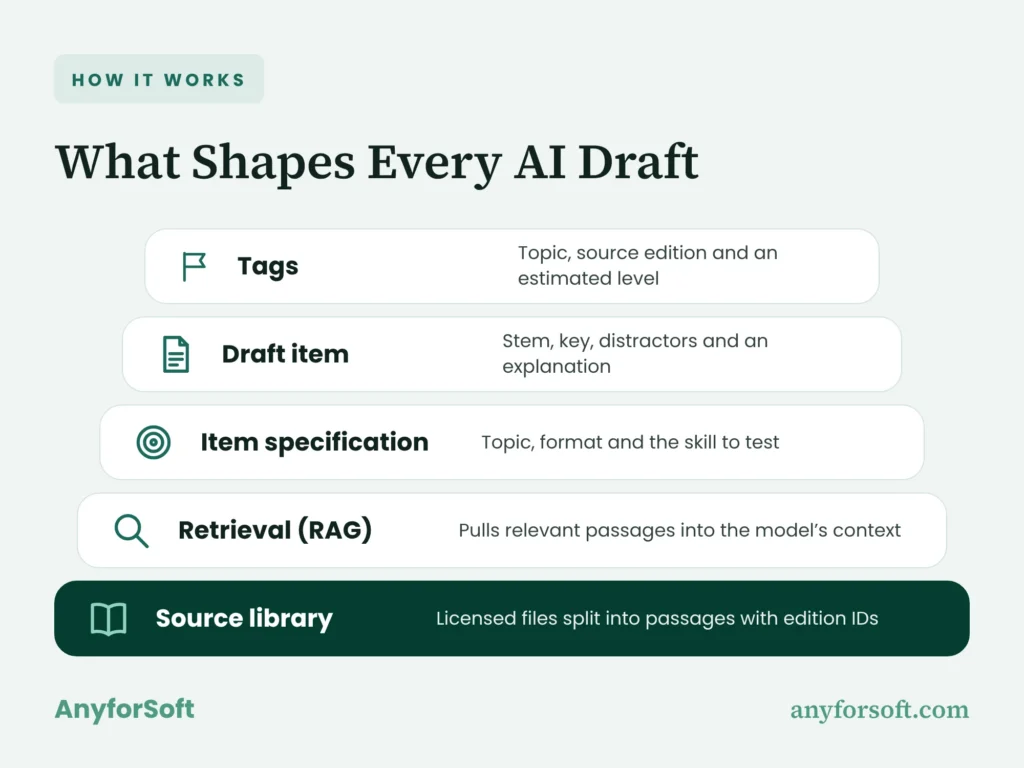
Every draft starts from two inputs: the material the model may use and a specification of what the question should test. A draft that looks finished is still a draft until a subject expert approves it.
Source Ingestion: Grounding Questions in Your Own Content
The source library holds current exam specifications and teaching content the business has the rights to use, such as its own lesson transcripts or a licensed study guide. Each file is split into short passages that keep their source ID and edition, because one rule from last year’s outline can change a correct answer.
When drafting starts, retrieval-augmented generation (RAG) pulls the relevant passages into the model’s context, so it writes from approved materials instead of whatever it absorbed from the open internet. That’s the main defense against invented facts. Passage IDs also preserve content provenance, so a reviewer can open the exact page behind a proposed answer and catch a passage the model misread.
Item Drafting: Question Stems, Answer Keys, and Distractors
An item specification names the topic, the format and the skill the learner should show, for example choosing the next step for a patient with a specific contraindication. Given those constraints, an AI multiple choice question generator produces a stem, four answer choices and a marked key.
Teams use item templates to keep fields consistent, and prompt engineering handles the finer details: one instruction asks for a distractor built on a common misconception, another for a citation supporting the key.
Clinical and legal scenarios are where drafting goes wrong most quietly. A draft can leave out the one detail, like a drug interaction, that makes a different option correct, and still read smoothly. A specialist catches that omission; the model usually doesn’t.
Explanations and Metadata: Topic, Difficulty, and Cognitive Level
Along with the key, the model writes answer explanations for why the right option is right and each distractor fails. Each one gets checked like the key, because a single missing condition turns a confident answer into a misleading one.
Each draft is tagged with its topic, source edition and a predicted cognitive level on Bloom’s taxonomy, such as “apply.” Learners sometimes solve an “apply” item by recall alone, so that label stays provisional until someone sees how they answered. Difficulty is no different: the model’s “hard” is a guess, and it’s stored apart from the difficulty measured once learners have taken the item.
How Good Are AI-Written Exam Questions in 2026?
AI writes capable first drafts. Exam-ready items still depend on expert review and on data from learners who answer the questions.
What Makes a Question Exam-Quality?
A question earns its place when it measures what the exam blueprint says it should. Subject matter expert (SME) review checks the page for:
- one defensible key and plausible distractors
- a reasoning level that matches the exam task
- no answer cueing, such as a key noticeably longer than the other options
- accurate facts and clear wording
- a bias and sensitivity review for assumptions that disadvantage some learners
Seeing how it behaves with real learners takes pilot testing and two numbers. The first, item difficulty, is the share of learners who answer correctly, so a higher number means an easier question. The second, the discrimination index, shows whether stronger candidates get the item right more often than weaker ones; a value near zero means it doesn’t separate them.
A 2026 systematic review by Kıyak and colleagues covered 71 studies of AI-written medical questions and found that most judged quality through expert review alone. That’s the gap a prep business has to budget for: a pilot, before practice scores start guiding how learners study.
Where AI Performs Well
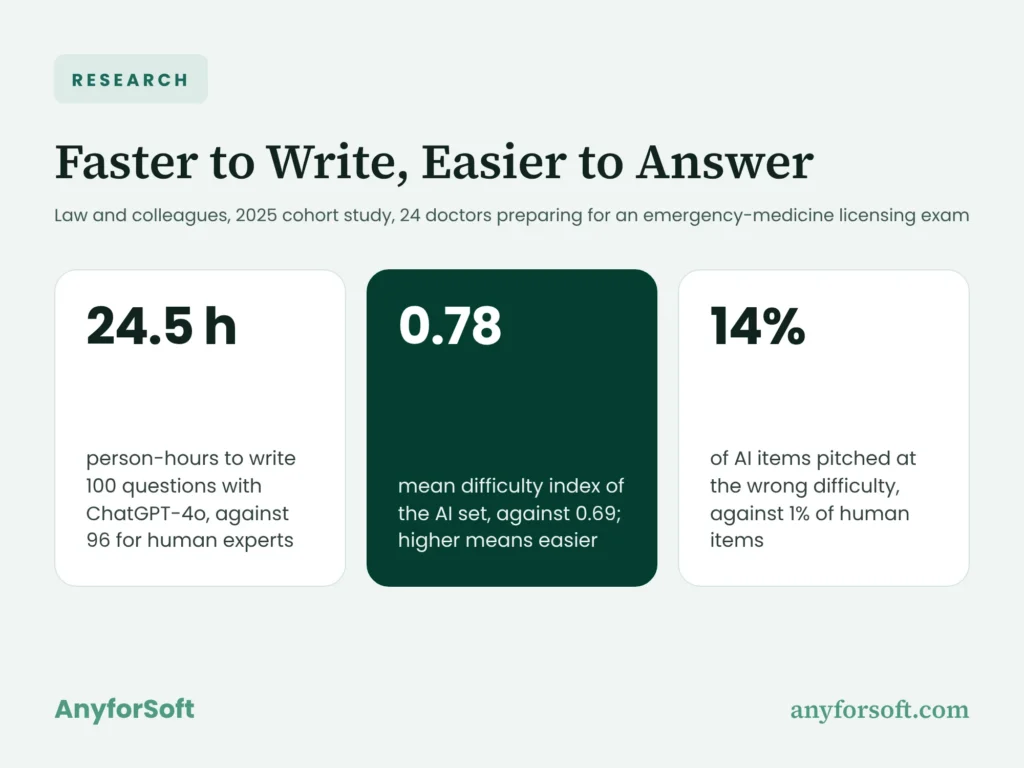
Speed is the clearest gain. In a 2025 cohort study by Law and colleagues, writing 100 questions took 24.5 person-hours with ChatGPT-4o and 96 person-hours for human experts. Editors get a bigger pool of candidate items for their budget, and they’re choosing and fixing drafts instead of facing a blank page.
Quality holds up better than many editors expect. Alani and colleagues pooled 12 studies in a 2026 meta-analysis and found no evidence of a difference in difficulty or discrimination between AI-written and human-written items. The studies came from health professions training, so an NCLEX, SAT or bar exam provider gets its most reliable answer from a small pilot on its own items.
Where AI Still Falls Short
Drafts from an AI exam question generator fail in ways that look fine on a first read:
- a missed exception in a bar exam rule that changes the key
- two options a specialist would both accept
- distractors weak enough to eliminate without solving anything
- near-duplicates of items already in the bank
- recall questions where the exam tests application
The recall problem shows up in data, and so does a second one: questions that are too easy. In the same study by Law and colleagues, 24 doctors preparing for an emergency-medicine licensing exam answered both sets of questions. The AI set was easier, with a mean difficulty index of 0.78 against 0.69, and it mostly tested lower-order skills. Expert reviewers also found more factual errors in the AI items (6% against 4%) and more items pitched at the wrong difficulty (14% against 1%). Alani’s meta-analysis points the same way for licensure: on medical licensing exams, the human-written questions were harder.
Practice that’s gentler than the real test sends learners into the exam overconfident. Automated hallucination checks catch invented facts, but an accurate, too-easy question only surfaces when editors compare drafts with approved reference items.
Why Do Prep Businesses Need More Than a Free AI Quiz Generator?
A free tool solves drafting. A prep business also has thousands of items that must stay accurate and findable as courses multiply, with learner data kept private.
Generic Tools vs. a Prep-Specific Workflow
Manual review in a shared folder works for a tutor writing a hundred questions a month for one course. Trouble starts when one question appears in five practice tests across three courses and its answer changes: every copy has to be found, corrected and re-approved. Those hours rarely show up when tools are compared, but they’re what decides whether AI drafting delivers lower item-writing costs.
One-Off AI Question Drafting vs. Managed Test Prep Workflow
| One-off drafting tool | Managed prep workflow |
| Output copied into files | Item stored with source and status |
| Reviewer decisions kept separately | Approvals and revisions logged |
| Exam updates checked manually | Affected items flagged for review |
| Uploads handled under the tool’s terms | Content and learner data stay on the platform |
A basic AI test generator produces drafts and stops there. In AI test prep that spans courses, it’s the record around each item that carries the weight. Some LMS platforms already keep part of it, and a custom layer earns its cost once item-sharing or simulation rules outgrow them, turning the bank into scalable practice content.
Owning Your Item Bank, Content, and Student Data
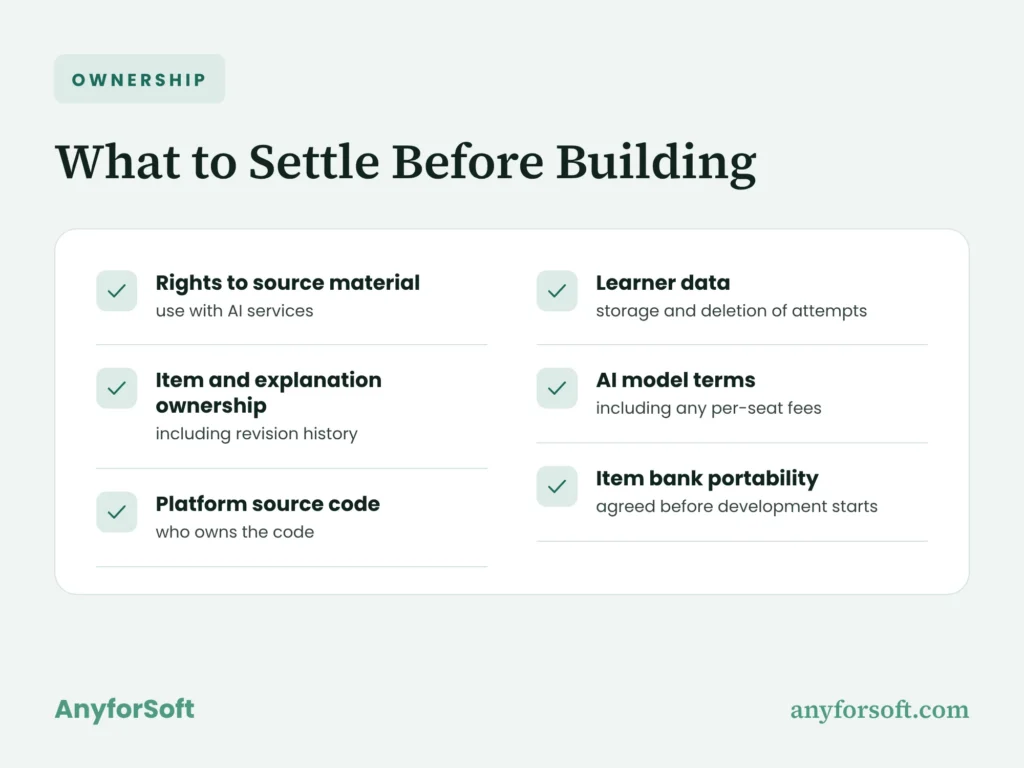
Buying a publisher’s study guide doesn’t usually include the right to send its chapters to an AI service. Licensing terms come first, then the terms of every system the item bank passes through:
- ownership of the items, explanations and revision history
- source code ownership for the platform
- storage and deletion of learner attempts and reviewer accounts
- the third-party AI model’s terms, including any per-seat fees
When a business commissions a custom test prep LMS, the development contract settles those terms. Portability is easier to agree on before development starts, since a bank locked in a proprietary format makes any later platform move expensive.
Keeping Pace with Exam Format Changes
The NCLEX-RN shows that exam changes come on a schedule. The nursing licensure exam’s current test plan took effect on April 1, 2026, and runs through March 31, 2029, so every provider teaching to it had to decide which older practice questions to revise, and will face the same decision again at the next update.
With blueprint tags and version records, that job is a filtered list in the review queue. Without them, it’s a search through folders, and an outdated explanation can stay live for months. New timing, navigation or scoring rules also have to reach exam simulation, or full mock exams stop feeling like the real test.
How to Write Practice Questions with AI Without Losing Quality: A 6-Step Workflow
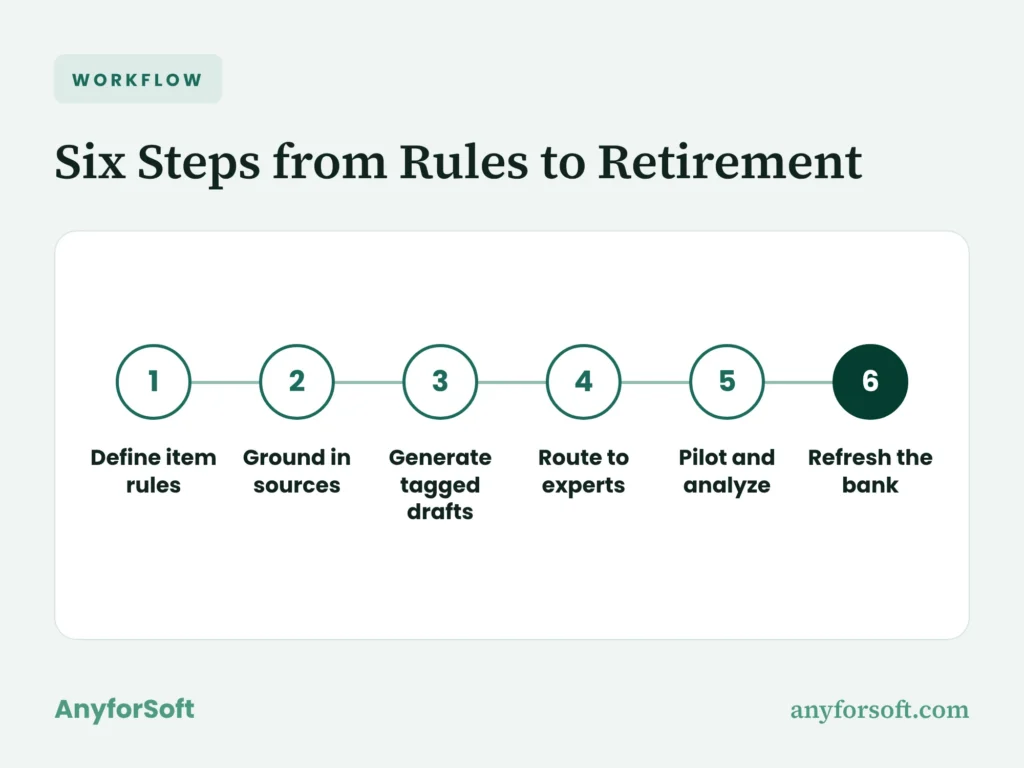
Six steps take an item from rules to retirement: define the exam blueprint and item rules, ground the model in approved sources, generate tagged drafts, route each item through expert review, pilot the approved items, and keep the bank current as the exam changes. Each step leaves a record, so a correction made at review reaches the live bank.
Step 1 — Define the Exam Blueprint and Item-Writing Rules
Before any drafting, an assessment lead turns the target exam’s official content outline into rules a model can follow. For an SAT-style algebra item, that means naming the skill (linear equations in one variable), the format and the reading level. On the College Board’s Educator Question Bank, educators filter official SAT questions by content domain and skill, and that’s a structure a prep team can copy for its own tags. The specification sheet records:
- topics and their weightings in the exam blueprint
- allowed question types and number of options
- reading level and expected reasoning
- rules for keys, distractors and explanations
Even an AI practice exam generator needs this detail, because “make it hard” leaves every decision to the model.
Deliverable: an approved item specification sheet.
Step 2 — Ground Generation in Approved Source Content
Next comes the curated source library, the only material the model draws from. For each lesson or guide, editors confirm the license allows sending it to an AI service, record its edition and source ID, and add the exam owner’s current guidance with its effective date. Access rules decide who can replace a file, since one outdated passage can quietly produce a whole set of wrong keys. A retrieval log links every draft to its passages, so a correction months later doesn’t miss any affected item.
Deliverable: a versioned, permission-checked source library.
Step 3 — Generate Drafts with Tags and Explanations
Working from the specification and an approved algebra passage, the AI question generator drafts a four-option equation problem with a key and an explanation. One distractor reflects a common sign error, as the specification asked. Source and topic tags are firm; the predicted cognitive level and difficulty stay marked as estimates.
Drafts then go to an AI practice test generator that assembles a candidate practice set, though assembly doesn’t make any item publishable. Automated checks catch a missing key, a repeated stem or the wrong number of options. Problems of meaning slip past them.
Deliverable: tagged draft items, clearly marked unapproved.
Step 4 — Route Every Item Through Expert Review
In the review queue, a math specialist spots what the automated checks missed: two options in the algebra draft, 0.5 and 1/2, are the same value. The item goes back for a fix. Every draft gets four checks:
- accuracy: the cited source supports the key, with no missing exception
- exam fit: the item tests the intended skill, and the options don’t signal the key
- fairness: no unnecessary assumption disadvantages a group of learners
- clarity: the stem and options have only one reading
The reviewer approves, edits or rejects, and the approval workflow saves that decision with the reviewer’s name and the item version. Clinical and legal items often get a second specialist, logged the same way.
Deliverable: a review queue with an approve, edit or reject log.
Step 5 — Pilot Items and Run Item Analysis
Once approved, the algebra question goes into a timed practice set. After enough learners at the right level have taken it, the report shows the share who answered correctly, the discrimination index and how often each option was chosen. If almost nobody picks the sign-error distractor, the editor rewrites that option or pilots the item again.
Sample sizes and cutoffs depend on the exam’s intended use, and assessment staff set them; there’s no single threshold that proves an item valid. Weak items are revised or retired, borderline ones are piloted again, and each decision is logged.
Deliverable: an item analysis report on difficulty, discrimination and distractor performance.
Step 6 — Retire, Revise, and Refresh the Item Bank
After release, the algebra question keeps its source, blueprint tags and a record of who approved it against which blueprint version. With item versioning, a live question can change without its history disappearing. Refresh reviews come from:
- a new exam specification, or a changed clinical or legal reference
- weak results in later learner attempts
- a scheduled review date
Learners see the latest approved version. Editors keep the earlier ones, so it’s easy to check a correction when someone challenges it.
Deliverable: a versioned item bank with a refresh schedule tied to exam updates.
Which Features Should an AI-Ready Test Prep Platform Have?
Short practice sets need review controls and a versioned item bank first. Full-length mock exams add strict timing, navigation and exam-accurate scoring, while advanced analytics can wait until learners have produced enough responses to study.
Human-in-the-Loop Review and Editing
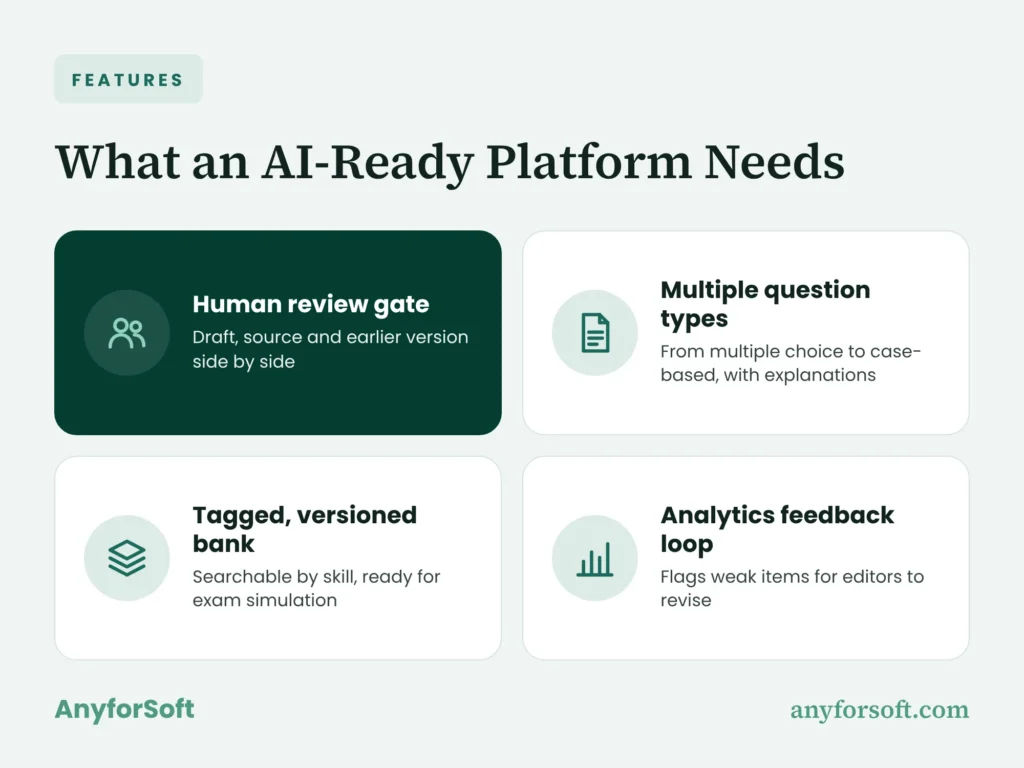
The review screen is where AI drafting either saves editors time or eats it. With the draft, its cited source and the previous version side by side, a disagreement about an answer choice gets settled by evidence on screen. Permissions decide who can approve, who can only comment and which items need a second specialist. Keeping a human in the loop at that gate holds consistent question quality as the team grows, and disputed questions stay out of live tests until someone authorized signs off.
Multiple Question Types with Built-In Explanations
A case-based clinical item and a four-option algebra question don’t share instructions or scoring. Depending on the exam, the platform supports:
- multiple-choice and multiple-answer items
- true/false checks for simple concepts
- short answers, often graded by hand
- case-based items built around a scenario and a decision
Drafting all four is within reach of an AI exam generator, though each type’s scoring and accessibility need testing before release. Explanations attached to every item let learners understand a mistake before the next attempt instead of just seeing a red mark.
Item Bank Tagging, Versioning, and Exam Simulation
Tags make a bank searchable by subject, skill, blueprint area, source edition and release status. Release status keeps retired or unapproved questions out when a practice test mixes old and new items. Duplicate flags stop near-identical questions from landing in one test, and version history ties each live item to its review.
For full-length mock exams, exam simulation has to match the target exam’s timing and scoring rules. Adaptive difficulty at the module level, as on the digital SAT, is a separate decision, and it’s worth making only when the target exam works that way.
Performance Analytics That Feed Back into Generation
Response data tells editors where to look. A question nearly all learners get right probably lacks challenge; one that takes twice the usual time is often confusingly worded. The analytics flag items, and editors decide:
- item signals: low discrimination, a distractor nobody picks, unusual response times, and error-type tagging that links each wrong answer to a misconception
- learner signals: completion rates, repeat attempts and return visits, which track student engagement
When learners keep missing linear equations, the platform suggests an approved practice set on that skill. Higher pass rates are a claim to measure with a before-and-after comparison, since engagement alone doesn’t show improved learning.
From Concept to Live Platforms: AnyforSoft Assessment Case Studies
Review controls, exam-accurate delivery and performance reporting all appear in AnyforSoft’s assessment work: one design concept for AI-assisted authoring and two delivered platforms.
AI-Assisted Quiz Creation (Concept)
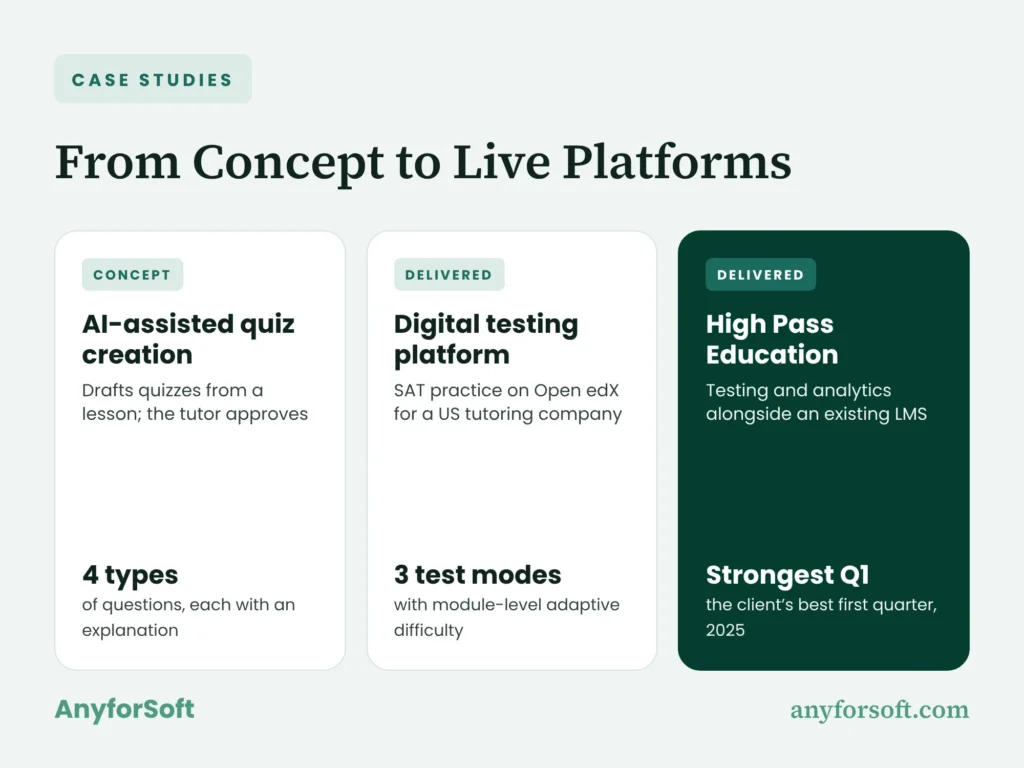
For online course teams, writing a quiz after every lesson takes time tutors would rather spend teaching. AnyforSoft’s concept for AI-assisted quiz creation describes an assistant that drafts quizzes from the lesson itself and leaves every decision with the tutor.
- inputs: a recorded lesson, its text, or files the tutor uploads
- question types: single- and multi-answer choice, true/false and short answer, each with an explanation
- tutor controls: editing, reordering and publishing once the drafts are checked
The design goal is shorter quiz preparation, with the tutor’s approval as the final gate. It’s the review-first approach a prep business needs, scaled up to a full item bank.
Digital Testing Platform (Delivered)
A US tutoring company wanted SAT practice that felt like the digital exam its students would face. AnyforSoft built the company a digital testing platform with Open edX at its base, modeled on the College Board’s own practice app, and took testing and grading off paper.
- for learners: three test modes, module-level adaptive difficulty, SAT-style scoring and PDF score reports
- for staff: a proctor cabinet for supervising sessions, an admin panel and two-way Salesforce integration
Most of the tasks the company used to handle manually are now automated. For a prep provider, it shows that exam-accurate simulation and automated grading fit on an open-source LMS they’re likely running already.
High Pass Education (Delivered)
High Pass Education trains mental health professionals for the certification exams that open the way to private practice. Instead of replacing the company’s LMS, AnyforSoft built testing and analytics that work alongside it, so learners got exam-specific practice inside the course platform they already knew.
- testing: configurable test structures, per-learner time limits, attempts and passing thresholds, and speedrun tests for accuracy under time pressure
- reporting: comparisons across attempts that separate knowledge gaps from time-management issues, plus question-level statistics for administrators
The client reported its strongest first quarter to date in 2025. Those question-level statistics are what AI drafting would build on, since they’re the data editors need: the most common response to each question and the average time spent on it point to the items worth revising.
Why Test Prep Businesses Choose AnyforSoft
AnyforSoft is an EdTech partner that builds assessment and exam delivery platforms and extends existing LMS platforms with testing and reporting layers. For prep businesses, that covers the parts of AI drafting that need the most support: review, exam-accurate delivery and the data behind item decisions.
15+ Years Building EdTech and Assessment Platforms
Founded in 2011, AnyforSoft has worked in EdTech for more than 15 years, and education is the focus of most of its 150+ delivered projects. More than 80 engineers make up the team, and 88 client reviews give the company a 4.9 rating on Clutch. Its assessment projects range from digital SAT simulation to licensure-prep analytics layered on an existing LMS. Prep businesses get a team that already knows how exam timing and proctoring have to work.
AI Built Around Expert Review, Not Instead of It
AnyforSoft’s AI solutions for education include adaptive assessment and automated grading. An authoring workflow for a prep business follows one rule: the model drafts, and a named expert approves. Source links, reviewer permissions and release gates live in one workspace, so every published item traces back to the version someone signed off. Second reviews for clinical or legal items and item analysis after piloting extend that gate.
Full Ownership of Your Platform, Source Code, and Item Bank
A custom platform is an asset the prep business keeps. The contract assigns the source code, the item bank and its revision history to the client, with export in an open format if the business ever changes platforms. Licensed study materials and third-party AI models keep their own terms, and those get reviewed before any content reaches a model.
Phased Delivery: Discovery, Proof of Concept, Full Build
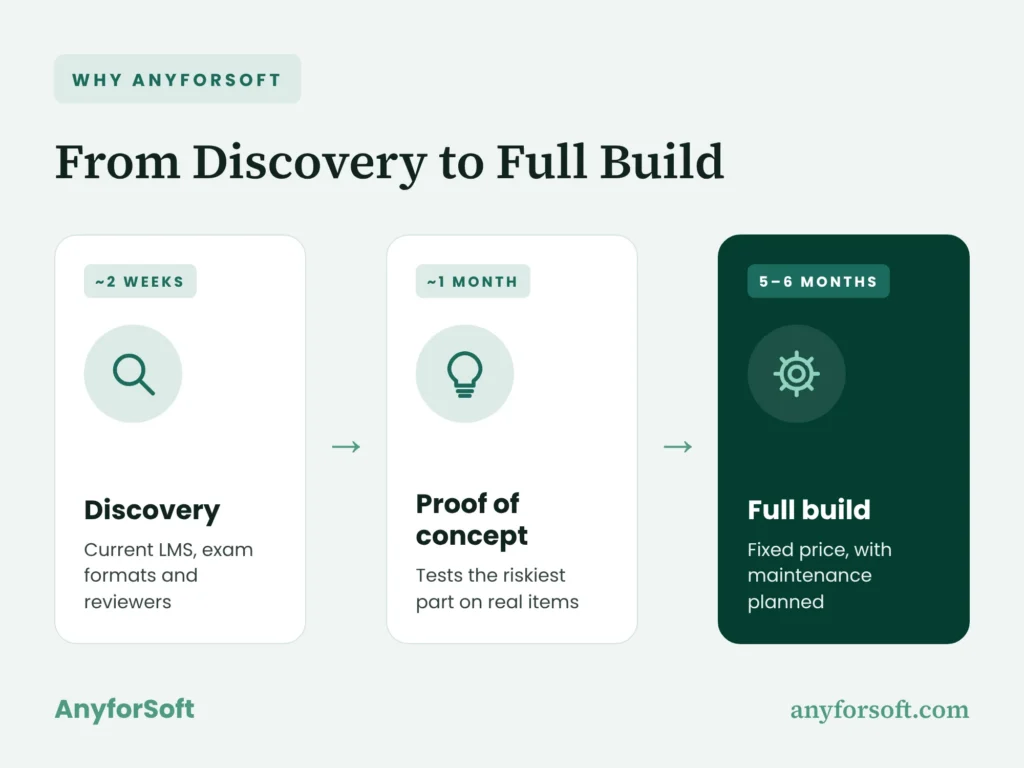
Work starts with discovery, about two weeks spent on the current LMS, the target exam formats and the people who review questions today. A proof of concept, roughly a month long, then tests the riskiest part, such as source-linked drafting or the review queue, on real items. The full build takes around five to six months at a fixed price, with maintenance planned from the start.
Frequently Asked Questions
What is an AI question generator, and how does it work?
The tool drafts exam questions with a large language model, working from material you provide, such as a lesson transcript. Each draft includes a stem, options, a proposed key and an explanation. In a prep workflow, drafts come from approved sources and wait in a review queue for a subject expert.
Are AI-written questions reliable enough for high-stakes exams like the NCLEX or SAT?
Not without review. Pooled studies find AI-written questions roughly match human ones on difficulty and discrimination, yet individual sets can come out easier and lean on recall. An NCLEX-style scenario can omit the clinical detail that decides the answer, and an SAT-style item can offer two equivalent options. AI-drafted items become usable for high-stakes practice once a specialist has checked them against the current test plan and a pilot has confirmed how they perform.
Is a free AI quiz generator enough for a test prep business?
For a tutor making a few worksheets a week, often yes. Once courses share items, though, a corrected answer has to be found and fixed by hand in every copy, because free tools don’t track sources or approvals. Uploads also fall under the tool’s own terms, which matters for licensed material.
How do you review and validate AI-generated exam questions?
Validation has two stages:
- expert review: the key follows from the cited source, one answer is defensible, the distractors are plausible, the item tests the intended reasoning
- pilot data: item difficulty, discrimination and distractor choices
Together, the two decide whether an item is approved, revised or retired.
What are the biggest risks of AI-generated test questions?
The worst errors look plausible: a key based on an outdated rule, two acceptable answers, a clinical exception left out of a scenario. Questions easier than the real exam give learners false confidence. Sending licensed content to an AI service without permission is a business risk of its own.
Who owns the questions an AI test generator creates?
Three sets of terms decide it: the AI provider’s, the source materials’ license, and the contract with whoever builds or hosts the platform. Major model providers generally assign outputs to the user, though a question closely based on a licensed study guide may still fall under that guide’s license. Copyright law on AI output is still developing, so an edit history showing expert revision is worth keeping.
How much does it cost to add AI-assisted item writing to a test prep platform?
It depends on what the current platform already does. If the LMS stores and delivers questions, the development goes mostly into the authoring layer: source handling, the review queue, versioning and analytics. Model usage and expert review time make up most of the running costs. The factors behind custom LMS development cost, from integrations to analytics, shape this budget as well.
Can AI drafting tools be added to an existing LMS like Moodle or Open edX?
Moodle and Open edX keep delivering tests while a separate authoring service drafts and reviews questions, then publishes approved items to the LMS question bank. AnyforSoft’s digital testing platform, for example, runs on Open edX with custom layers on top. The integration has to carry each item’s tags, version and source reference, and return learner results for item analysis.
Can ChatGPT generate exam questions, and which AI models work best in 2026?
ChatGPT drafts exam questions with keys and explanations, and so do other general-purpose models such as Claude and Gemini. No single model is best for every exam, and rankings shift with each release. A fair comparison gives two or three models identical sources and specifications, then counts how many drafts pass expert review. For licensed material, a business account that doesn’t train on submitted content is the safer choice.
How can AI use learner performance data to improve and personalize practice questions?
If learners keep missing word problems with fractions, the platform serves an approved practice set on that skill while editors check whether a confusing item is part of the problem. Distractors nobody picks and items with low discrimination show editors what to change in the item specification, so later drafts improve. Claims about higher pass rates need a measured comparison first.