




Corporate L&D, Associations and CE
Strategy & Discovery
Innovative education platforms
Build & Launch
Online training solutions
Grow & Support
Creative content & apps
Platform & Technology Expertise

Gamification Software Development for E-Learning and Corporate Training

Employees start your courses and stall before the final module. AnyforSoft builds corporate training gamification into the LMS you already run, so they come back and finish.

Get a Free Consultation
Partners, not just projects

Behind each logo is a long-standing relationship, built on trust as much as delivery.

The Business Impact of Gamification in E-Learning and Corporate Training

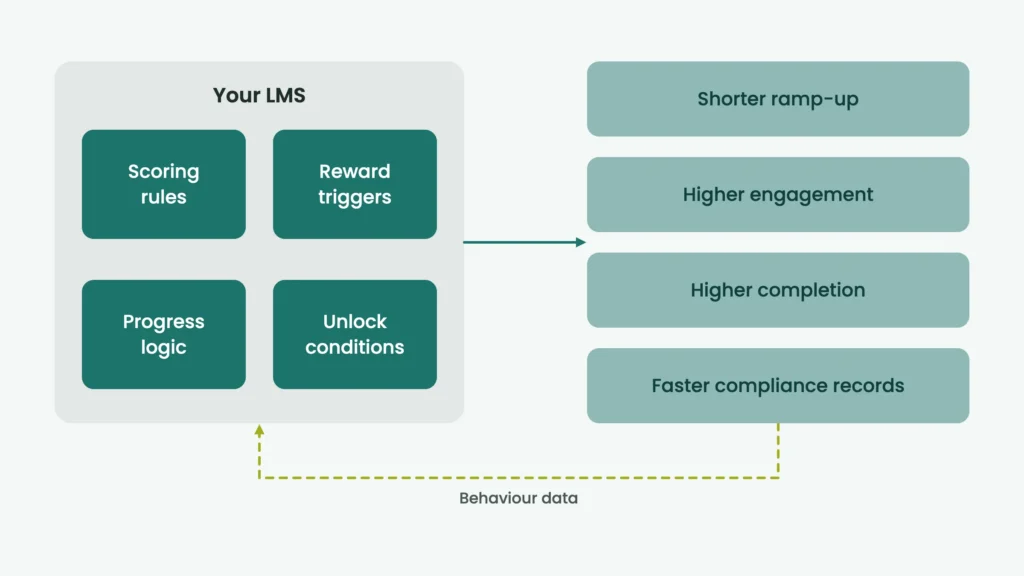
Real gains in finish rates come from gamification software engineered into the system a company already runs. Scoring rules, reward triggers, progress logic, and unlock conditions shape how employees move through their courses. The design choices show up in the numbers L&D leaders report:

  • Ramp-up for new hires shortens when onboarding paths show progress and mark each milestone reached
  • Learner engagement rises as employees return to unfinished modules between working sessions
  • Course completion rate climbs where the reward pacing matches how quickly people actually work
  • Compliance records close faster, with fewer manual chases from the training team
  • Students in EdTech products come back to the environment between assignments

AnyforSoft builds these mechanics into the client’s own stack, so the rules stay editable as behaviour data comes in.

Gamification Development Services We Deliver

Points, Badges, and Leaderboards Development

Most clients ask what earns a point and who tops the board, then discover that the design choices decide whether people care. Earning rules and ranking scope built around your goals turn LMS gamification into something employees check rather than ignore.

Custom Achievement and Reward Systems

Recognition loses its pull once employees work out that showing up earns the same recognition as doing the work. Trigger logic tied to real behaviour keeps streaks and unlockable content worth pursuing months after launch.

Progress Tracking and Level Design

Employees abandon courses when they cannot tell how far they have come or how much is left. Level pacing and progress bars tuned to your content length hold people through the middle stretch, where drop-off concentrates.

Gamified Assessments and Quizzes

Scored attempts, retry loops, and instant feedback do more for knowledge retention than a single pass-fail test at the end. Assessment engineering built into your environment covers the scoring, the attempt logic, and the analytics behind e-learning gamification.

Social and Team-Based Gamification Features

Points earned alone carry little weight in teams that already compete and compare on their own. Cohort challenges and peer recognition lift employee engagement through corporate training gamification that uses the group dynamics already there.

Custom Gamification Engine Development

Subscription tools sell the engine prebuilt, which caps what your rules can ever do. Owning the engine means your scoring, events, and reward logic stay extensible, and it is often built alongside custom LMS development when the gamification software has to reach deeper into the learning system.

Gamification Tech Stack and Integration Capabilities

The mechanics plug into the stack you already run, reaching your data through the standards your learning system speaks.

LMS and LXP Integration (SCORM, xAPI, LTI)

Ranking and reward data stranded inside a separate tool tells your admins nothing about who is falling behind. Three standards carry the load, packaging course content, recording detailed activity statements, and connecting external tools securely. Scores flow both ways, so a stalled cohort surfaces on the dashboard your team already opens each morning.

API Integration and Third-Party Integrations

An employee hits a milestone, and their manager never hears about it. Endpoints into your CRM, HRIS, SIS, and analytics tools let a finished module raise an HR record or trigger a manager notification, which puts recognition in front of the person who can act on it within the hour.

Cloud-Native and Scalable Architecture

When end-of-quarter compliance pushes and enrollment waves land together, rankings freeze exactly as attention peaks. Containerised services scale horizontally through those surges, and mobile-friendly gamification holds up for staff checking standings from phones between shifts.

Real-Time Leaderboards and Notifications

Between doing the work and seeing it counted, motivation decays. Live rankings and reward alerts update the moment someone acts, which matters in corporate gamification programs where teams compare standings daily and achievements register while the effort still feels recent.

Security and Data Privacy (GDPR)

Behavioral records capture timing, pacing, and navigation patterns for every participant. Role-based access, encryption in transit and at rest, consent handling, and EU residency options let your compliance team answer an audit request from existing documentation rather than a scramble.

AI-Powered Gamification and Adaptive Engagement

AI systems from AnyforSoft already run in production, including a website-native assistant for Wittenborg University and a photo-verification build for FilterSync. Each one extends what the client already had, with a person keeping control of the edge cases.

Adaptive Challenge Difficulty

Hand-tuned difficulty settles on the average participant and loses both ends of a cohort. Models reading how someone moves through a module apply adaptive learning to the next challenge. Rewards arrive when each person has earned them, which is how AI gamification paces admissions journeys too.

Personalised Next-Step Recommendations

Participants who finish one module often stall on choosing what to do next. Recommendation logic points them toward the task worth doing, drawing on what they completed and where they slowed. Teams running upskilling programs get fewer people parked on content that stopped matching their level.

Behavioural Analytics for Engagement Optimisation

Fading interest reaches your finish rates weeks after the first signal appears in the data. Return visits drop and pace through assessments slows before anyone stops logging in. Analytics built into e-learning gamification surface those patterns early, and your product owners decide which signals feed the model.

What we have accomplished
Each cohort that runs now finishes at the rate you already have. Share your requirements and we scope the mechanics that move it.

LMS and E-Learning Platforms We Gamify

Moodle

Plugin-based scoring hits its ceiling once your grading logic gets specific. Progress and scoring rules built natively into the codebase keep your course structure and grade calculations untouched.

TalentLMS

Admins lose time moving between a separate incentive tool and the place they actually manage courses. Earning rules and team challenges connect through the API, so daily administration stays in one screen.

Docebo

Standings that update on an export schedule reach your L&D team after the moment has passed. Ranking displays and achievement triggers sync live, removing the manual report pull from the weekly routine.

Canvas

Students track assignment deadlines closely and their overall progress barely at all. Progress visibility and mastery badges extend the environment for academic cohorts, putting standing next to coursework.

Cornerstone OnDemand

Compliance reporting structures resist anything bolted on beside them. Recognition rules and completion paths plug into the existing reporting model, so enterprise programs keep their audit trail intact.

Purpose-Built Learning Environments

Teams running their own product own the roadmap and the constraints that come with it. Engineering LMS gamification straight into the codebase keeps the rules yours to change as behavior data arrives.

How We Build Custom Gamification Solutions

Five stages take you from an audit of what you run now to a live release with a roadmap behind it.

Discovery and Engagement Strategy

Discovery starts with what your data shows about where people stall. An audit of your setup and goals defines which actions need to change and which numbers track them. Motivation patterns in your cohorts shape what gets designed for gamification for training. You leave with an engagement strategy document and an integration map.

Game Mechanics Design

Rules that work on paper collapse the first time someone finds the shortcut. Scoring logic, reward triggers, and levels get specified in full. Wireframes then let the flow be walked through before anyone builds it. A full specification and a working prototype come out of this stage.

Development and LMS Integration

Scoring built beside the learning system leaves your admins reconciling two sets of records. Front-end components and engine code go into the environment your teams already run, connecting through its standards. Conformance to SCORM keeps course content and completion data moving as before. Your team gets a working solution in staging to test before release.

Testing and Learner Feedback

Reward pacing tuned by assumption reads as generous to some participants and stingy to others. A pilot cohort works through the flow while QA covers the technical side, and observed behaviour drives adjustments to difficulty and pacing. Watching real learner experience beats predicting it from a spec. The stage closes with a pilot report and a tuned set of rules.

Launch and Iteration

Engagement rules go stale as people work out how to game them. Production release comes with monitoring on the metrics defined at discovery, plus a scheduled cadence for revisiting the rules. Data from the first quarter usually reshapes at least one reward threshold. Your live release ships alongside an iteration roadmap.

Industries We Build Gamified Learning and Training Solutions For

Corporate L&D and Employee Onboarding

New hires ramp up faster:

  • Guided paths with visible progress
  • Corporate training gamification inside your setup

Higher Education

Students stay with the coursework:

  • Engagement mechanics in your portal
  • Finish rates up across cohorts

Healthcare Certification

Certification records stay audit-ready:

  • Progress tracking and renewal prompts
  • Audit prep down to hours

Retail

Store staff learn on shift:

  • Short mobile challenges between customers
  • Product knowledge without floor time lost

Government

Every stage proves completion:

  • Verified checkpoints and badges
  • Full history for auditors

Professional Certification

Candidates see the finish line:

  • Milestone progression and stage gates
  • More accreditations reached and renewed

Sales Training

Reps compete on real numbers:

  • Leaderboards tied to performance metrics
  • Enablement finished on time

Compliance Programs

Submissions land before the cutoff:

  • Reward rules and automated reminders
  • On-time finish rates climbing
Ready to Add Gamification to Your E-Learning or Training Platform?
Tell us which numbers need to shift. We map the gamification software that moves them.

Why Choose AnyforSoft for Gamification Development

E-Learning and LMS Domain Expertise

Agencies new to learning platforms spend the first month learning your data model. AnyforSoft has built assessment layers, portals, and integrations for education and workforce L&D clients, so the mechanics get designed by people who already know how these systems store progress. That shows up as fewer discovery questions and faster answers when edge cases appear, including on corporate e-learning development work.

Custom Game Mechanics, Not Templates

Settings panels offer a fixed set of switches, and your reward logic has to fit inside them. Rules, thresholds, and visuals get designed around your people and goals instead, with gamification software built to your specification. Your team can raise the bar for earning a badge when the pilot data says so.

Flexible Engagement Models

Buying a subscription commits you to one way of working with a vendor. A dedicated development team suits a full product build, while staff augmentation fits companies extending an in-house group.Product companies packaging game features for their own customers take the white-label gamification module route.

Proven Track Record in Education Technology

Vendors without education clients learn the compliance and accessibility constraints on your project. Platform, assessment, and custom gamification development work has already shipped for education and training organisations here. Game mechanics come out of the same team behind the wider e-learning software development services on offer.

Proof of Concept for a US University: How We Gamified the Admission Process

Applicants at a US university were dropping out of a long, multi-step application partway through. The flow AnyforSoft built rebuilds the stages where they stalled:

  • Structured micro-steps with visible progress at every stage
  • Completion badges and an evolving avatar that grows as the form advances
  • An AI assistant answering questions inside the flow
  • Program matching and lead scoring that surface strong candidates early

A working proof of concept has been delivered. A 30–40% increase in application completion rates is expected once the full build goes live.

FAQs

Is AnyforSoft a game design or instructional design studio, or does it build the technology behind gamification?

We are a software engineering company. The mechanics, the engine, and the connections into your existing setup are what we build, and gamification software is engineered to your rules rather than configured from a template. Course authoring and instructional design stay with your team.Gamification consulting runs inside the engineering engagement, shaping which game features fit your goals before anyone writes code.

What gamification features can be added to an LMS, e-learning platform, or corporate training program?

Most requests cover points, badges, leaderboards, levels, streaks, rewards, team challenges, quizzes, progress tracking, and notifications. Which combination works depends on what your people respond to, and the LMS gamification features guide walks through how each one behaves in practice. Mechanics get selected during discovery from your own participation records.

How long does it take to build a custom gamification module?

Scope, the number of mechanics, and the depth of connection into your setup drive the timeline. A typical build runs:

  • 3 to 5 months from discovery through to launch
  • Closer to 3 for a focused set of tools on one system
  • Closer to 5 when several systems exchange data both ways

Discovery produces a dated plan before development starts.

Can gamification features integrate with our existing LMS or training platform?

Yes, through published standards and APIs, with data moving both ways. Activity statements travel over xAPI, so a completed challenge lands in your reporting alongside course records. CRM and SIS connections already run in our work, including Salesforce, Slate, Ellucian, and Workday. Scoping starts with an audit, described under LMS integration.

What is the cost to add gamification to an e-learning or corporate training platform?

Feature count and connection depth set the range. Typical figures:

  • $50K–$75K to start, for a defined set of features
  • Higher as systems, roles, and reward logic multiply
  • Detailed breakdown produced at discovery, once requirements are clear

Weigh the number against training ROI on the programs affected, since finish rates and ramp-up time both carry a cost today.

Which engagement mechanics work best for corporate training vs. academic e-learning?

Workplace programs respond to team challenges, habit loops built on streaks, and recognition tied to performance. Certification training adds renewal prompts and stage gates that mark verified progress. Academic settings do better with progress visibility, levels, and mastery-based rewards. Which set holds up gets tested against your real participation data, and e-learning gamification is tuned from what that shows.

How do you measure the impact of gamification on learner engagement and training completion?

Baselines get captured before launch, so every later number has something to compare against. Work on gamification for training is then tracked on finish rates, time-to-complete, return frequency, assessment scores, and drop-off points. Cohorts running with the mechanics are compared against those without. Rules get adjusted from what the comparison shows.

How does post-launch support work for gamification features?

Monitoring runs on the metrics defined at discovery. Rule tuning follows the data, since reward thresholds that worked at launch often need moving after a quarter. New mechanics go onto a roadmap you set the priorities for. Version compatibility with your learning system is maintained, and support terms are agreed in an SLA.

How is AI used to personalize gamification in modern LMS platforms?

Models read how someone moves through a module and adjust difficulty to their pace. Next-step recommendations follow from what they finished and where they slowed. Reward pacing personalises the same way, so incentives arrive when they still register. Behavioral signals flag fading interest early, giving your team time to act before someone stops logging in.

Can AI-driven gamification improve training completion rates and reduce onboarding time?

The mechanism is straightforward: stall points get identified, then pace and incentives adjust per person. New hires stop waiting on content that no longer matches what they know. Whether that shows up in your numbers depends on your baseline and cohort, which is why corporate gamification work starts with measurement rather than assumptions.


Ready to see more learners finish?

Tell us where learners drop off. We’ll send back a scoped plan for gamification software development.

Let’s talk
Vlad
Vlad

Business Development Manager

Anatolii
Anatolii

CEO