
















FAQs
What is custom association management software?
It is a system built around how a specific organization already manages members, dues, and events, instead of a fixed template. It typically covers membership records, billing, event coordination, and reporting in one connected platform. The build starts from what’s already in place, keeping staff workflows intact instead of forcing a redesign.
How is custom AMS different from off-the-shelf platforms like Wild Apricot or MemberClicks?
Off-the-shelf platforms ship with fixed workflows that every customer uses the same way. The off-the-shelf vs. custom AMS divide shows up once an organization’s structure gets more complex than that fixed workflow supports, like multiple chapters or tiered dues. Custom AMS is built around actual rules from the start, so structure doesn’t have to bend to fit the software.
How long does it take to build a custom association management system?
Timeline depends mainly on scope: how many integrations are needed, how much data has to migrate, and how many distinct user roles the system supports. A single-chapter organization with standard dues typically takes less time than a multi-chapter platform with several integrations.
- Simple membership database and portal: shorter timeline
- Standard build with dues, events, and one or two integrations: mid-range timeline
- Multi-chapter or multi-association platform with several integrations: longer timeline
A detailed scope during discovery determines the specific number of weeks.
How to build a school management system?
Building a solution for K-12 institutions is a complex process. It involves multiple steps. Each development company has a different approach to it. Typically, the process looks as follows:
- Requirement gathering. At this stage, the dedicated team communicates with key stakeholders (school administrators, parents, teachers, and students) to gather requirements and define the features of the system.This typically involves interviews and working sessions with each stakeholder group.
- Planning and design. This phase considers various teaching methods and user experience strategies to create an intuitive system. Developers define the system architecture and design the database structure. The interface is built around the workflows identified in the previous stage. They also choose the tech stack, utilizing the latest technologies to build a future-proof and scalable software solution.
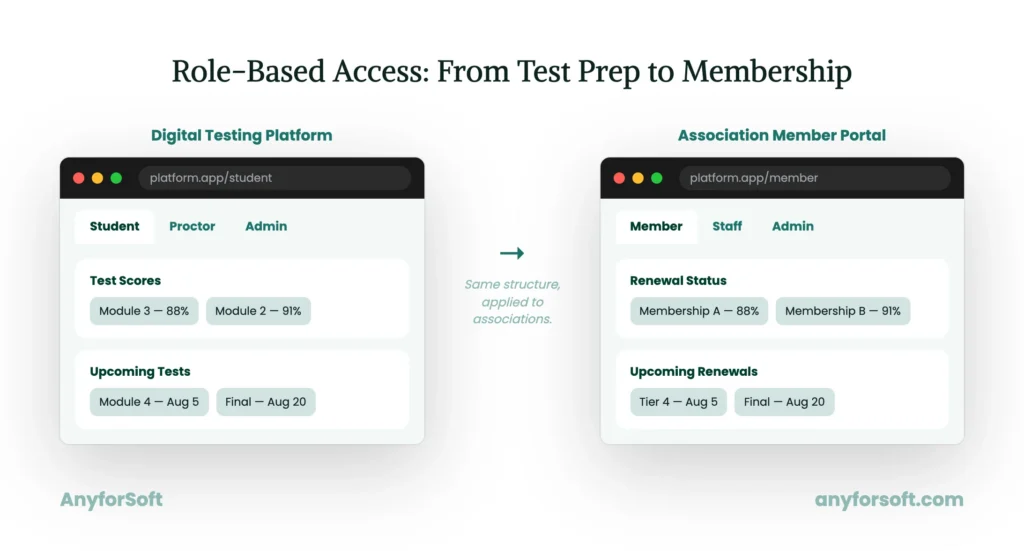
- Development. Back-end development covers server-side logic and database connections. Front-end developers build the client interface and implement the workflows defined during planning. Integrations are handled in parallel with both tracks. The dev team also implements user authentication and role-based access control to make the system secure. We ensure the system functions as a reliable interactive platform to enhance the learning experience of students and educators.
- Testing. At the testing stage, QA engineers test the software and its features to ensure they work as intended and don’t interrupt the learning process.It covers functional, compatibility, performance, usability, security, integration, and regression testing. Quality assurance allows educational institutes to minimize the amount of bugs before release, improving the user experience of students, teachers, and parents.
Once these four steps are complete, the dedicated team deploys the software. After that, it provides continuous maintenance and support to ensure its stable work.
What is the cost to develop custom association management software?
Cost scales with the same factors as timeline: integration count, data volume, and the number of distinct portals needed. Organizations with a single membership list and standard dues sit at the lower end. Multi-chapter platforms with several integrations and tailored reporting land higher.
- Core membership and dues system: lower range
- Added integrations, portals, or reporting: mid-range
- Full multi-chapter platform with extensive integrations: higher range
A firm number follows a discovery call, once the scope is confirmed.
Can you migrate our data from our current AMS to a new custom platform?
Yes. AMS migration preserves existing member records, dues history, and configurations rather than starting from a blank system. Migration runs on a schedule built around active renewal cycles, so nothing gets disrupted mid-cycle. Historical data carries forward, keeping the reporting staff already rely on intact.
Which integrations can you build into our AMS (CRM, payment gateways, email marketing)?
Association software integration covers CRM platforms, payment gateways, and email marketing tools, connected through documented APIs. Membership updates sync automatically once these connections are in place, keeping contact records current across every connected system. Most organizations start with one or two integrations and add more as needs grow.
How do you ensure member data security and compliance?
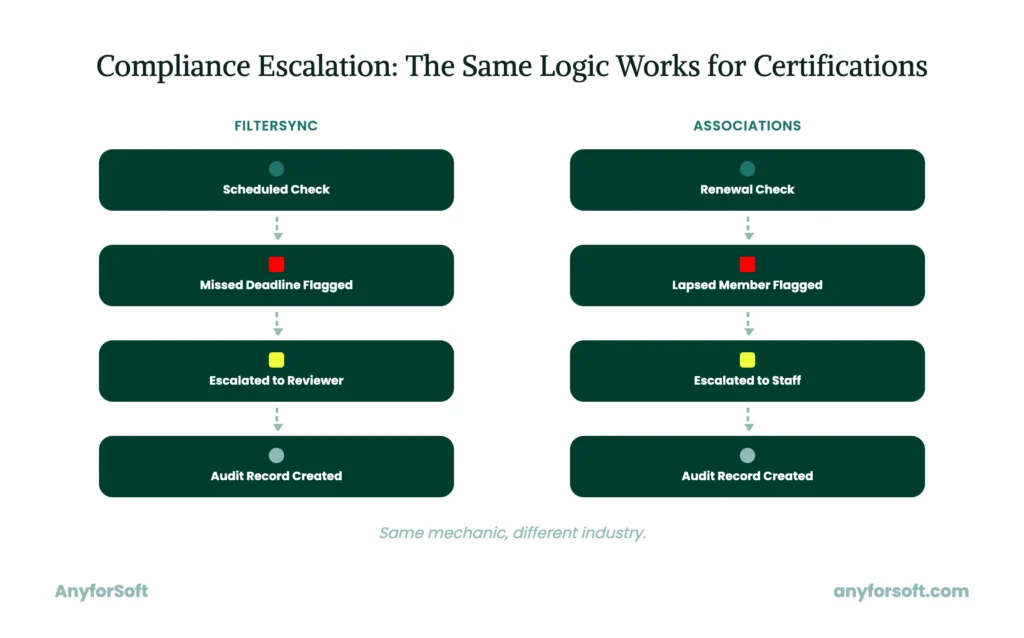
Every build includes encryption, access logging, and regular security audits aligned with standards like GDPR and SOC 2. Role-based access control limits who can view or edit sensitive records. Compliance documentation is available for board review on request.
What ongoing support do you provide after launch?
Support continues after launch with bug fixes, routine updates, and new features as the organization’s needs evolve. A dedicated team handles requests directly, without a separate re-engagement process for each change. This mirrors the same ongoing relationship described in the Process section above.
How is AI used in modern association management software?
AI supports renewal tracking by flagging declining engagement before a member lapses, and it automates routine communications like renewal reminders and event confirmations. Predictive models draw on membership activity to catch patterns staff might miss on their own. AnyforSoft has shipped both types of AI work in production, including a verification engine and a content-grounded assistant, giving each feature a track record beyond a roadmap promise.
Can AI features improve member renewal rates and reduce administrative work?
Yes. Predictive analytics catch declining engagement early, giving staff time to reach out before a renewal lapses instead of after. That earlier window is where renewal rates tend to improve most. Automating routine tracking and reminders also frees staff from manual follow-up, adding directly to administrative efficiency across a renewal cycle.