


AI System Сuts Order Processing Time 5x for a Medical Device Distributor
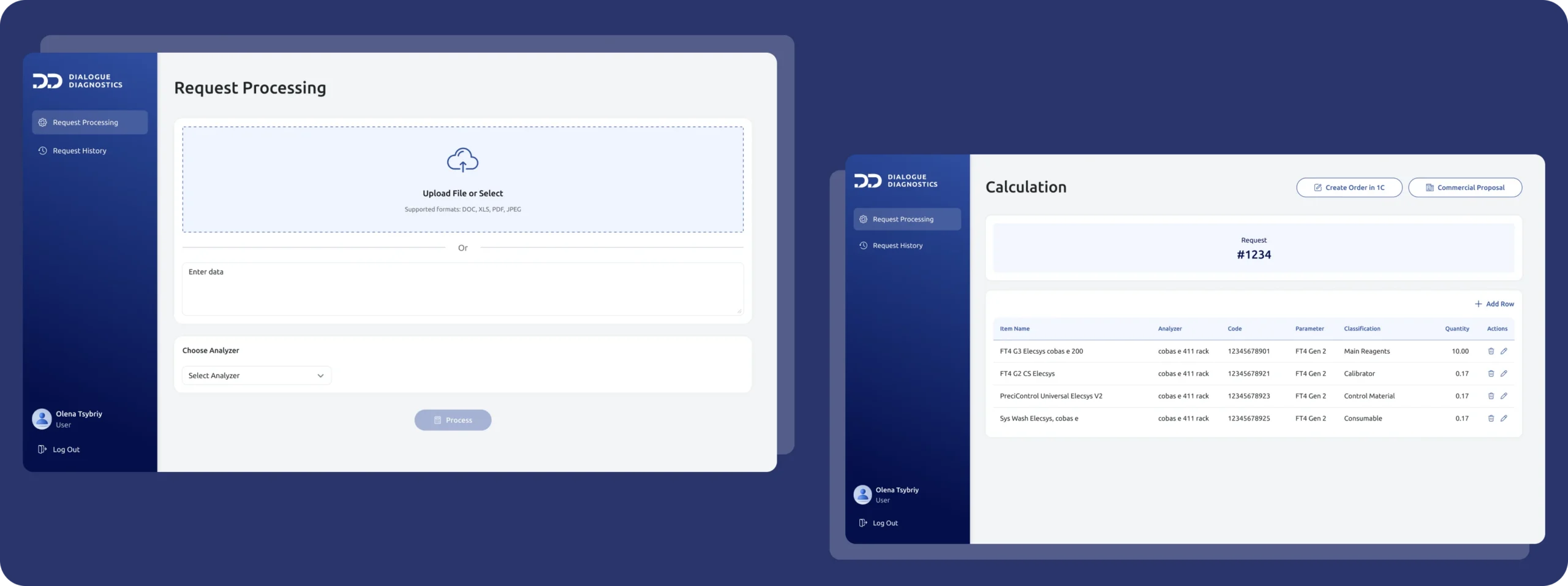
Dialogue Diagnostics processes medical supply orders that arrive in every format imaginable — from spreadsheets to handwritten photos. AnyforSoft built an AI system that reads these inputs, structures them, and prepares ready-to-send proposals.
A task that once took an operator around ten minutes now takes about two.
Human review stays in place, which keeps accuracy high and prevents costly mistakes.
For AnyforSoft, this was a debut in the medical domain, and the efficiency gains show how well the approach works in real clinical operations
TECHNOLOGIES
See all technologiesSERVICES USED
See all servicesTEAM
5 membersYEAR LAUNCHED
January 2025 — June 2025TECHNOLOGIES
See all technologiesTEAM
5 membersSERVICES USED
See all servicesYEAR LAUNCHED
January 2025 — June 2025Turning Medical Orders Into AI-Readable Data
Operators at Dialogue Diagnostics receive a constant flow of requests — in tables, text documents, scanned sheets, and quick photos. This variety creates an overwhelming workflow.
Inputs in different formats, often imperfect
A single test can appear as an abbreviation, a synonym, a partial medical term, or a misspelled name. For the business, this means operators constantly interpret and standardize requests instead of moving them forward. For AnyforSoft, the challenge was to teach the system to understand the intent behind these variations and map each one to the correct catalog item.
Complex dependencies behind each order
A test system requires a set of related materials—calibrators, controls, and washing solutions—previously calculated manually with vendor spreadsheets. This added even more pressure during peak periods. The challenge for AnyforSoft was to translate these fragmented, sometimes implicit rules into software that could produce consistent, reliable calculations.
The need for high accuracy when training data is limited
The dataset for recognition and normalization was small, while the terminology was broad and inconsistent. With little historical material to learn from, achieving reliable recognition immediately is inherently difficult — yet essential in a domain where even a minor mismatch affects real procurement decisions.
These constraints shaped a direction where automation had to support specialists rather than replace them, setting the stage for a solution built around collaboration between AI and human expertise.
AI Drafts the Order; Humans Approve
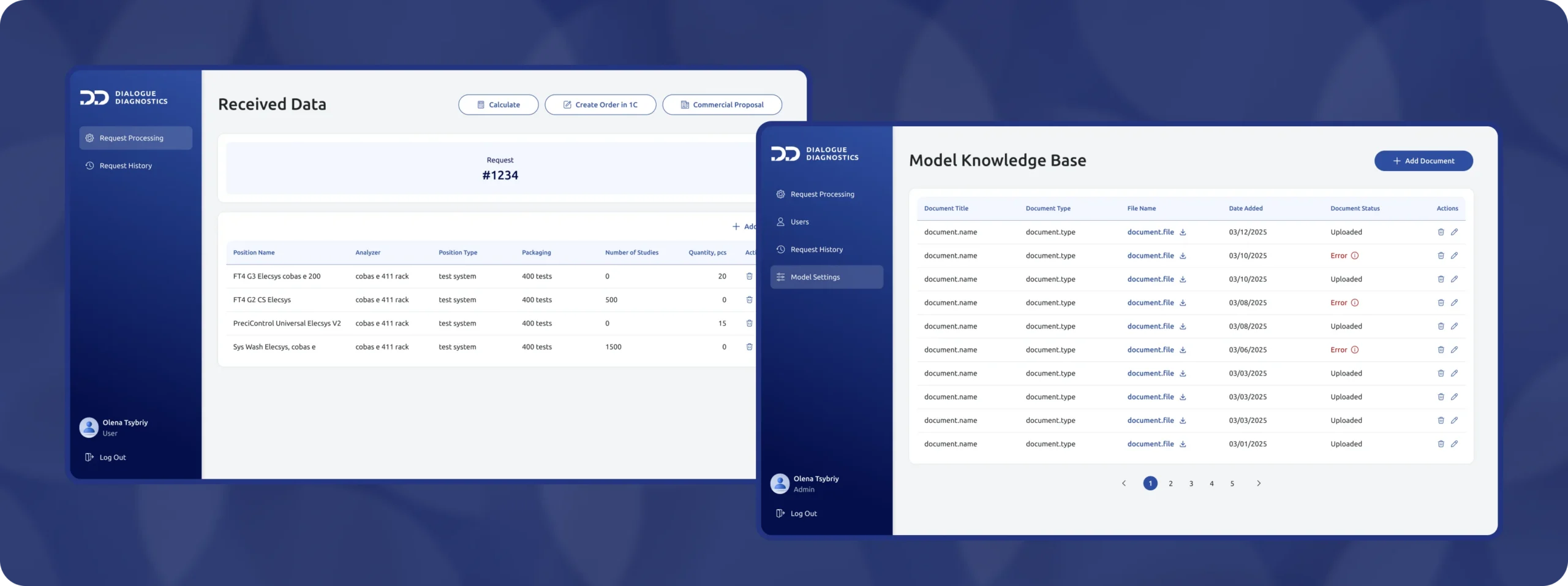
The AnyforSoft team developed a solution that reduces the pressure on operators by transforming scattered, inconsistent requests into clear order drafts. With the request already organized into a structured draft, each review takes only moments.
Making sense of varied and inconsistent request content
The variety of request formats was handled by introducing a system that turns mixed, loosely structured inputs into a consistent draft operators can review quickly. Computer vision ensures that scattered details become arranged into a clean, standardized view, giving specialists a clear starting point instead of raw, uneven data.
Preparing the logic needed for full order assembly
An AI-based solution assists in extending the request with the materials required to run laboratory tests reliably, such as calibrators and related supplies. It replaces the manual workflow that depended on processing vendor spreadsheets and operator experience. The system gathers these additional materials automatically and organizes them into a structured flow for operator review.
Keeping accuracy high through human-guided validation
To reduce the risks created by inconsistent terminology and a small training dataset, the AnyforSoft team designed a workflow where AI prepares the draft. Operators then review the output and confirm the final structure. This balance protects accuracy, reduces cognitive load, and gives specialists confidence that each order is complete and correct.
Together, these components form a workflow where AI handles the heavy interpretive work and specialists contribute the final, informed judgment essential in medical operations.
What we have accomplished
Processing time: 10 min → 2 min
AI cuts preparation from roughly ten minutes to about two, removing most of the routine interpretation work.
Throughput increased ×5
With each request processed faster, operators can handle up to five times more orders during a typical shift.
Reduced need for new staff
Routine processing no longer depends on hiring specialists with narrow pharmaceutical or laboratory expertise, easing staffing demands and lowering costs.
Error rates significantly lower
Standardized terminology and structured drafts reduce misinterpretations and minimize the chance of missing essential materials.
Specialists focus on high-value work
Freed from routine decoding, experienced specialists can apply their knowledge to marketing, cross-functional tasks, and other areas where their expertise creates greater value.
What we have accomplished
Interpretation of requests across formats
Computer vision and text recognition process XLS files, PDFs, scans, and phone photos, turning mixed inputs into a unified draft.
Standardization of laboratory terminology
The system identifies abbreviations, synonyms, partial names, and inconsistent wording, mapping them to a standardized internal nomenclature.
Extension of requests with test-related materials
The system assists in identifying calibrators, controls, and other materials needed for laboratory tests, replacing spreadsheet logic with a structured flow and preparing the ground for future automation.
Accuracy through human-in-the-loop validation
Operators refine and confirm the AI-generated draft, with the system highlighting items that may require attention and ensuring reliability even with limited training data.
Direct transfer of confirmed orders to 1C
After validation, the finalized order is sent directly into 1C, fitting naturally into Dialogue Diagnostics’ operational process.
Accuracy target: 97–98%
The team continues refining recognition and terminology mapping to reach a level of reliability suitable for partial automation.
Growing the training dataset
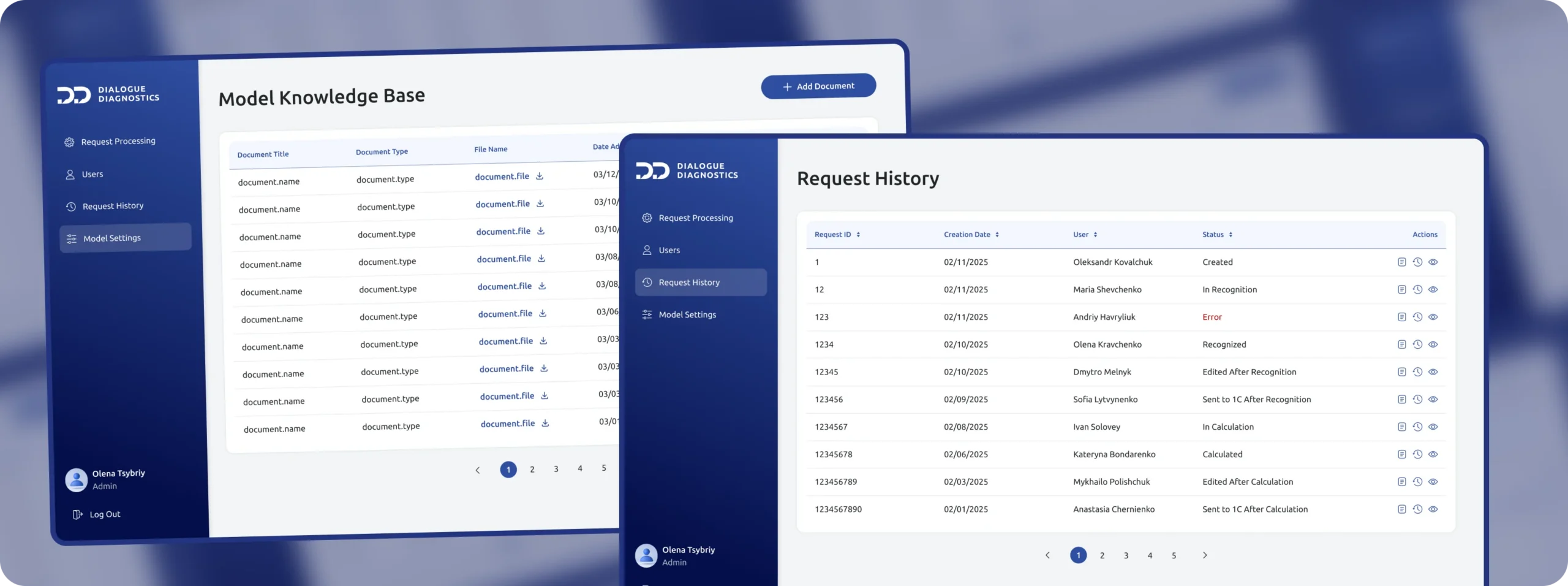
Every operator-reviewed request strengthens the dataset and improves the model’s behavior over time.
AI validation for routine cases
Once accuracy stabilizes, the workflow will allow AI to approve standard cases automatically while sending edge cases to specialists.
Forecasting and smart suggestions
The system can evolve toward predicting laboratory needs and suggesting complementary or related materials.
Transition to full operational use
As accuracy improves and calculation logic matures, the system is expected to move from pilot use into daily operations.