





Every Program on Pace for Test Day: A Concept Case for Test Prep Companies Like Compass
Compass Education Group is a trademark of Compass Education Group, LLC. Used here for identification purposes only. AnyforSoft is not affiliated with, endorsed by, or sponsored by Compass Education Group, LLC. SAT is a registered trademark of the College Board, and ACT is a registered trademark of ACT Education Corp. Neither was involved in this concept or endorses it.
A typical Compass program runs 12 to 16 lessons over three to four months, timed to the student’s test date. In-home tutoring covers six US metro areas, and students anywhere can join online.
Read as a project, each student’s program has:
- a deadline: the official test date
- a scope: the lessons in the student’s package
- milestones: the diagnostic and the practice tests
- a plan: the lessons that should be done by today
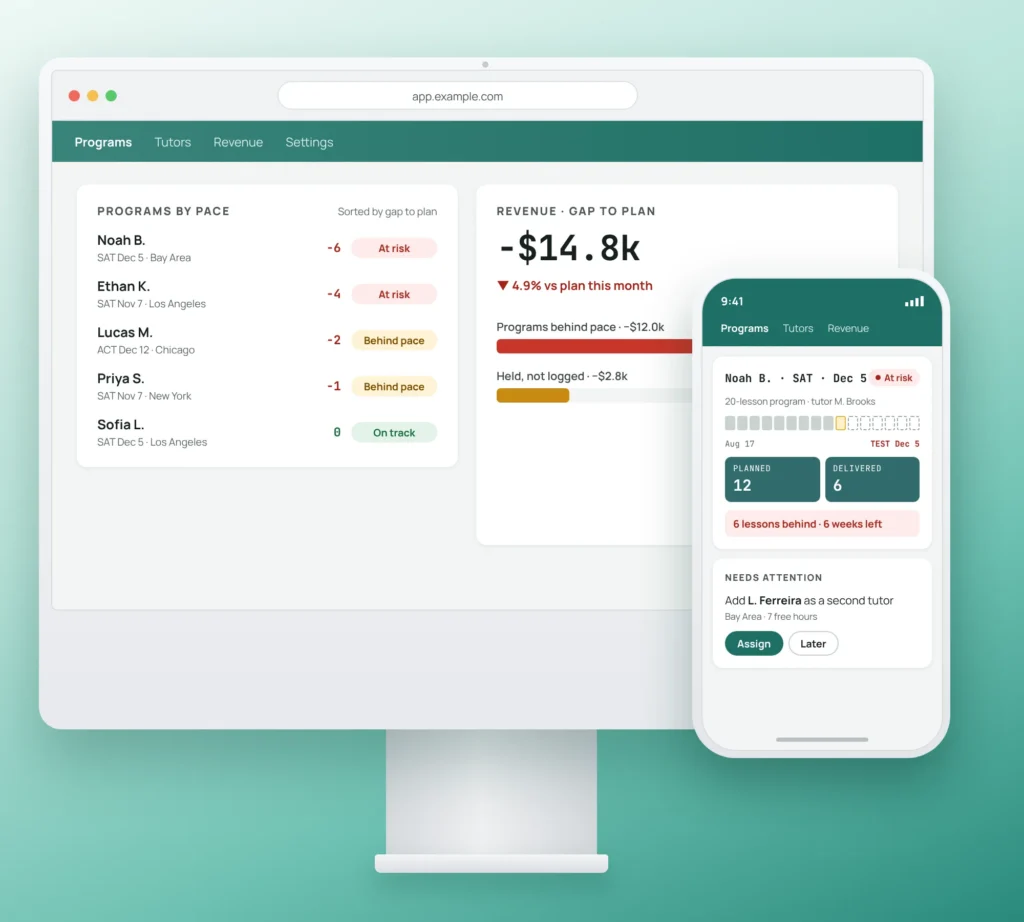
In this concept case, AnyforSoft explores a leadership dashboard that tracks each program against its plan. It shows directors early on which students won’t be ready in time.
CHALLENGEA late slip leaves no time to recover
In a company with a model like Compass’s, a director oversees many programs at once. Each one runs to its own test date with its own tutor. Part-time tutors give 5 to 20 hours a week and set their own schedules.
At the student level, progress gets close attention. Instructors and directors follow homework and practice test results, then adjust the plan. Families see progress through an online account with interactive score reports.
The harder task for a director is seeing all those programs at once, across every tutor and test date. Timing is what makes it hard. A program that falls behind in October can still catch up with extra sessions. Two weeks before the test, the same gap leaves too few lessons to close it.
Across test prep, leadership often learns too late that a program won’t make its date, and the reasons tend to repeat:
- The real picture lives in one person’s spreadsheet. Often no one else may edit the core file, because a single wrong edit breaks it. When its owner is away, the company’s view of itself goes too.
- Sessions happen but don’t get logged. Some lessons may go unreported, with no way to measure the gap. Each one is tutoring delivered and left unbilled.
- Plenty of data, few decisions. A company can hold all the data it needs and still be working out what to do with it.
- Separate systems, joined by workarounds. Scores and sessions live apart from billing, and records move between them through manual copying and fragile connections.
- The busiest weeks leave the least slack. The run-up to major test dates is the busiest season. A program that slips then competes for tutor hours that are already booked.
SOLUTIONRun each program like a project with a deadline
AnyforSoft’s concept is a custom tutor scheduling platform with a leadership dashboard that treats each student’s program as a project. It compares lessons planned by today with lessons delivered, then flags any program off pace for its test date. As a vision piece, the concept has not been built for any client.
The dashboard reads session logs and billing records already on file, for in-home and online lessons alike. Tutors keep logging sessions as they do today, and the dashboard adds no new forms.
1. Will this student be ready by test day?
Noah, a Bay Area student taking in-home lessons, is preparing for the December 5 SAT.
His program appears as a row of weekly cells that starts on August 17 and ends on test day.
By today, the plan calls for 12 lessons, and Noah has had 6. With six weeks left, he needs 2.3 sessions a week to finish, which the status line states plainly.
Along the row, markers show the diagnostic and three practice tests.
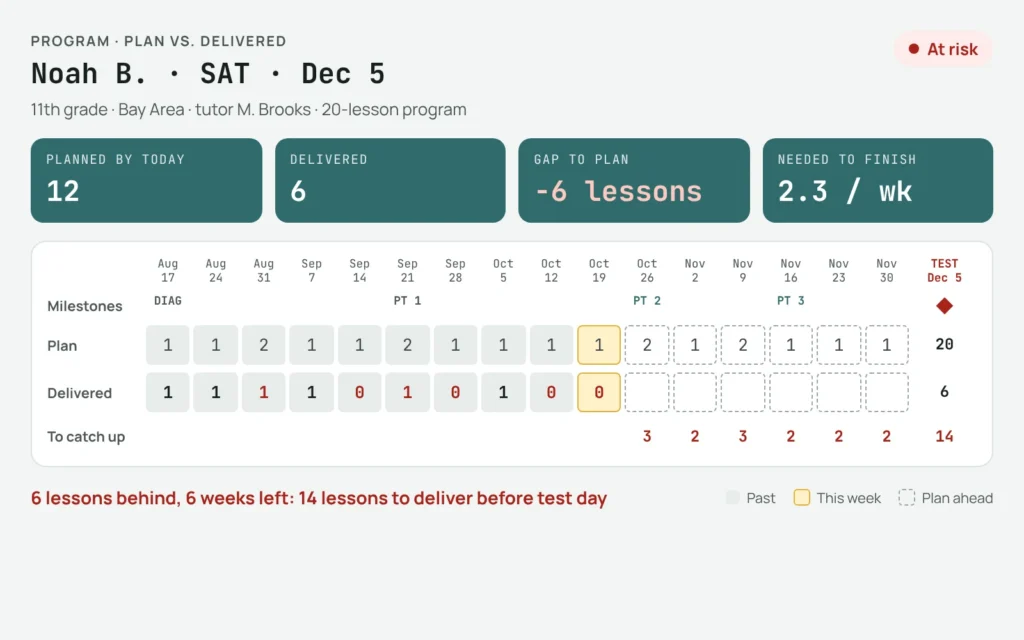
Concept screen: one student’s program, tracked like a project against a deadline that can’t move.
2. Which programs are falling behind?
Zoomed out, the director sees all active programs in one list, sorted by gap to plan. Noah’s one comes first.
For each student, a bar shows lessons delivered, with a tick where the plan says they should be today. Next to it comes the gap and the weekly pace now required.
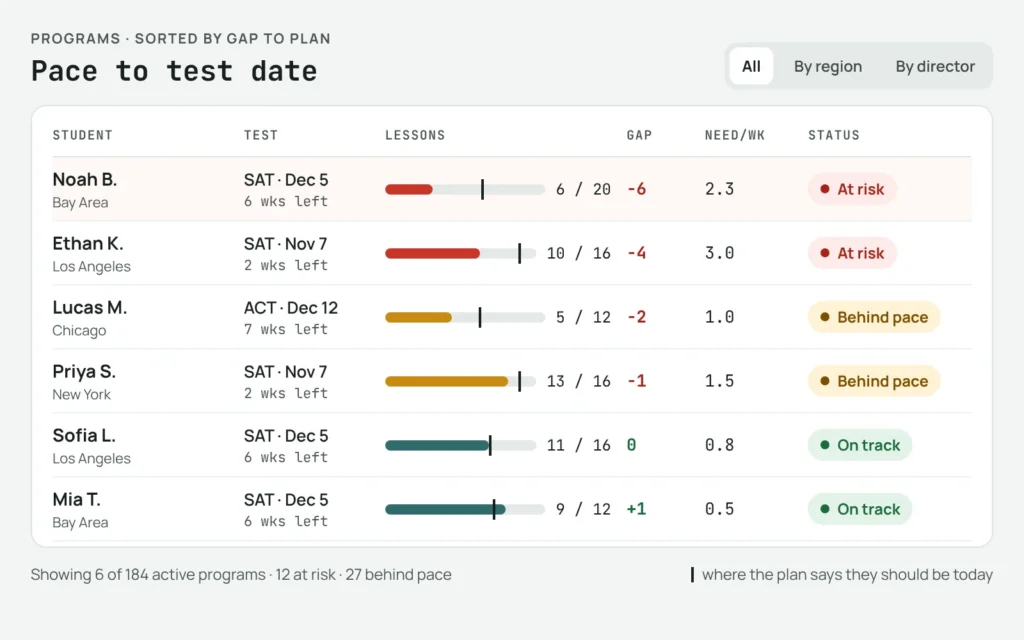
Concept screen: the programs that need help rise to the top.
3. What should we do about it this week?
From the same records, the concept generates a short list of alerts, each with one concrete action. An alert fires when a program falls behind pace, a student goes too long without a session, or held sessions stay unlogged.
For Noah, the action is specific: add L. Ferreira as a second tutor.
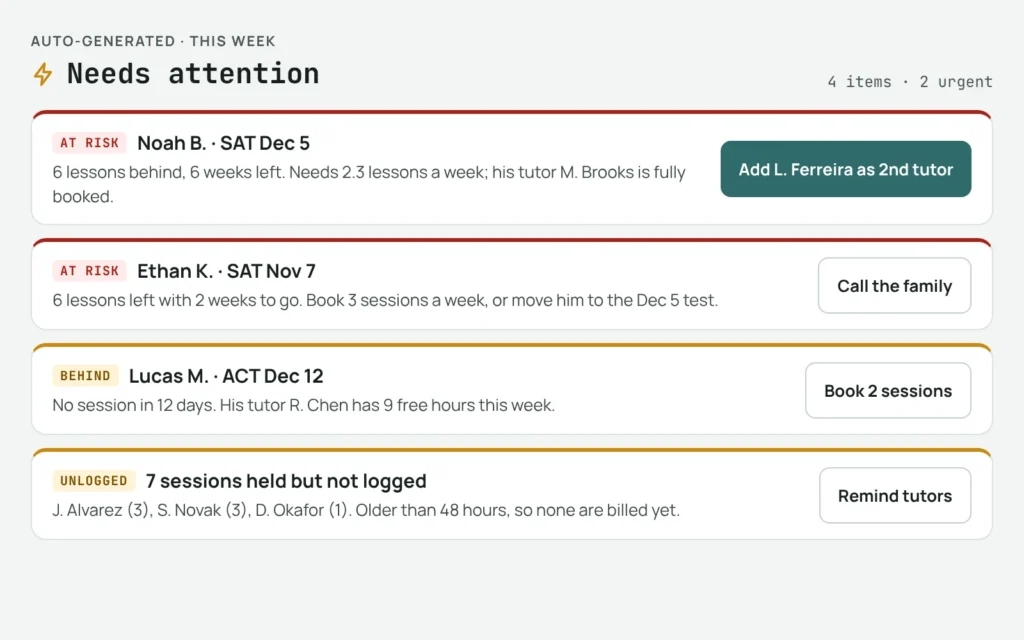
Concept screen: alerts that say what to do, not just what went wrong.
4. Who has room for extra sessions?
Extra lessons need tutor time, and part-time tutors choose their own weekly load. The capacity screen compares booked hours with that chosen load, day by day. Here the platform does the scheduling: extra sessions go to a tutor with free hours, in the right region.
Noah’s tutor, M. Brooks, is full at 15 of 15 hours. His lessons are in-home, so extra sessions need a local tutor: L. Ferreira, also in the Bay Area, has 7 free hours.
For an online student, any tutor with free hours could take the extra sessions.
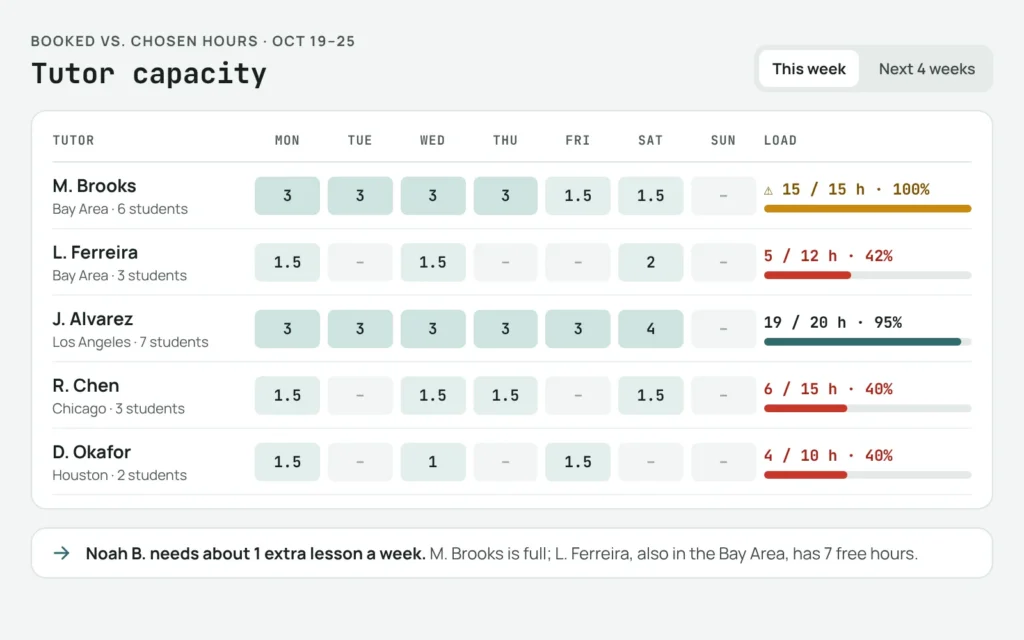
Concept screen: spare tutor hours, visible where they’re needed.
5. What does this mean for revenue?
Each lesson Noah hasn’t had is revenue the company planned for and hasn’t earned yet. The business health screen sets revenue delivered against plan and margin against target. It also counts sessions held but not logged.
In the mock data, revenue runs $14.8k below plan. Programs behind pace, Noah’s among them, account for $12.0k, and unlogged sessions for $2.8k.
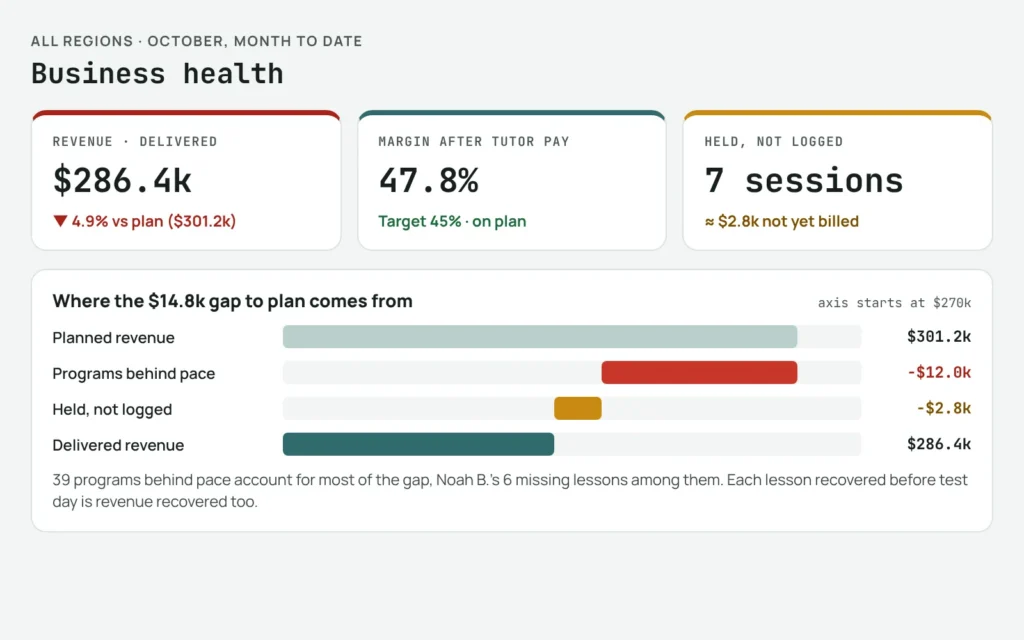
Concept screen: what slipping programs mean for revenue.
INTENDED OUTCOMESWhat the concept is meant to deliver
These are the outcomes the concept is designed to support, not measured results. Nothing here comes from real-world use.
- Could warn directors about a program behind pace while weeks remain to add sessions
- Aims to bring unlogged sessions into view, so fewer slip through unbilled
- Is meant to match extra lessons with tutors who have free hours
- Sets out to give leadership one picture of the business across regions and online
- Might reduce the company’s reliance on a single spreadsheet owner
WHAT’S NEXTFrom tracking pace to planning ahead
Later versions could build on the same plan:
- A family-facing view of the student’s plan and pace toward the test date
- A season forecast comparing demand with tutor capacity in the weeks before major test dates
This is an independent product concept created by AnyforSoft for illustrative purposes.