







Why Drupal, not Moodle, Docebo, or another established LMS? The answer depends on whether your requirements center on content architecture and integration or on learning delivery itself.
Drupal for learning management systems makes sense when you:
- manage extensive educational content beyond courses
- need learning embedded within a broader institutional portal
- already operate your organization on Drupal infrastructure
In other words, if content management and complex system integration drive your design, Drupal provides the foundation you need.
As a Drupal development company with roots in Drupal from its founding, AnyForSoft has built complex university websites, student portals, and integrated educational platforms for institutions. We recently embedded an AI assistant within a university’s Drupal platform, demonstrating how Drupal’s content foundation supports integrated institutional features beyond traditional websites.
Building these platforms taught us what makes Drupal LMS implementations succeed.
The guide that follows helps you determine which approach fits your situation:
- Five Drupal LMS use cases where content architecture drives learning platform design
- Real examples from universities and enterprises facing these requirements
- What Drupal provides for these specific needs
- What this approach requires
If several scenarios match your situation, Drupal becomes a strong foundation. If few match, dedicated LMS platforms likely serve you better.
What is Drupal as an LMS foundation
Drupal is a content management system, not a packaged learning management system.
It wasn’t designed specifically for course delivery and assessment workflows. It was built to manage complex content with flexible structures, governance workflows, integration capabilities, and custom relationships.
Think of it this way: traditional LMS platforms are like fully furnished apartments. You move in and everything you need for standard living is already there, including furniture arranged, appliances installed, layout predetermined. You can rearrange some items and add personal touches, but the fundamental structure is fixed.
Drupal is like an architectural foundation and building materials. You design the floor plan, decide where rooms go, choose how spaces connect. This requires more work upfront and needs construction expertise, but you get a building that matches exactly how you need to use it. When your needs change, you can expand or reconfigure because you control the architecture.
There’s also a middle approach: Drupal-based LMS distributions like Opigno LMS. These are pre-built learning systems constructed on Drupal’s foundation. They provide course management, assessments, and learning delivery features while retaining Drupal’s content architecture capabilities.
Think of Opigno LMS as a partially built house on Drupal’s foundation. Some rooms are already finished for learning delivery, but you still have Drupal’s flexibility to add custom spaces, change layouts, and integrate everything into a unified structure.
What is the difference between Drupal vs traditional LMS? The key distinction isn’t whether platforms are customizable.
Both Drupal and traditional LMS platforms support customization. The distinction is what foundation you’re customizing from:
- Traditional LMS platforms like Moodle, Canvas, and Blackboard start from a learning delivery foundation. You customize learning features, add assessment types, extend course formats, integrate analytics.
- A custom LMS on Drupal starts from a content management foundation. You customize content architecture, build integration layers, design governance workflows, embed learning within broader portals.
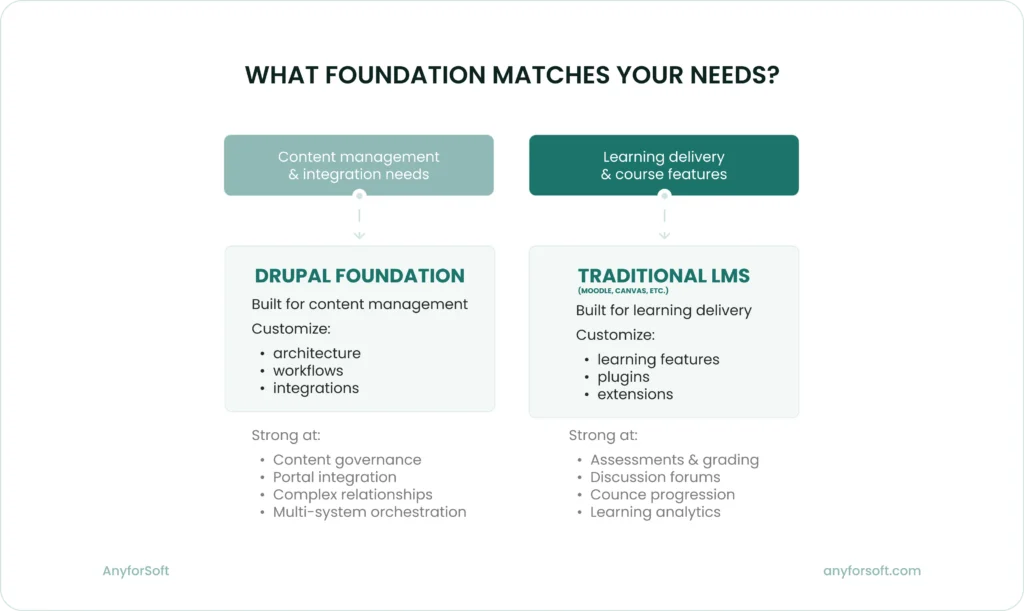
LMS on Drupal or a standard LMS: foundation-based decision diagram
| Platform type | Foundation | Customization strength | Best for |
| Traditional LMS(Moodle, Canvas, Blackboard) | Learning delivery | Learning features, assessment types, course formats, analytics extensions | Organizations where learning delivery features drive requirements |
| Drupal foundation | Content management | Content architecture, integration complexity, governance workflows, portal embedding | Organizations where content complexity and integration drive requirements |
| Opigno LMS(Drupal-based) | Content management with learning delivery features added | Both learning features and content architecture | Organizations needing both learning tools and Drupal’s content capabilities |
Drupal works best in specific scenarios where content complexity, integration needs, or architectural control matter more than out-of-the-box learning delivery tools. The following scenarios show when content architecture drives platform design.
When to use Drupal for an LMS: cases and scenarios
Let’s examine five scenarios where Drupal’s foundation makes sense for learning platforms.
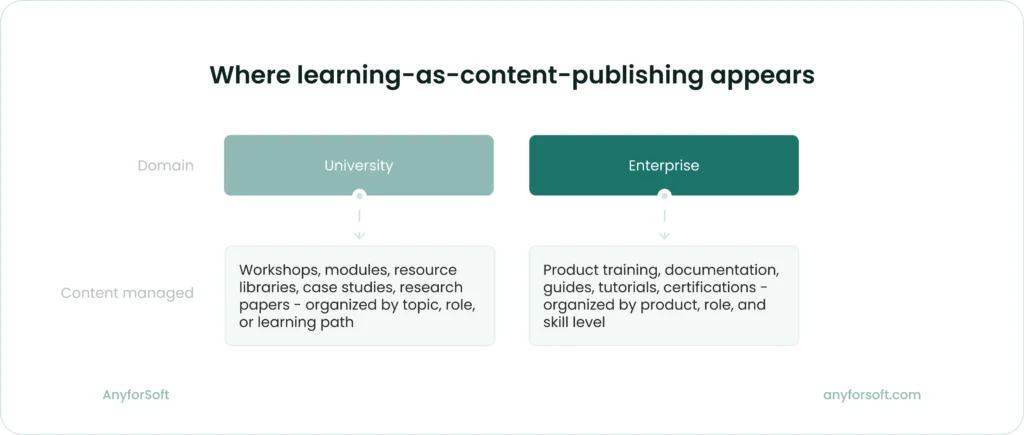
Scenario 1: Learning-as-content-publishing
You manage extensive content alongside courses, including resource libraries, documentation, guides, multimedia collections, reference materials. Volume and variety require publishing infrastructure, not just course containers.
Content architecture becomes central: taxonomy for organization, relationships between resources, search across diverse formats, version control, editorial workflows.
See the difference:
- standard LMS platforms organize learning activities
- content management platforms organize and govern information at scale
IEEE, a global community for technologists, chose Drupal to manage 25,000+ educational resources including conference content, videos, webinars, white papers, and technical presentations. Managing their extensive content library was as important as delivering courses, so they needed one platform handling both.
The platform delivered:
- Personalized learning paths tailored to user roles and interests
- Drupal H5P interactive content (quizzes, presentations, videos) embedded directly in learning materials
- SAML single sign-on integration (one login for multiple systems) for secure authentication
- Custom theming aligned with IEEE’s brand and user experience requirements
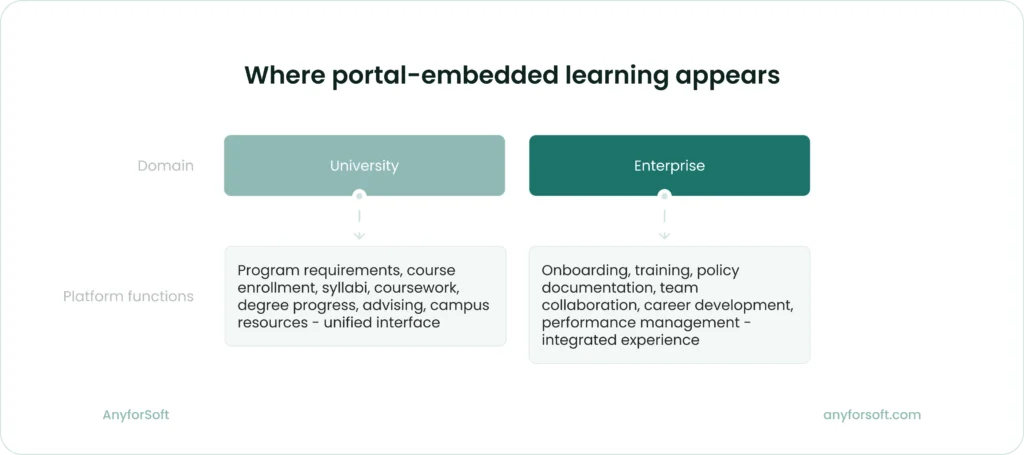
Scenario 2: Portal-embedded learning
Learning needs architectural integration into your broader institutional or company platform. Students or employees should access courses alongside advising, resources, collaboration tools, and services. Everything should work through one unified experience.
This means more than adding links to a separate LMS.
See the difference:
- Standard LMS platforms function as separate destinations with their own login and interface
- Portal integration embeds learning within broader institutional or company infrastructure
American Council on Education (ACE) built their “Engage” peer-to-peer learning platform by embedding Opigno LMS and Drupal Open Social within their broader community platform. They needed learning, networking, and collaboration to function as integrated components rather than separate tools.
The platform delivered:
- Seamless embedding using Learning Tools Interoperability specification
- Unified user experience without forcing users to navigate to separate systems
- Synchronized accounts and credentials across all platform functions
- Community interaction and learning within the same interface
One more example. Portal embedding extends beyond learning modules to any institutional function that serves students or applicants. AnyForSoft embedded an AI assistant within Wittenborg University of Applied Sciences’ Drupal platform, applying this architectural approach in a higher education context.
The university needed students and applicants to access guidance about admissions, programs, and student life directly within their website rather than through separate systems.
Drupal’s content foundation enabled the assistant to pull answers from university pages and documents, with responses updating automatically as content changed.
The integration delivered:
- Native embedding within the existing Drupal platform
- Automatic updates synchronized with website content changes
- Unified user experience requiring no separate login or interface
The approach mirrors how Drupal embeds learning within broader institutional platforms. Learning functions as an architectural component, integrated directly into the platform.
Scenario 3: Existing Drupal infrastructure
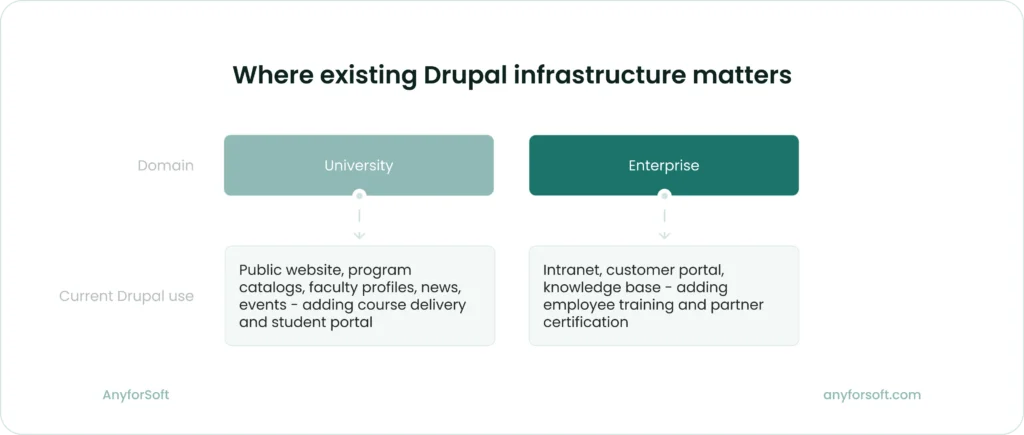
Your institution or company already operates on Drupal for websites and program information. You want to add custom LMS on Drupal to your existing platform rather than introducing a separate system.
Building on existing infrastructure means maintaining consistent governance processes and avoiding the complexity of managing multiple platforms.
You keep one content architecture, one set of workflows, and one technical stack.
See the difference:
- Standard LMS platforms require separate infrastructure and governance processes
- Drupal-based learning extends your existing platform with new capabilities
Harvard University uses Drupal for their online learning portal, building on their existing Drupal infrastructure to provide courses and resources to a global audience. They needed learning capabilities that matched their established technical approach and institutional standards.
Harvard achieved:
- Consistent platform architecture across all institutional digital properties
- Unified governance and content management workflows
- Technical team efficiency through shared expertise and tools
- Scalability supporting thousands of simultaneous users
Another example of Drupal for higher education shows how multi-site management works in practice.
AnyForSoft managed Drupal infrastructure across three Delaware County Community College websites — one public-facing and two student-restricted portals.
The multi-site approach maintained unified security protocols, technical maintenance, and governance processes while supporting different access controls per site. One technical team handled updates, migrations, and support across all three platforms simultaneously.
This shows how existing Drupal infrastructure can support multiple sites while one technical team handles everything.
Scenario 4: Complex content governance requirements
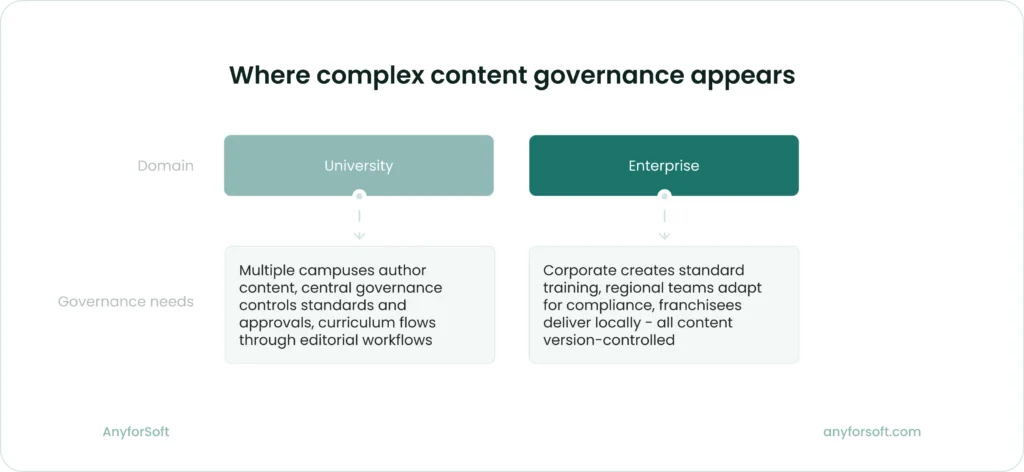
You manage learning content across multiple departments or partner organizations. Content creation happens in many places, but you need centralized control over standards and approvals.
Editorial workflows, version control, and distributed authoring become as complex as the learning delivery itself.
This level of governance requires publishing infrastructure designed for scale.
See the difference:
- Standard LMS platforms provide basic content management for courses
- Content governance platforms manage distributed authoring, editorial workflows, and publication control at scale
Yardstick LMS in Dubai uses Drupal in education to manage K-12 curriculum across multiple schools. Each school needed to manage its own content while central administration controlled quality standards, approval processes, and publication schedules.
Yardstick achieved:
- Hierarchical content management with school-level and system-level controls
- Multi-tenant architecture supporting multiple institutions on shared infrastructure
- Custom approval workflows ensuring content quality across all schools
- Version control and publication scheduling for curriculum updates
Scenario 5: Integration-heavy ecosystems
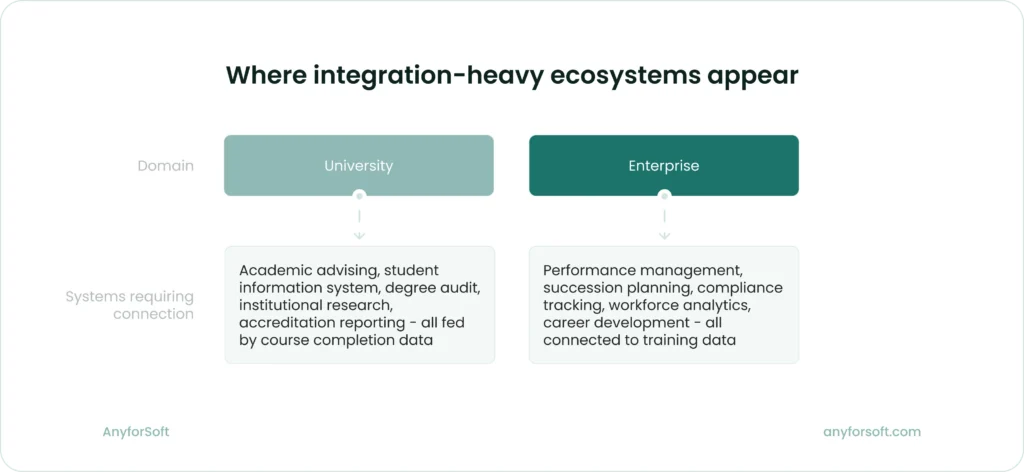
Learning data needs to connect to multiple institutional or business systems simultaneously. Course completion, progress tracking, credentials, and performance data feed different systems. Moreover, each of them requires different formats, update frequencies, and business logic.
This goes beyond standard integrations that connect two systems. You need orchestration across multiple platforms and data transformation for different requirements. In addition,you need programmatic control over when and how information flows between systems.
See the difference:
- Standard LMS platforms offer point-to-point integrations with common systems
- Drupal LMS integration architecture orchestrates complex data flows across multiple platforms simultaneously
University of Colorado Boulder integrated their Drupal learning platform with existing LMS, student information systems, and institutional tools. They needed personalized learning paths that connect to multiple backend systems for tracking, grading, and institutional reporting without manual data coordination.
CU Boulder achieved:
- Seamless integration with existing learning management and student information systems
- Personalized learning paths drawing data from and feeding data to multiple platforms
- Automated data synchronization eliminating manual coordination across systems
- Unified reporting combining learning data with institutional analytics
Drupal’s capabilities for content-driven learning platforms
The scenarios above share common technical requirements:
- managing complex content structures
- governing distributed authoring
- integrating across multiple systems
- embedding learning within broader platforms.
Drupal addresses these requirements through its content management architecture.
Content modeling and structured publishing
Drupal treats content as structured, related entities.
All content, such as courses, resources, documentation, program information, has custom fields, relationships, and taxonomy.
Teams model learning hierarchies specific to their needs rather than fitting into predefined structures.
A medical school models competencies, rotations, and assessments as distinct content types with custom relationships.
A manufacturing company models equipment types, procedures, and certifications, linking them based on operational requirements.
When this matters:
- Learning platform manages diverse content types beyond course containers
- Content relationships don’t fit standard course/module hierarchies
- Users need to navigate by topics, roles, or custom paths
Editorial workflows and governance
Drupal provides enterprise-grade content governance.
Editorial workflows, revision control, scheduled publishing, moderation states, and approval processes come built-in.
Multi-author environments maintain distributed content creation with centralized governance.
University departments create curriculum independently while central administration controls quality. Corporate divisions develop regional training while headquarters maintain brand consistency and compliance.
Content moves through defined stages: draft, review, approval, publication. Authors create, editors review, approvers validate, publishers release — all tracked with version history.
When this matters:
- Multiple teams create content requiring oversight
- Quality control and approval processes are complex
- Version tracking and scheduled publishing are critical
Multi-site and multi-tenant architecture
Drupal runs multiple sites from shared infrastructure.
Each site maintains separate branding, workflows, or user bases while sharing code and selected content.
University systems run separate portals per campus, sharing curriculum while managing campus-specific programs independently. Franchise organizations run regional training sites, sharing corporate materials while allowing local additions.
One technical team manages the platform while different entities control their own content and users. Updates deploy across all sites simultaneously.
When this matters:
- Learning operates across multiple entities or locations
- Each entity needs autonomy with shared infrastructure
- Managing separate platforms multiplies cost and complexity
Integration and API architecture
Drupal orchestrates complex data flows across systems.
Robust API capabilities support multiple simultaneous connections, data transformation, real-time synchronization, and business logic.
Course completion can trigger advising system actions, update student records, calculate degree progress, feed institutional research, and document accreditation compliance. Each system requires different data formats and update frequencies.
Training completion, in turn, can affect performance reviews, succession planning, compliance status, workforce analytics, and career recommendations simultaneously.
When this matters:
- Learning data feeds multiple systems with different requirements
- Point-to-point integrations become insufficient
- Business logic governs when and how data moves between systems
Learning portal on Drupal and ecosystem capabilities
Drupal builds learning into unified platforms.
Students access courses, degree progress, advising, campus resources, and administrative tasks through one platform.
Employees complete training, track development, collaborate, access documentation, and manage performance through integrated experience.
When this matters:
- Learning functions as one ecosystem component
- Multiple logins and inconsistent interfaces create friction
- Data needs to flow between learning and other functions
Building a Drupal LMS: resources and investment required
Building an LMS on Drupal means investing in development, architecture planning, and ongoing platform ownership.
Drupal development resources and expertise
Drupal LMS development requires specialized expertise. Developers will start with architectural planning before writing code. Content modeling, workflow design, integration requirements, and user experience get defined first. Development follows those decisions.
Platform work doesn’t stop at launch. Ongoing maintenance and evolution continue as your learning needs change.
Initial development and ongoing maintenance investments
Building the platform involves initial development work and continuous platform stewardship. Both phases require budget allocation and resource commitment.
Initial development phase includes:
- Discovery, architectural planning, and scope definition
- Platform development and customization
- Integration with existing systems and content migration
Development timeline depends on scope complexity and decision clarity. Platforms with well-defined requirements and priorities move faster through this phase.
Continuous maintenance requires:
- Hosting infrastructure and performance monitoring
- Regular security updates
- Technical maintenance and bug fixes
- Content governance and quality management
- Feature development as requirements evolve
Maintenance isn’t optional overhead. It keeps the platform secure, aligned with organizational changes, and responsive to emerging learning needs.
Ongoing platform ownership requirements
Custom platforms require ongoing governance decisions, content management processes, technical maintenance, and continuous alignment between platform capabilities and organizational needs.
When you hire Drupal developers or partner with a development agency, they typically handle these ongoing responsibilities as part of their service. You decide how involved you want to be – some organizations prefer active oversight while others delegate platform management entirely to their development team.
Conclusion
Drupal makes sense as an LMS foundation when content architecture, portal integration, or complex system orchestration drive your platform requirements.
The decision between a Drupal-based solution or a traditional LMS comes down to what matters most: content management infrastructure or learning delivery features.
When evaluating whether Drupal fits your learning platform needs:
- Count how many scenarios match your current or anticipated requirements – multiple matches suggest Drupal provides capabilities you need
- Assess whether your team has or can acquire Drupal development expertise and budget for custom platform development
- Determine if architectural control over content modeling, workflows, and integrations justifies investment over packaged solutions
- Evaluate whether learning needs to function as an integrated component of broader institutional or company infrastructure
If the scenarios in our guide match your situation, the next step is translating requirements into a development approach (see our How to Build an LMS on Drupal: A Decision-Maker’s 2026 Guide for detailed implementation steps). Your content architecture, governance workflows, integration points, and portal embedding needs become the blueprint for platform design. The earlier you clarify these decisions, the more predictable development becomes.
FAQs
How does Drupal LMS investment compare to traditional LMS platforms?
Drupal requires higher upfront investment in development and architectural planning. Traditional LMS platforms have lower initial costs but may require customization investment as your needs grow beyond standard features.
The difference is where investment concentrates. Drupal frontloads architectural design to build exactly what you need. Traditional LMS platforms spread costs across licensing, incremental customization, and potential limitations when requirements exceed platform capabilities.
Choose based on whether upfront architectural control justifies higher initial investment, or whether starting with standard features and customizing incrementally better matches your budget and timeline.
How does the implementation timeline compare between Drupal and traditional LMS?
Traditional LMS platforms deploy faster – weeks to months for configuration and setup. Drupal-based platforms take longer – several months to over a year depending on complexity, customization depth, and integration requirements.
Timeline differences reflect what you’re building. Traditional LMS platforms start with established features ready to configure. Drupal platforms start with content management architecture that you design and build to match your specific workflows.
If rapid deployment matters most, traditional LMS platforms serve you better. If your requirements justify custom architecture, expect longer timelines but gain platforms built for your exact needs.
How do I know if Drupal fits my specific learning platform needs?
Count how many scenarios in this article match your current or anticipated requirements. Multiple matches indicate Drupal’s content management foundation addresses your needs. Few matches suggest traditional LMS platforms likely serve you better.
Pay attention to what drives your requirements. If content governance, portal integration, complex multi-system orchestration, or architectural control matter more than standard learning delivery features, Drupal becomes compelling.
What if only some scenarios match my situation?
Partial scenario matches deserve closer evaluation. If one or two scenarios strongly match your core requirements – for instance, you manage extensive content libraries or need deep CRM integration – Drupal might still make sense even if other scenarios don’t apply.
Consider scenario importance, not just quantity. One critical architectural requirement often justifies the platform choice more than several minor feature preferences.
Discuss partial matches with development teams who can evaluate whether Drupal’s strengths align with your highest-priority needs.
Is it possible to combine Drupal content capabilities with traditional LMS features?
Yes, through Drupal-based LMS distributions like Opigno. These provide course management, assessments, and learning delivery features built on Drupal’s content management foundation.
This hybrid approach gives you learning tools ready to use while retaining Drupal’s content architecture, governance workflows, and integration capabilities. You gain both without building learning features from scratch.
The tradeoff is less flexibility than pure Drupal builds but more learning functionality than starting with only content management architecture.
What if my requirements change after choosing a platform?
Drupal’s architecture accommodates evolving requirements because you control the underlying content model and integration layer. Adding features, changing workflows, or integrating new systems happens through development rather than working within platform constraints.
Traditional LMS platforms handle changes well when requirements stay within their design boundaries. Changes requiring different content structures or integration patterns may hit platform limitations.
Both platforms evolve, but Drupal offers more architectural flexibility for requirements that diverge significantly from initial plans.
Do I need technical expertise to evaluate whether Drupal fits?
No. Decision-makers can evaluate fit by matching scenarios to requirements, assessing whether content complexity drives design, and determining if architectural control justifies investment.
Technical expertise becomes critical during planning and implementation, not during the initial “does this approach make sense” evaluation. You need development partners for building, but you can assess strategic fit based on organizational needs.
Can Drupal integrate with our existing systems?
Yes. Drupal’s API architecture supports integration with student information systems, CRM platforms, identity services, and institutional tools. Integration capability is one of Drupal’s core strengths.
Integration success depends on clear requirements about what data flows where, how systems synchronize, and what business logic governs data movement. Plan integration architecture early rather than treating it as an afterthought.