


When your hospital network introduces a new EMR system across 15 facilities, training 3,000 staff members in person becomes a huge challenge. Traditional classroom training requires pulling nurses off shifts, coordinating schedules across different time zones, and watching your budget rise due to travel and venue costs. Meanwhile, patient care suffers from being understaffed, and compliance deadlines keep getting closer.
This is where e-learning for healthcare professionals changes the game. At AnyforSoft, we’ve helped healthcare organizations facing these exact issues, from medical universities updating their curriculum to hospital systems needing compliant and scalable training.
The shift to digital learning doesn’t replace human instruction entirely. Instead, it builds systems that work alongside your current operations, allowing medical professionals to learn when and where it fits into their schedules while maintaining the high standards of healthcare.
In this article, you will:
- learn what makes e-learning platforms effective, specifically for healthcare;
- discover the real benefits that drive their use in hospitals and medical schools;
- explore actual examples from onboarding to crisis training;
- understand how to evaluate and implement scalable solutions that fit with your existing systems.
What Is E-Learning for Healthcare?
E-learning for healthcare includes digital training platforms and content designed for medical professionals, healthcare administrators, patients, and students. Unlike generic training systems, these platforms must meet strict compliance needs, maintain clinical accuracy, offer simulation-based learning, and address the unique scheduling challenges of healthcare workers who often have irregular shifts.
The technology ranges from simple learning management systems (LMS) hosting video modules to complex platforms that include virtual reality surgical simulations, AI-driven personalized learning paths, and real-time competency tracking. What makes healthcare e-learning different is the high stakes — errors in training can directly affect patient safety, compliance with rules, and organizational liability.
Why Healthcare Needs Specialized E-Learning
Healthcare training has requirements that basic e-learning platforms struggle to meet. Medical content needs clinical validation and regular updates as best practices change. A cardiology module made last year may need adjustments based on new research or FDA approvals. Compliance tracking must adhere to standards like HIPAA in the United States or GDPR in Europe, with audit trails confirming that staff completed required training.
Additionally, healthcare professionals need training that fits around their patient care schedules:
- A nurse on a night shift can’t attend daytime seminars.
- An emergency room doctor can’t take hours off during a shift for a certification course.
E-learning platforms for healthcare solve this by allowing asynchronous learning; professionals can finish modules between patients, during breaks, or at home.
The visual and hands-on nature of medical training also requires more than just text and multiple-choice quizzes. Good healthcare e-learning includes interactive simulations, 3D anatomical models, case studies with branching scenarios, and assessments that reflect real clinical decision-making.
Key Stakeholders Using Healthcare E-Learning
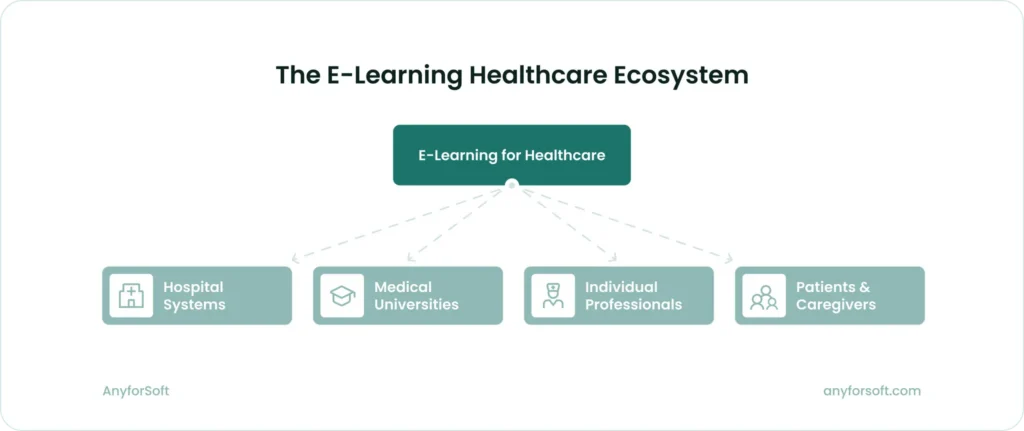
Three main groups drive the need for healthcare e-learning solutions:
Hospital systems and healthcare networks use these platforms to standardize training across multiple facilities. When a 20-hospital network implements a new patient safety protocol, e-learning ensures consistent messaging and documentation everywhere. Administrators can monitor completion rates, quickly identify gaps, and keep compliance records for accreditation reviews.
Medical universities and training programs leverage e-learning to supplement clinical rotations, provide foundational coursework, and give students access to case libraries that they couldn’t experience during limited hospital time. A medical student might witness five appendectomies during rotations but can review 50 through video case studies and VR simulations.
Individual healthcare professionals use e-learning platforms to earn continuing medical education (CME) credits, gain specialty certifications, and stay up to date with evolving best practices. A rural doctor can take the same advanced oncology training as their peers in major teaching hospitals.
The Role of Compliance and Certification
Healthcare operates under strict regulations. Staff must finish mandatory training on infection control, patient privacy, emergency procedures, and special protocols. Documentation proving completion is not optional; it’s required for accreditation, reimbursement, and legal protection.
E-learning medical platforms must track who completed what training and when, remind them when refresher courses are needed, and securely maintain these records for years. If a hospital faces a Joint Commission audit, administrators need reports showing 100% staff completion of required safety training. If a malpractice claim arises, legal teams need proof that involved staff had current competency certifications.
This compliance requirement shapes how healthcare organizations assess e-learning platforms. A system that delivers high-quality content but lacks strong reporting fails to meet essential needs. The platform becomes part of the organization’s risk management framework, not just a training tool.
Benefits of E Learning for Healthcare Professionals
Healthcare organizations adopting e-learning often see clear benefits in cost, accessibility, quality, and patient outcomes. These advantages increase as systems grow across larger networks and meet more diverse training needs.
Cost and Time Efficiency
Traditional healthcare training can carry hidden costs. Bringing together 100 nurses for a day-long in-person seminar means paying for the venue, instructor travel and fees, printed materials, catering, and parking. More importantly, it means pulling 100 nurses off the floor, either paying overtime to cover their shifts or leaving units short-staffed.
E-learning solutions for healthcare cut many of these costs. Once content is developed, the cost of training additional staff drops to nearly zero. A hospital system can train 50 staff or 5,000 with minimal differences in cost. The same module can serve multiple facilities without the need to coordinate schedules or book conference rooms.
Our research shows that healthcare organizations often see cost reductions of 40-60% when shifting from primarily in-person training to blended learning models. Time savings are similarly significant. A three-hour in-person session may cover the same material as 90 minutes of focused e-learning since digital content avoids logistical delays and the slower pace needed when teaching diverse groups at once.
Flexibility for Healthcare Professionals
Healthcare operates 24/7, with shifts that rarely fit traditional training schedules. E-learning platforms for healthcare professionals meet this need by offering training whenever staff can access it. A night-shift respiratory therapist can complete required training at 2 AM between patients. A traveling nurse can maintain certifications while using a tablet during downtime.
This flexibility also supports different learning paces. Some professionals grasp concepts quickly and can move through modules faster, while others need more time with complicated material or want to review sections multiple times. Asynchronous e-learning accommodates both without holding back those who learn quickly or rushing those who need additional time.
Mobile access is particularly important in healthcare. Medical professionals increasingly expect training that works on phones and tablets, letting them learn during commutes, in break rooms, or while waiting for procedures. The best e learning platforms for healthcare in 2025 will focus on responsive design that provides full functionality across devices without sacrificing interactivity or assessment quality.
Impact on Patient Care and Professional Development
The effectiveness of healthcare training ultimately comes down to patient outcomes. E-learning platforms allow quicker sharing of new protocols and best practices, reducing the time between research findings and implementing them at the bedside. When a new sepsis identification protocol shows success, hospitals can provide training across the organization within days rather than months.
Ongoing learning opportunities keep professionals informed as medical knowledge changes. A cardiologist who graduated 15 years ago needs continuous education on new devices, pharmaceutical options, and treatment strategies. E-learning makes this ongoing medical education more accessible and relevant to each person’s practice.
Standardized training also helps reduce variation in care quality. When all nurses in a hospital network receive the same training on medication administration protocols, patients get more consistent care regardless of which facility they use or who is on duty. This uniformity is particularly critical for complex procedures or rare emergency situations where most staff may have limited hands-on experience.
From our observations working with healthcare organizations, institutions that invest in strong e-learning infrastructure see clear improvements in compliance metrics, fewer adverse events, and higher staff satisfaction regarding professional development opportunities.
Key Features of an E-Learning Platform for Healthcare
Not all learning management systems are designed for healthcare’s unique needs. Organizations evaluating e learning for healthcare should look for features that address clinical accuracy, compliance documentation, simulation-based learning, and integration with existing healthcare IT systems.
Must-Have Features in 2025
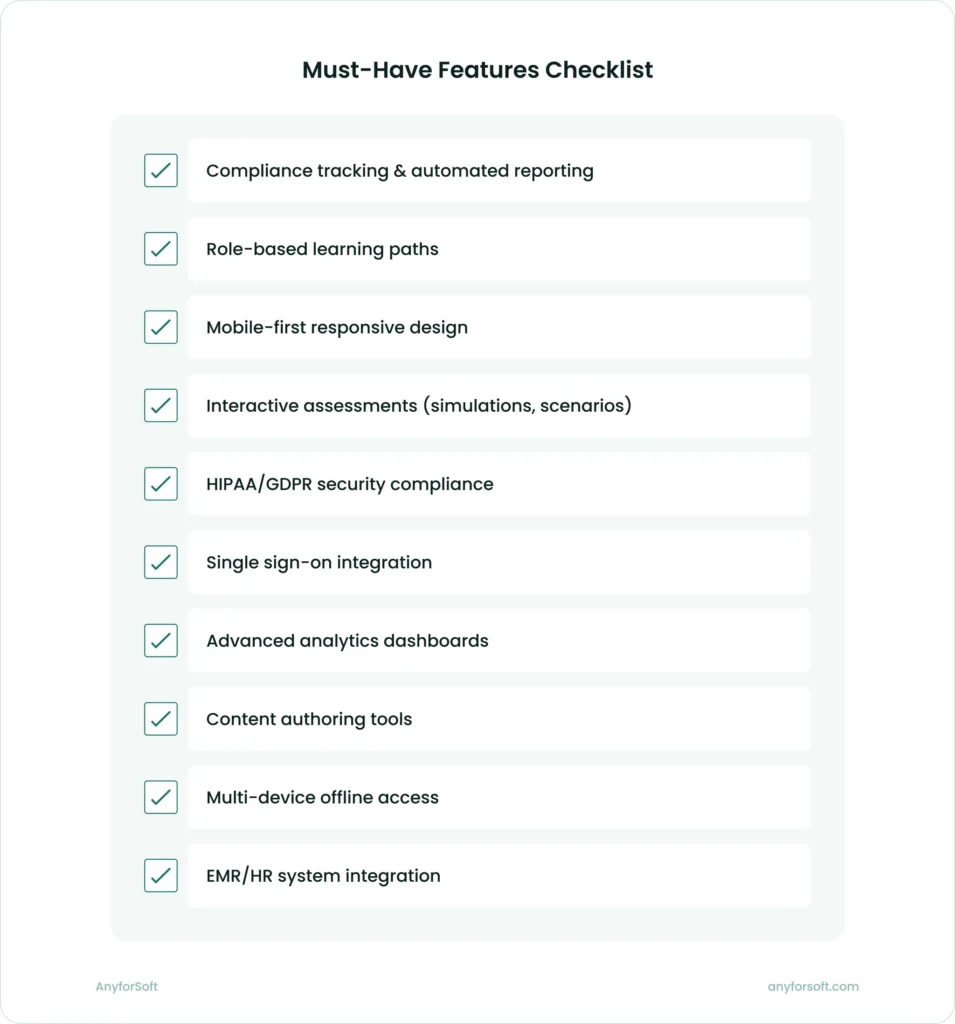
Compliance tracking and automated reporting are fundamental to healthcare e-learning. The platform must monitor completion status for required training, send automated reminders when certifications are about to expire, generate audit-ready reports for regulatory reviews, and keep secure historical records. Administrators need dashboard views displaying compliance rates across departments, facilities, and training categories.
Role-based learning paths ensure that staff get relevant training for their specific roles. A phlebotomist doesn’t need the same modules as a surgical nurse, but both require core safety training. The platform should automatically assign appropriate content based on job roles, departments, and credential levels while allowing administrators to create custom learning paths for specialized positions.
Interactive assessment tools need to go beyond simple multiple-choice tests to assess clinical skills. Case-based scenarios with branching logic simulate real decision-making. Video-based questions illustrate clinical situations and ask learners to identify issues or suggest interventions. Competency checklists allow supervisors to verify hands-on skills shown in clinical settings and track them alongside theoretical knowledge.
Mobile-first design acknowledges that healthcare professionals seldom sit at desks during shifts. The platform must offer full functionality on smartphones and tablets, provide offline access for locations with poor connectivity, use touch-friendly interfaces for quick navigation, and allow users to pause and resume across devices whenever their schedules permit.
Content authoring and management tools should let healthcare organizations develop and update their own training materials without relying on vendors. Subject matter experts, such as chief nursing officers, infection control specialists, and department heads, require simple tools for authoring content, incorporating multimedia, updating modules as protocols change, and tracking revisions over time.
Compliance and Security Requirements
Healthcare e-learning platforms handle sensitive data regarding staff performance, competencies, and potentially patient information in training scenarios. Security and compliance are essential; they are fundamental to the platform’s viability.
HIPAA compliance in the United States requires encrypted data transmission and storage, access controls that limit who can see training records, audit logs that track every system access, and business associate agreements between the platform provider and healthcare organizations. Even de-identified patient data in training materials must meet safe harbor or expert determination standards.
International healthcare organizations need to consider GDPR requirements for EU staff, rights for accessing and deleting training records, data residency needs in specific regions, and cross-border data transport when hospital networks span different countries.
Accreditation body standards from organizations like the Joint Commission, ACGME, or specialty boards often specify training documentation needs. The platform must generate reports in required formats, keep records for mandated retention periods (usually seven years or longer), and offer certification mechanisms where staff can confirm completion and understanding.
Integration with hospital security systems needs to support single sign-on through existing authentication mechanisms, comply with network security policies and firewalls, meet institutional cybersecurity standards, and participate in regular security audits alongside other clinical systems.
Advanced Technology: AI, AR/VR Simulations
Leading healthcare e-learning platforms use emerging technologies to add real educational value beyond just being trendy.
AI-driven personalization customizes learning paths based on individual performance. If a learner struggles with pharmacology but excels at procedural knowledge, the system will adjust to emphasize weak areas, suggest additional resources, and speed through content the learner has mastered. Natural language processing can assess free-text responses in case studies, providing more detailed feedback than multiple-choice questions allow.
Virtual and augmented reality simulations allow for hands-on practice without the risk to patients. A surgical resident can repeatedly practice laparoscopic techniques in VR before stepping into an operating room. Nurses can rehearse emergency responses in simulated scenarios with realistic patient reactions to interventions. AR overlays on mannequins or models can enhance anatomical detail during physical exam training.
The key is ensuring these technologies support learning goals rather than distract from them. Our experience with educational platforms suggests that organizations should implement advanced features only when they clearly improve learning outcomes, not just because they are popular. A well-designed case study often teaches more effectively than a poorly executed VR experience.
Use Cases of E-Learning in Healthcare
Healthcare e-learning addresses various training needs across the industry. Understanding specific use cases helps organizations identify where digital learning provides the most value and where traditional methods are still best.
Training Medical Students and Residents
Medical schools are increasingly using blended learning models that mix e-learning with traditional clinical education. Pre-clinical courses, like anatomy, physiology, and pharmacology, adapt well to digital formats through interactive 3D models, spaced repetition systems, and self-paced modules that students can review before labs and problem-based learning sessions.
Clinical rotations benefit from e-learning using virtual patient case libraries. Students can work through many cases covering conditions they might not encounter during limited rotation time. They learn to recognize symptoms, order appropriate tests, and create treatment plans. The platform offers feedback on their decision-making and lets students explore different pathways without time pressure.
Residency programs use e-learning for theoretical content, which frees up in-person time for hands-on training and mentorship. A surgery resident might complete modules on surgical techniques, post-operative management, and recognizing complications. They then discuss applications during cases with attending surgeons. The system tracks required competencies and highlights residents who need more focus in certain areas.
Drawing on our own experience with High Pass Education – a test preparation platform for mental health professionals pursuing licensing certification – we’ve seen how specialized e-learning transforms exam readiness when standard solutions fall short.
High Pass Education needed to replace their assessment platform which provided only basic pass/fail metrics. Their learners preparing for high-stakes licensing exams needed granular feedback identifying specific weaknesses, tracking improvement patterns, and receiving real-time guidance during practice tests.
We built a custom platform delivering over ten advanced metrics instead of two or three: section-specific subscores, time management analysis, mistake pattern identification, and performance trends across attempts. We also implemented “in-exam coaching” providing non-intrusive guidance during practice, helping learners allocate time effectively and avoid common pitfalls.
The results: learners reported the detailed feedback gave them tangible advantages on licensing exams, and High Pass Education saw its strongest quarter in history following launch. As their CEO noted, “When people take their licensing exam, they specifically mention the guidance from our testing platform as something that gave them an advantage.”
This principle applies directly to medical education – residents preparing for board exams or nurses maintaining certifications benefit dramatically from adaptive platforms providing actionable performance feedback. See the full case study.
Continuing Education for Nurses and Physicians
Healthcare professionals need to keep up their certifications and knowledge throughout their careers. E-learning platforms make continuing medical education more accessible and relevant to practice.
Specialty certifications from professional organizations now often include online elements. An emergency medicine physician can earn required CME credits by completing case-based modules, attending virtual conferences with recorded lectures available on demand, and joining discussion forums with peers nationwide, rather than being limited to local options.
Regular refresher training benefits competency maintenance in specific procedures or technologies. For instance, if a nurse rarely inserts central lines, quarterly simulation modules help them stay proficient. When new monitoring equipment is introduced, staff complete training modules before the technology goes live, which helps reduce errors during implementation.
Updates based on evidence-based practices reach frontline staff quickly through e-learning. When research shows better outcomes from protocol changes, organizations can deliver training right away instead of waiting for annual sessions. The system can also require completion before staff access updated order sets or documentation in the EMR.
Scalable elearning for healthcare systems is particularly valuable for continuing education because content reaches professionals across all facilities at the same time. A network with 50 hospitals doesn’t have to coordinate traveling educators or duplicate in-person sessions. One expert develops the content, and the platform delivers it to thousands of staff members.
Onboarding New Staff
Healthcare organizations deal with constant turnover as staff move between facilities, travel nurses rotate through contracts, and new graduates enter the job market. Efficient onboarding that maintains quality and compliance standards gives organizations an advantage in tight labor markets.
E-learning standardizes onboarding across facilities, ensuring every new hire receives consistent information about policies, safety protocols, compliance requirements, and role-specific competencies. The system tracks progress and flags required training completion before new hires work independently.
Blended onboarding combines e-learning with in-person components. New hires complete general orientation modules – hospital mission, HR policies, parking details, IT system access – before their first day, allowing in-person time for department-specific training, meeting coworkers, and hands-on practice with equipment.
For traveling and contract staff, e-learning reduces repeated training. Nurses who completed core safety modules at their previous job shouldn’t have to retake the same content at their next assignment. Portable competency records and mutual recognition of training completed on different platforms lessen administrative burdens and help experienced staff start working more quickly.
Educating Patients and Caregivers
Healthcare e-learning extends beyond staff training to include patient education. Hospitals and clinics develop content to help patients understand diagnoses, prepare for procedures, manage chronic conditions at home, and make informed treatment choices.
Pre-procedure education helps reduce patient anxiety and leads to better outcomes. For example, someone scheduled for joint replacement surgery can complete modules explaining what to expect before, during, and after the surgery, review post-operative exercises they’ll need to do, understand pain management options, and learn to recognize concerning symptoms that need medical attention. Research shows that patients who complete structured education before procedures feel less anxious, recover faster, and report higher satisfaction.
Chronic disease management programs use e-learning to support patients between clinic visits. A newly diagnosed diabetes patient can complete modules on blood sugar monitoring, medication management, nutrition planning, and complication prevention. The system offers resources that family members and caregivers can access to ensure they know how to help the patient.
Discharge instructions delivered through e-learning medical platforms are more effective than paper handouts that patients often don’t read. Video demonstrations of wound care or medication administration make sure patients understand the instructions. Interactive quizzes confirm understanding before discharge. The platform also sends reminders about follow-up appointments and medication schedules after patients return home.
Crisis Response Training
Pandemics, natural disasters, and mass casualty events require quick training deployment to large numbers of healthcare workers, often including temporary staff, redeployed personnel, and volunteers with limited recent clinical experience.
E-learning platforms enable rapid crisis response training at scale. During the COVID-19 pandemic, hospitals needed to train staff quickly on new infectious disease protocols, proper procedures for wearing and removing enhanced PPE, ventilator management, and updated treatment protocols as evidence changed weekly.
Traditional in-person training could not match the speed or scale needed. Healthcare e-learning platforms trained thousands of workers at once, updated content as guidance changed, tracked completion to ensure compliance, and reduced instructor exposure by moving much of the training online.
Regular training through simulation scenarios also helps with emergency preparedness, even when there is no active crisis. Staff can practice triage protocols for mass casualty events, rehearse evacuation procedures, and review roles during code responses. Periodic refreshers keep everyone ready, and the platform documents compliance with emergency preparedness requirements from accrediting bodies.
Best E-Learning Platforms for Healthcare 2025
Healthcare organizations have two choices when adopting e-learning: use an established platform or build a custom solution. Each option has its advantages and limitations.
Top Platforms at a Glance
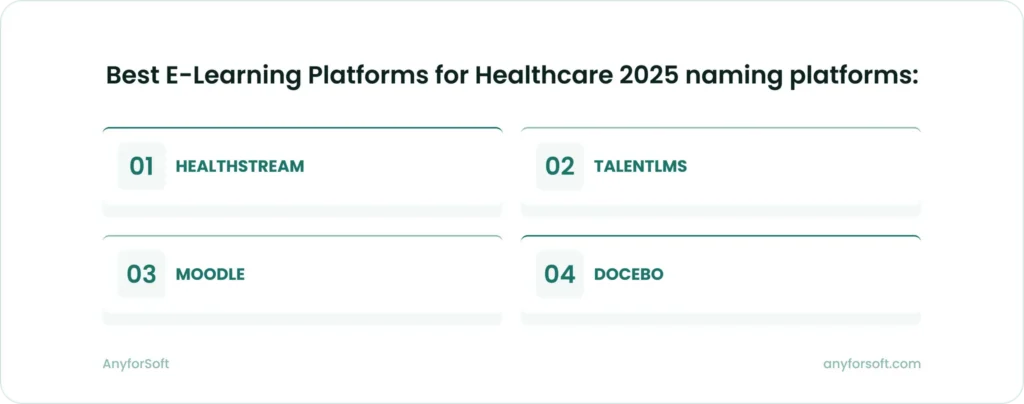
Various learning management systems have become popular in healthcare settings by addressing specific industry needs.
HealthStream
HealthStream focuses on healthcare training alone, offering extensive content libraries for clinical and non-clinical topics, compliance tracking tailored to healthcare regulations, and integration with major EMR systems. The e learning for healthcare platform works well for organizations looking for comprehensive off-the-shelf content, but offers limited flexibility for custom development.
Moodle
Moodle provides an open-source foundation that many healthcare organizations customize for their needs. The platform supports detailed learning designs, scales well across large user bases, and allows complete control over features and data. However, it requires either internal or external technical resources to implement, customize, and maintain.
Docebo
Docebo offers enterprise-level learning management with AI-driven personalization, a strong API ecosystem for integrations, a good mobile experience, and learning analytics that track engagement beyond mere completion rates. Healthcare organizations that need thorough reporting and integration with other systems often consider Docebo, though costs can rise quickly as features are added.
TalentLMS
TalentLMS strikes a balance between simplicity and functionality. It has user-friendly administration, reasonable pricing for mid-sized organizations, decent mobile support, and basic compliance tracking. It works well for healthcare organizations with straightforward training needs but may not meet the needs of those requiring advanced features or intricate learning designs.
Choosing Between Off-the-Shelf vs. Custom Solutions
Deciding whether to adopt an existing platform or commission custom development depends on the organization’s needs, technical resources, and long-term strategy.
- Off-the-shelf platforms work well when standard features meet most requirements, available content libraries provide value, quick implementation is important, and there are limited internal technical resources. A community hospital with typical training needs and few IT staff will likely do well with an established platform that requires little customization.
- Custom-built e-learning solutions for healthcare are appropriate when unique workflows or requirements go beyond what a platform can accommodate, integration with proprietary systems needs significant customization, or the organization has the resources to maintain custom systems over time.
Based on our experience with educational tech platforms, this decision often focuses on control and specificity. Organizations that do well with off-the-shelf platforms accept some limitations in exchange for lower technical upkeep. Those investing in custom solutions gain the precise functionality they need but must commit to upkeep and development.
A hybrid approach combines established platforms with custom extensions. Start with a proven LMS that provides core functions, then develop custom modules or integrations for specialized needs. This balances the speed of implementation with necessary customization.
How to Implement Scalable E-Learning for Healthcare Systems
To implement healthcare e-learning successfully, organizations need careful planning, engagement from stakeholders, and realistic timelines. They should treat implementation as a change management project rather than just a technology deployment.
Implementation Roadmap
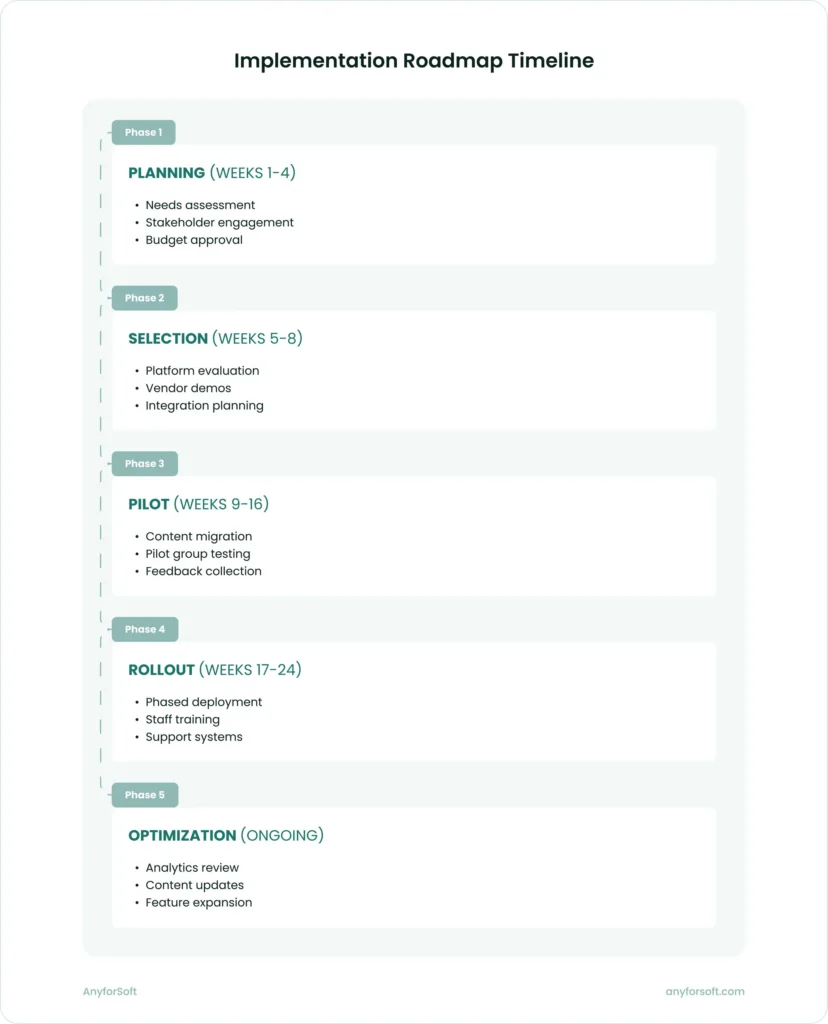
- Start with a needs assessment. Identify current training gaps, compliance requirements, and existing pain points. Survey staff about their training preferences, scheduling needs, and comfort with technology. Interview administrators about their reporting needs and integration requirements. Document findings using specific terms instead of vague goals like “improve training.”
- Engaging stakeholders early on helps avoid later resistance. Include clinical leaders, IT staff, compliance officers, and frontline workers in planning. Identify champions in each department who can support the system and provide peer assistance during rollout. Address concerns about technology replacing valued in-person instruction by emphasizing that e-learning complements traditional methods.
- Choose a platform or develop custom solutions following the needs assessment. If you are adopting an existing platform, request demonstrations that include healthcare-specific scenarios rather than general examples. Test with actual content and user workflows, and verify integration capabilities through technical documentation, not just vendor claims. If building custom solutions, ensure your development partner understands healthcare regulations and has relevant experience.
- Conduct pilot testing with a small group before the full rollout to pinpoint issues in a controlled setting. Select a pilot group that includes a range of roles, technical skills, and schedules. Gather detailed feedback about user experience, content clarity, technical issues, and administrative processes. Revise based on pilot results before expanding access.
- Content migration or development often takes longer than expected. Existing training materials may not translate easily to e-learning formats. Subject matter experts need time to create or review content. Interactive elements, simulations, and assessments require instructional design expertise beyond merely recording lectures.
- Training and change management help ensure staff can use the system effectively. Provide clear instructions, support resources, and troubleshooting help. Schedule intro sessions at various times to accommodate different shifts. Create quick reference guides for common tasks and assign super-users in each department for immediate peer support.
- Phased rollout reduces risks compared to switching everything at once. Begin with less critical training or a single department. Gradually expand as the system proves stable, and staff get comfortable. This approach allows for adjustments based on real-world experiences before full implementation.
Integration Challenges
Healthcare organizations operate complex IT ecosystems. E-learning platforms must integrate with existing systems rather than creating isolated data silos.
- Single sign-on integration with hospital authentication systems allows staff to access the e-learning platform without additional credentials. This boosts adoption by making logins easier and strengthens security by centralizing access control.
- EMR integrations support valuable workflows. The system can suggest relevant training based on staff roles or credentials in the EMR. Competency records can go straight into staff files. Required training can become a prerequisite for accessing specific order sets or documentation templates.
- Human resources system connections automate user provisioning and role assignments as staff are hired, change positions, or leave the organization. Training records sync with personnel files for performance reviews and promotion decisions.
- Badge or certification system integration allows the e-learning platform to automatically update external credentials when staff complete required training, reducing duplicate data entry and ensuring compliance records remain current across systems.
Implementation challenges arise from outdated systems with limited API capabilities, security requirements that restrict data sharing, IT policies that demand extensive testing before going live, and the need for coordination among multiple vendors who may not see healthcare customer integrations as a priority.
Our findings show that organizations that successfully handle complex integrations allocate enough IT resources from the project’s start and keep dedicated technical staff for the first year of operation. Underestimating the complexity of integration leads to many implementation delays and budget overruns.
Continuous Improvement and Scaling
E-learning implementation does not stop at launch. Successful organizations view their platforms as evolving systems that need ongoing refinement.
Usage analytics reveal which content keeps staff engaged and which causes dropouts. Track completion rates, time spent on modules, assessment scores, and user feedback. Find bottlenecks in learning paths and modules that are often rated as unclear or unhelpful.
Content review cycles ensure accuracy as medical knowledge and institutional protocols change. Assign subject matter experts to assess training modules every year or when significant events occur, such as new equipment purchases, protocol updates, regulatory changes, or sentinel events suggesting training gaps.
Expanding features add new capabilities as organizational needs grow. Start with basic training delivery and compliance tracking. Add simulations, virtual reality components, or AI-driven personalization as their value becomes evident and budgets allow.
Scaling across facilities in healthcare systems requires balancing standardization with local flexibility. Corporate compliance training should be consistent everywhere, but department-specific orientation may differ. The e learning for healthcare platform must support both shared content and facility-specific additions.
Vendor relationships for off-the-shelf platforms should involve regular reviews of roadmaps. This helps understand how the platform will develop and ensures it continues to meet organizational needs. For custom solutions, maintain the capacity for enhancements and technical support.
Moving Forward With Elearning for Healthcare
Healthcare organizations that transform training through e-learning gain measurable benefits in cost efficiency, compliance management, clinical outcomes, and staff satisfaction. The technology has advanced beyond basic video platforms to sophisticated systems incorporating simulations, AI-driven personalization, and deep integration with healthcare IT infrastructure.
Success involves more than picking a platform and uploading content. Organizations need to connect their e-learning strategy with clinical goals, engage stakeholders across departments, face integration complexities honestly, and commit to ongoing improvement as needs change.
The path forward starts with a clear assessment of current training challenges, an honest evaluation of internal capabilities, and realistic timelines that consider healthcare’s regulatory and operational complexities. Whether adopting an established platform or building custom solutions, healthcare organizations benefit from partners who understand both educational technology and the unique needs of healthcare.
Need guidance building a scalable e-learning solution for healthcare? AnyforSoft’s team
specializes in designing and implementing platforms tailored to healthcare organizations – from medical universities to multi-facility hospital systems. We understand the regulatory landscape, integration requirements, and instructional design principles that make healthcare e-learning effective. Reach out to discuss your specific training challenges.
